More
Presented by Doug Noland since 2012

* * *
Kevin: Welcome to the McAlvany Weekly Commentary. I'm Kevin Orrick, along with David McAlvany. David, one of my favorite poets is Samuel Taylor Coleridge, I think he's the one who came up with the phrase, "Suspend disbelief." Now, last week you were away, and I'm hoping that you were able to suspend some disbelief.David: Well, you have to at Disney World.Kevin: Yeah.David: It is the happiest place on earth. It may be the most bizarre place on earth as well.Kevin: Yeah, yeah. Well, I would think the Middle East is sort of bizarre right now. So, you had an awful lot of chaos going on worldwide at the same time that you were— What's your favorite ride at Disney World?David: Definitely Guardians of the Galaxy, and Trump did not make an appearance. They didn't play his theme songs. In fact, we didn't even get Tears for Fears, not even one time.Kevin: Really?David: No, no. We were gypped.Kevin: Well, while you were gone, gold and silver tumbled. Okay? Interest rates on, well, not so much the sovereign debt, but interest rates on other debt have been rising fairly quickly. And so, yeah, welcome back, David.David: Yeah. Well, I mean, interest rates were on the rise with sovereign debt, and it was notable, but not to a point which is critical. So, US 10-year Treasury yields, 4.37%. This week, UK 10-year gilts, 4.89. And German 10-year, up to 2.99. There has been a directional shift higher, but little in the sovereign debt markets that signals a massive shift in inflation expectations.Sovereign debt is the core of the core of the fixed income markets. There is developing drama there, but far more if you look at the periphery of credit quality. So leveraged loans, private credit, CLOs, they are now a daily feature on Bloomberg. And as I look at the Financial Times, New York Times, Wall Street Journal, you're going to find a different company featured almost daily. Credit sponsors, limiting redemptions, and it looks more and more like contagion in the private markets has set in.Kevin: Well, you had talked about Blue Owl, and that was— You said every once in a while we would have something three or four weeks ago. Now what you're saying is, every day that's showing up. So in a way, it's really hard to find a safe haven, right?David: Yep, Blue Owl was the first, there's now at least 10 funds that have followed suit, limiting or suspending redemptions as requests have exceeded the quarterly caps. And so, that'll make for a very interesting second quarter as people get in line for liquidity. So, safe havens, you're right, they're hard to find at the moment. Sovereign paper is a classic safe haven. It has sold off, and to see interest rates on the rise would suggest that there's more concern about inflation than there is a drive into sovereign paper as a safe haven.Kevin: And that's probably energy related, right?David: Yeah. I think they're reconsidering the impact— Investors are reconsidering the impact of record debt levels and rising rates. Obviously, an energy shock is gradually being priced in as a fledgling inflationary concern.Kevin: Well, correct me if I'm wrong too, we passed 39 trillion this week, didn't we?David: Yeah.Kevin: While you were in Disney World?David: Wednesday. Yeah, it's a small world and a large number. 39 trillion, that threshold. Bessent has his work cut out for him at the Treasury. And of course, precious metals were not so precious last week. Significant technical pressure and a cascade of stop-loss orders, all the way down to the 200-day moving average. At least in the European markets prior to the Monday open, we saw that steep decline. And then a quick rebound of several hundred dollars off the lows.Kevin: It was like a $400 drop overnight and then the bounce, right?David: Correct, and same with silver. $10 higher for silver off the overnight lows. We give the benefit of the doubt to the secular trend in metals, mindful of a necessary, even if seemingly brutal, short term price correction. Lower prices earlier in the year are a great setup for a third, fourth quarter reassertion of the primary trend.Kevin: Well, and I think it's good to remember, we've talked often in the Commentary, Dave, that countertrends, whether you're in a rising long-term market and you see the downturn, or if it's vice versa, the countertrend is usually the violent one. And what I was sharing with you last night when we were together was just, it's encouraging to see the violence of this drop because it just shows how strong the secular bull is in the long run.David: Yeah. I think the countertrend moves, they're always particularly dramatic. In this case, the primary trend is up and the countertrend decline has found support at the major moving averages. And 4,100 is a very relevant number for gold. Retesting that level in the US markets would be healthy. Yes, temporarily uncomfortable. The line of purchasers was getting longer and longer, in the 5,000 to $5,400 range, and now the line is non-existent.Kevin: Well, and the enthusiasm for gold, you watch that, and the enthusiasm for gold when that was happening was 100%. Now it's dropped to what, three?David: Yeah, the bullish percentage, if you're looking at the bullish percentage measured for gold shares in particular, was pegged at 100, where you had wild enthusiasm. And Friday of last week, it hit 3.6%. Only lower, I think you have to go back to December 2015 for a measure which got to zero.Kevin: Wow.David: Got to zero.Kevin: And that would have been a good time to buy. Yeah.David: Well, when you get sentiment that knocked around, it is an indication of putting in lows. And so, it doesn't mean we're at the lows, but it means we're very near them if we're not at the lows already. So I mean, time will tell, but this is typical herding behavior, and I would act in the opposite spirit to the market. You buy lower and when you're at higher levels, you trim back your positions, versus the recent instincts to buy higher and then sell lower.Although in fairness, I think buyers of physical metals tend to love the lower prices, you get to add ounces at a better cost basis. It's really where you see the pressure most is in leveraged ETFs, in the futures market, with options traders. That's where you see more of the liquidation mode.Kevin: Well, and we saw that, Dave. For the person who owned gold in 2008 when we had the stock market crash and the global financial crisis, the people who had gold, they needed liquidity. So, gold is one of the most liquid assets in the world. That's what happens.David: Yeah, and always worth recalling that gold as a safe haven, if you're in the context of deleveraging, it has in the past looked and behaved like a risk asset for a period of time. And the current selloff suggests to me that the pressure in private credit and in a variety of leveraged trades is more intense than the business news media has suggested. So you go back to 2008, that is a good example of gold selling off as the mortgage backed securities and asset backed securities market was coming unglued, only to reassert its primary trend within 30 to 60 days.Kevin: Yeah, it was very quick.David: Yeah, so finished with a positive number for the year in 2008. I think gold was up five or six percent by the year end, even though it had a 30% drawdown in that correction. And then went on, it was followed by more than a doubling in price off of those corrective lows. So, the late 2008 correction was short, it was sharp as a countertrend correction typically is. And when this correction is over, we'll have set the stage for $6,000 gold, $8,000 gold, ultimately over $10,000 gold.Kevin: Well, and you had mentioned the need for liquidity. We're seeing that in the credit markets, but also Morgan this morning brought up the fact that probably Middle Eastern selling with the Straight of Hormuz being bungled up right now, they're needing to raise liquidity as well, and a lot of their liquidity is in gold.David: Yeah, and a part of that is just, how do we pay the bills? You've got Qatar, Kuwait, Iraq, all looking at a decline in GDP of between 11 and 14%, which is on par with what it was at its worst during the pandemic. And so, you get a couple of countries that are going to take a major hit and will have to fund operations, governmental operations, with something. So having gold reserves, it's a classic rainy day fund. And so yes, they are in some essence, in some sense, raiding the piggy bank.Kevin: Well, but here in America, a lot of times there's a preference for dollars and that preference is based on the need for liquidity, like what you're talking about.David: Yeah, and I think that that preference for dollars over gold, it is a liquidity preference as solvency comes into focus as a concern. Counterparty risk will drive safe haven buying back into gold, and it'll behave less like a risk asset and more like a ballast or a reserve asset.Kevin: So you're basically saying stay patient, because this is temporary?David: Yeah, I would be patient. I'd stay the course. The primary trend is very clear. I would add on weakness, this is temporary. It's also worth noting that the Bank of International Settlements, the central bank to the central bankers, had commentary out in the last couple of days on the role of leveraged ETFs in exaggerating the price volatility of the precious metals.Kevin: Right.David: And I think that's fair on both sides. I mean, how do you get a 50% move in the price of silver in less than 30 days, and then a remarkable decline on the other side of it?Kevin: Margin calls.David: Yeah. Forced liquidations or, if it's just looking at losses accumulating at twice the usual pace, you exit those positions and add even further downside pressure.Kevin: And wasn't it leverage that also pushed the price up so quickly? I mean, at that end when you started to see the spike?David: Exactly. I think it's exaggerated on the upside by that same leverage. And now we get to see the dark side of a leveraged move. And it's worth noting where we're at in the precious metal secular cycle. Thus far, we've seen some opportunism in purchases. You see price appreciation, you see outperformance of gold and silver versus the S&P or the NASDAQ, and you want some of that. So you're lining up for gains, and typically a bull market reaches its crescendo when you have fear and panic buying. And this is anything but fear and panic buying. The late 25 and early 26 scenario was fear of missing out. Wait, it's a winning trade and I'd like some of that.Piling on, and piling on with leverage, the fact that there was a lot of activity in the leveraged ETFs, futures market and options markets, again, suggests that it's a different quality of buyer. And the motivation, the reason, is really not macro in nature. I think you certainly have some macro hedge funds that look at gold as a core holding and look at mining shares as an extension of that, a leveraged play on a longer term bet on the metal itself.But your smaller retail speculator is looking and says, "Well, if silver's up 10%, I'd rather be up 20. If silver's up 40, I'd rather be up 80." And so they're playing for gains. It's a different motivation than asset preservation. It's a different motivation than having something that at the end of the day has simply been money for 5,000 years and is a better expression of a currency allocation not managed by the current PhD standard.Kevin: Right, right. You don't want to play precious metals necessarily for the gain, even though it brings the gain. But with what you're talking about in the credit markets right now, there is an increased need for liquidity. And so the pressure, why don't we talk about pressure on what everyone has, which is a mortgage. And we're not seeing the lower rates that we were hoping for.David: Well, and when we begin to see liquidity drained from the system, it is first at the periphery. So we mentioned leveraged loans and collateralized loan obligations, private credit being under acute pressure last week, but you also saw increased pressure last week in the mortgage market, mortgage backed securities, the prices went higher, agency paper, the cost went higher. And we also saw acute pressure in corporate credit as well, both investment grade and high yield paper. You're beginning to see some real attention paid to credit quality and of course the spreads begin to rise above the Treasury rate.Kevin: Well, and Morgan said what we're seeing are classic signs of a liquidity squeeze right now, and corporate credit, that's going to fall into that as well. Companies are going to be affected.David: And as corporate credit shows stress, as we've long argued, corporate credit pressure increases pressure on the equity markets. So first in most— If you want to see where a real nasty decline in equities comes from, it's when the cost of capital is on the increase for your corporate borrower and that—Kevin: So that's affecting the equities price right now as well.David: Yeah, I think that's probably on a lag. So yes, we saw some volatility last week, but I think what happens in credit ultimately plays out in equity, and we are seeing some shifts in the credit market. So whatever we saw last week in the equity market pales in comparison with what we're likely to see going forward should that pressure in credit remain.Kevin: Well, and that's leveraged as well. I mean, equities are leveraged just like the credit has been.David: Yeah. And so to the degree that interest rates migrate higher, your leveraged traders will be forced into a very awkward position. And again, the biggest leverage out there is in the hedge fund community, whether it's risk parity or basis trades or carry trades, they were getting stomped on last week. And so, again, these are certainly, they play both equity and debt, but they were catching it on both sides last week, risk parity in particular. So, interesting, we see credit default swaps moving up meaningfully on investor concerns of solvency. That was a shift last week, and also, particularly in the emerging markets, you saw credit default swaps on the increase.Kevin: Which is basically insurance on volatility, right?David: It's insurance on default. And so as the cost of insurance goes up, you've got more people clamoring for coverage. It'd be like, you've got a minimal policy, fire policy on your house, but then all of a sudden you've got a forest fire and it's raging and you're thinking to yourself, maybe I should top that off. Well, try to get it.Kevin: To do that. while it's going. Yeah.David: And it may be on offer, but it's going to be at a much higher price.Kevin: That's a good analogy.David: Yeah. It's also in the emerging markets that you see evidence of an unwind in carry trade speculation. So when CDS rates are going higher in the emerging markets, it's a pretty good indication that the carry trade, very leveraged speculation, is coming unwound. So Friday, credit default swap pricing was higher by 52 basis points in the emerging markets, a major move, and it went to the highest set in April of last year amid the tariff turmoil.Kevin: Well, I'm wondering, too, with the emerging markets, the emerging markets might— Do you think there's an effect of the higher energy prices because we're not as affected as, say, Asia would be, right?David: Yeah. And I think that's an important point, is much higher vulnerability to a rise in energy costs in Asia and in Europe. I mean, there's a number of popular emerging market investor destinations where carry trades have attracted a lot of capital, but if you just focus on Europe and Asia, if we're paying $3 per million British thermal units.Kevin: BTUs.David: BTUs.Kevin: Okay.David: It's about a 7% higher cost than before the conflict started.Kevin: So that's not that noticeable here.David: No, but Europe is higher by 140%.Kevin: Oh my.David: So from 11 to now $27 per million BTUs. And in Asia, the JKM market has moved from 14 to— I mean, it's quite volatile, but a range of 19 to 24. So it's up anywhere from 35 to 70%.Kevin: So is there a recession in the wind with the countries that are paying so much more right now?David: Yeah. I mean, think about your manufacturing base in Europe and in Asia. Energy costs are a significant input, and it stands to reason that a 35 to 70% increase is going to impact your profitability. A 140% increase in Europe is definitely going to impact your profitability.Kevin: And the price, and the price you pay for those goods.David: Yeah. So recession risk is much higher in Asia and in Europe. And these are places that are far more dependent on energy imports. So continuation of the conflict in Iran will see much more dramatic impact there. And if global recession dynamics set in, you'll see an impact first in Europe and then, on a lag, I think into US equities.Although we don't face the same risks in terms of import vulnerability, there still is an impact if you're thinking about US equities. The S&P 500, that comes to mind, two fifths of profits come from overseas. So if demand is squeezed overseas because of recessionary tendencies or trends overseas, then it will show up. Won't show up in something like the Russell 2000, small caps, which are really focused on a domestic market. But if you've got multinationals in the mix, that's where your two fifths of profits are coming from overseas and you've got to be much more mindful of recessionary trends outside the United States.Kevin: Well, and you had brought up, we don't really have to worry about a supply problem. That's very different than the 1970s, when we had the oil crisis in the 1970s. At this point, we export oil, right? We're not importing oil nearly as much as exporting.David: Yeah. And last year, we benefited from that to the tune of, I think, 64, $65 billion, if you're looking at sort of our energy trade balance. We're a net energy exporter. We don't have supply problems. We may end up with a consumer price problem. Swallowing higher prices at the pump is economically challenging for a lot of households, and it's very politically consequential.And so keeping in mind the midterms, this is something that could be a defining factor for the midterms. But in this respect, things could not be more different than the 1970s. We had total dependency on Mideast oil. It's a non-issue in the US today. It's very much an issue in Taiwan, very much an issue in Japan, very much an issue in South Korea.Kevin: When we're talking about Asia and Europe right now, I mean, this is probably an area that we haven't really paid enough attention to.David: Conflict in the Middle East tightens global energy supplies. It pushes oil and gas prices higher. Increases inflation as a net effect. I'll repeat, it's Asia and it's Europe that are the most vulnerable to recession. And frankly, from a strategic standpoint, there's glaring vulnerabilities in places like Taiwan, down to 11 days of oil reserves.Kevin: Wow.David: That is very interesting because you recall that what we've done, what the US has done, the Trump administration has done to blockade Cuba from fuel supplies. We had a complete power outage just a few days ago in Cuba, with no fuel available, zero. China can easily do the same to Taiwan, an energy blockade. And you're talking about such low reserves at this point, what happens to the global economy if Taiwan comes to a halt? I think it was McKinsey a year ago suggested that you're talking about a trillion-dollar hit to global GDP if you take Taiwan offline.Kevin: And you said they have 11 days, right now, of reserves.David: Correct. Correct. So in this regard, I think Trump has set an unhealthy precedent in terms of a blockade and sort of an energy— I mean, at this point, if the Chinese wanted to do the same, they basically say, same playbook, "You did it, what's wrong with us doing it?"Kevin: Right, right. Well, it sounds like it's coming to a head at this point. I mean, because we also have the midterm elections, and inflation is still on the minds of the people.David: Yeah. I think Friday of last week was sufficiently terrifying in the global financial markets for Trump to suggest an end to the Iranian engagement.Kevin: So you think it was just the turmoil that we had with a split force that-David: Oh, yeah. He pays attention— Just like he's claimed 50,000 on the Dow, look at our great success. To the degree that you see slippage in the financial markets or chaos in the financial markets, he's hypersensitive, hypersensitive to it. So I don't know what very soon means. I don't know what mission accomplished means. I don't know what he means by our objectives have been met.Kevin: They're still shooting missiles and drones.David: Yeah, and I'm shocked and amazed that after, I don't know how many hundreds of sorties and thousands of targets hit, seven to ten thousand targets hit. I don't know how there's anything left.Kevin: Where are they coming from?David: But they are.Kevin: Right.David: And the Strait of Hormuz is still under threat, and there's still the capability of launching hypersonic missiles and throwing into the air any number of drones.So we also had last week, we had PPI, Producer Price Index, it could have also been a strong warning to the Administration leading into the midterms. What was expected was a three-tenths percent increase. Instead, we got a 0.5 and that was on core. So if you're taking out food and fuel, there's your half percent increase, and factor in food and fuel, factor in fuel to the PPI, and it's 0.7% increase as opposed to the 0.3 expected.Kevin: And people really watch the gas price. I mean, they may not watch inflation, but they see what they're paying at the pump.David: Which suggests that with PPI surprising to the upside, CPI will probably, Consumer Price Index will probably surprise to the upside as well. And if we get past that $4.11 threshold—Kevin: What is that? Why 4.11?David: It's the point that we hit back in 2008 with the last run in oil to 150. And it was the point at which the consumers were coming unglued. You could have put anything in front of them and it was pitchforks and people ready to tar and feather anybody in the oil business because it seemed like this was being done to us. Again, it's politically consequential, and $4.11, if you breach that national average on gasoline prices, I think consumers will revolt in the midterms.Kevin: Well, and the Trump administration has to know that midterms typically go to the other party. And so they're already, they're vying for good perceptions. But when we were talking at the meeting today, three scenarios were put forward. One scenario was a quick, decisive, complete victory for the United States. The second one would be a longer prolonged issue, and that could actually lead to many long-term problems. That's the duration problem. And then the third would be some sort of negotiated settlement, which would probably have to include Russia and China because they're so closely tied. And so the three scenarios, the middle one, the duration one you talked about, you said duration is probably going to be key as to the aspects of the effect of this war.David: Weeks ago, that duration issue, that was the critical variable for us thinking about the Iran conflict. It remains the case. If you look at energy shocks and extended war, these are factors that increase the odds of recession dramatically. You could see consumer behavior become self-reinforcing here as well. Even if you've got a recessionary impact overseas and not in the United States, if prices at the pumps stay high enough long enough, back to the duration issue, you begin to see a shift in consumer dynamics and what are they spending on.Kevin: Slowing the GDP.David: Yeah. Correct. Correct. So you've got consumer expectations, which feed into inflation. You also have on the horizon expectations already shifting in terms of the duration of the conflict. The oil curve is shifting along with the yield curve, both higher levels and longer time frames being reflected on those curves.Kevin: That's interesting that you can look at that, but that's true. When you look at the future's markets, you can see what expectations are. And at this point, longer term oil. And that's a reversal from when the war first started, if I remember right.David: Well, so far the curve hasn't gone the other direction. It still falls off pretty dramatically, but the whole curve has shifted higher, and as it shifted higher, it's also extended further out. So the expectation is growing that it's going to be here longer than we originally thought. I mean, again, two weeks ago you could have looked at the curve— The difference between two weeks ago and today, the curve is bumped and extended further at a higher level. So again, when you start thinking about the long-term inflationary consequences of this engagement, will it be here long enough to change consumer behavior in the US? It's already at a level which is beyond critical in Asia and Europe.Kevin: So if consumption does slow down, okay, we are in a midterm election year, if consumption slows down, a classic Keynesian would say, "Well, the government just needs to print some money and spend it." Do you think that might be the response if that happens?David: Yeah, it's a fancy economic term, aggregate demand. To prop up aggregate demand—which is the sum total of demand within the economy, consumption in the economy—if that begins to fade, the consumer tightens his belt, classic Keynesian demand management kicks in, and government spending is supposed to fill the consumer gap so GDP contraction stays at a minimum—except that in this environment you've got deficit spending pre-conflict already on track, according to the Congressional Budget Office, to be $1.9 trillion. That's the projected deficit for 2026.Kevin: And we're not including war spending right now either, are we?David: Not included, not included. So how large a consumer gap would Donald Trump and Scott Bessent be willing to fill? If equities soften over the next six to nine months, you've got not only a diminishment in capital gains tax revenue, you've got that reverse wealth effect which would hit consumption pretty dramatically. Again, it's just a question of, let's say we spend an extra two, three hundred billion dollars in war spending, so 1.9, you're already at 2.2.Kevin: 2.1 or 2.David: And then again, if the consumer's retrenching, the government typically steps in. How much more are they willing to add, and what's the threshold level at which the bond market begins to reappraise the stability of US fiscal position? And I don't know what that threshold is, but that's where I think you begin to see significant issues within the fixed income markets.And it really is— We're in this phase where people are focused on, investors are focused on, liquidity, and there is a preference for dollars. It doesn't take much of a shift to start reconsidering solvency. That can be credit quality. It can also be duration risk. It can also be just sort of fiscal viability, which pressures rates higher. And these are all game changing elements.Kevin: So a stronger dollar today could mean a much weaker dollar tomorrow. I mean, there's no telling what could happen if that scenario plays out.David: Yeah. I mean, when I recall, when I bring to mind these backdrop issues, you could reverse the first quarter dollar rally with a swift decline by year end. I mean, not a gradual decline, but—Kevin: But a reversal.David: A reversal. A sharp reversal. And at the same time witness a ratcheting higher in rates reflective of Treasury oversupply. And we already talked about, a few weeks ago, the trillions of dollars that have to be refinanced this year, existing debt which is coming due. You've got to satisfy investors with an adequate compensation. Interest rates have to reflect their demands for compensation for risk. And you start adding, is it 1.9? Is it 2.2? Is it 2.5? What's the final tally for deficit spending in 2026?The war hangs a question mark over that, which is very material for the fixed income markets. And I think you have the Fed and the Treasury put in a very awkward position. They can either watch the financial markets circle the drain or they can instead intervene. And how they intervene, to what degree they intervene, when they intervene, these are all relevant factors in order to keep the Trump Dow 50,000 narrative alive through the midterms.Kevin: That costs some money. That costs some money.Well, okay, so let's talk about liquidity because that really is what's affecting things right now. I mean, even I had to sell some gold and silver, we're putting windows in on the house. And I mean, that's what it was for. So I needed to raise liquidity, but I didn't tap into the portion that I'm using for preservation. In other words, the difference between raising money for liquidity temporarily or holding long-term for preservation, you're still encouraging that you add to that position.David: Yeah. I mean, I think, again, looking at the macro backdrop, this is one of the best setups that gold has ever had, ever had, in US financial market history.There is a place for liquidity, and certainly we keep adequate liquidity in the asset management side of our business. We're close to 40% liquidity today. I mean, it's not like we don't prize short-term Treasuries or a cash equivalent position, but there's also a place for conviction on the gold trade. And while I can't argue with price action—I mean, the last week was ugly—I can see beyond the temporary price pressure to the enduring issues of our overindebtedness and of a significant monetary regime change. The Mideast conflict is in many respects helping to facilitate and codify a shift away from dollars.Kevin: Yeah. So the dollar recycling is still being replaced by gold recycling through other currencies.David: And I'm not talking about the immediate-tense investor liquidity preference, which boosts demand for dollars. I'm talking about global trade, and this is where global trade settlement is a far bigger issue. You're changing the international financial plumbing as opposed to watching today's preference for US dollars.Kevin: Well, and even Iran is saying that they'll only let ships through that are trading oil in other currencies, like Chinese yuan.David: Yeah. I mean, the Chinese are settling oil in yuan, and the very large crude carriers getting through the Strait of Hormuz are either connected directly to Iran—China, India's had a number of ships that have gone through—Kevin: But these are all BRIC type of countries that are moving away from the dollar already.David: Yeah. Largely anti-dollar-block countries that are seeing their VLCCs [very large crude carriers] get through the trade of Hormuz untouched, unscathed. Normal traffic's 138 vessels per day. That's what it was pre-conflict. Now it's down to five to six per day. And again, those with safe passage are tied to that largely anti-dollar block.So it is interesting that we see this codification away from dollars. I don't have evidence that every one of those barrels that's making it through Hormuz is being settled in yuan. I just can't imagine that China would be interested in doing so, or that Iran would be interested in trading their oil in US dollars.Kevin: Well, and it may not be yuan. It might be rubles. It might be rupee. I mean, these are countries that will trade their currencies for oil and then those oil countries will trade for gold.David: Yeah. I think post-conflict we are not going back to the old petrodollar recycling. And at the margins, you see the changes. Russian barrels will trade more and more in rubles. Payments from China for the purchase of whether it's Iranian oil or Russian oil will be in yuan or RMB. Indian purchases will be going forward in rupees. And so, at the margins we are codifying this demise of dollar hegemony.Kevin: Well, and Morgan has brought this up, too. You guys actually brought this up at the last McAlvany Wealth meeting that we had in October, that possibly Scott Bessent and the Trump administration need to see the dollar lose that hegemony to some degree because of the burden of being a reserve currency at this point.David: And the priority of reshoring jobs and building out our manufacturing base, it does imply a degraded dollar. I don't think they want an uncontrolled decline, but if they saw a gradual decline, that would certainly be compatible with their larger policy objectives.Kevin: So they might not be opposed to this disconnect that's going on, fully.David: Yeah. The question is how big of a decline it is, and that's the difference between the dollar being on— At the end of this conflict in the Middle East, are we on the injury list or are we sort of in the casualty catalog?Kevin: Right.David: So I could imagine the current liquidity preference for US dollars getting purged as the annual deficit comes in north of 2025. So again, currently we have dollar strength. That can flip pretty fast with a reappraisal of US Treasuries and the value of the US dollar. At what price stability?, is the question. What are the trade-offs that the current administration, between Bessent and Trump, is willing to accept in order to maintain financial market stability into the midterms, to keep a lid on rates and to prevent interest costs from skinning the Treasury alive? Is yield curve control something that we can assume is slotted for the back half of 2026? Is it out of the question? I think it's becoming more and more probable by the day. And where do you think gold goes in the context of desperate debt monetization?Kevin: Sure.David: This is again where I say my bullishness on gold is not biased or based on owning it and wanting to see it higher. I simply can't imagine a world where policymakers navigate these challenges without significant reputational costs. And it's loss of confidence tied to that reputational cost— It's loss of confidence that I see reflected in the gold bull market. Price appreciation is proportional and directionally opposite to confidence. So, declining confidence, and that's where gold begins to step up the pace.Kevin: Right.David: So the world is—at least from the perch that I sit in—the world is looking far less stable today than it was six weeks ago or six months ago or six years ago. And in the final analysis, gold is the preferred safe haven when solvency is on the line.* * *
You've been listening to the McAlvany Weekly Commentary. I'm Kevin Orrick along with David McAlvany. You can find us at mcalvany.com and you can call us at 800-525-9556.This has been the McAlvany Weekly Commentary. The views expressed should not be considered to be a solicitation or a recommendation for your investment portfolio. You should consult a professional financial advisor to assess your suitability for risk and investment. Join us again next week for a new edition of the McAlvany Weekly Commentary.* * *
Kevin: Welcome to the McAlvany Weekly Commentary. I'm Kevin Orrick along with David McAlvany.Dave, you had an unusual conversation with Lauryn Williams, an athlete who has won medals both in the Winter and the Summer Olympics.David: Yeah. Amazing to see someone who's competed four different places around the world, Sochi, Athens, London, and in China as well. A 100-meter racer is someone who's got some real talent. I mean, it's down to fractions of fractions of seconds to be the fastest person in the world. And so to medal and to be in the top two, three in the world in that event is meaningful. Then to translate all that power into what she can do in a bobsled is great.As we talked to Lauryn Williams, a four-time Olympian and first women, as you mentioned, to win both the Summer and Winter games, that is certainly a part of her legacy. I was fascinated as we got to the end of the conversation that for her, her greatest accomplishment was nothing to do in the world of sports, but was something that she had just recently discovered. The beauty of motherhood and what it means to lead in a different way, to inspire in a different way.And she's been both an inspiration and a leader on the Olympic team. And she competed not only individually but also in teams, in various relay events, and of course, the bobsled is a two person team as well.And so, I was left with the impression that here's a woman who is a reader, here is a woman who is legacy-minded, both from the standpoint of high levels of competition and wants to win—is there to do one thing: win.So many people in the world of business can win, and it's at the expense of other people. That sometimes is the unfortunate case of zero-sum game. I think, for her, being legacy minded, being a lifetime learner, these are things that were very impressive to me.* * *
Lauryn Williams, great to have you join us today. I don't know that I've had the privilege of speaking with someone who's won as many medals as you have at a level of competition that is second to none. There's athletes all over the world who aspire to someday be in the Olympics. And you've been there not once, not twice—Athens, London, Sochi. The accolades for you as a sports professional just go on and on. Tell us a little bit about yourself, just kind of background for our listeners.Lauryn: So a little bit about me, I'm born in Pennsylvania, raised in Michigan. Split time between both because my parents split up. Then I went on to the University of Miami, and then I moved to Texas for a little bit. When I say a little bit, about 10 years, and now I live in Medellin, Columbia.The things that I think my mom would say are important if she was saying, "This is my daughter, let me tell you about her," is that at age nine-ish, I got home faster than the family German Shepherd. And she was like, "I got to get my daughter into a track and field program."My dad's story, on the other hand, is a little bit different. He says we were at the Carnegie Science Center, and there was a Flo-Jo hologram, and I didn't see anything else at the Science Center that day, I only raced the hologram until I beat it. I don't think it was set at World Record pace back then, but that's when he knew I had some promise for track and field.And I was really fortunate that my parents instilled in me the importance of education. And so I wasn't really thinking about track as a thing that I was going to do long-term, or the Olympics. I didn't really understand what it meant to be in the Olympics. I just liked running faster than the boys in my neighborhood. I was like, "Okay, I can beat the girls. Now I can beat the boys." Then I started to beat boys older than me, and I just thought it was a really cool thing to be able to brag about.I wanted to be able to use my education in order to be able to help people, because my godmother and my godfather were a neonatologist and an anesthesiologist, and I saw their big house. I saw the fun parties that they had. And I just thought, "Education is the key to get me the money so I can do whatever I want." And at a young age, that was the extent of my thought process.David: Well, would love to hear about your journey to becoming first American woman to medal in both the Summer and Winter Games.Lauryn: Yeah, I think that the journey was just kind of mapped out for me. So in 2004, I was a junior in college. I was just focusing on winning the NCA championships, and I was so excited for that opportunity. I had gone my freshman and sophomore year to the national championships, but I had not won, and my sole focus that year was winning the NCAA championships. No thought of the Olympics had crossed my mind.I get to the NCAA championships, I run the second-fastest time in the world. I do win. And now I'm the fastest American heading into the Olympic Trials. And I was just like, "Oh my goodness, what do I do?" Luckily, I had a coach that helped me just kind of navigate the world of becoming a professional athlete. I made it to my first Olympic Games in 2004 at 20 years old, and then on went the journey. 2008 in China, 2012 in London.And the cool part, I think, of the story is, everybody says like, "How did you become a bobsledder? What was that path like?"I met a girl in the airport. Reading is fundamental. I love to read. I read an article about a fellow Olympian who had tried bobsled and enjoyed it, and she and I were in the airport headed to a race. So she came back to track and field. We were both just randomly heading over to Rome and met in the same airport, and I asked her about it. "How was it? What was your experience like? How did you find bobsled?"And she's like, "Lauryn, you got to try it." And it's the Olympic year. And I was like, "The Olympic year? How do you become Olympian in bobsled?" That was not a thought process of mine at all. But I did go ahead and give it a try because I knew I was getting ready to retire from track and field. And so, little did I know, six months later I would be at the Olympic Games.David: It combines both team dynamics because you've done track and field relay, as well as competing on your own, and bobsled, again, it's a team dynamic. How would you compare, how would you contrast the difference between being an individual competitor, this is your event, it's all on you, versus the working collaboratively with someone else or with a team.Lauryn: Yeah, I think my path was divinely made for me to be prepared to win that medal in bobsled. And I mean that in a way that in 2004, 2008, I was a part of the four-by-one Olympic relay team, and we didn't have any success.And a lot of things happened behind the scenes, but what I realized is what we need to be able to do to work together, especially when you have different chemistries. We're taught to compete against each other all year long, so these are the same girls that you are racing to beat, racing for a spot on the Olympic team. And then they throw you all together and say, "Go win Olympic gold medal for Team USA." And we botched it, like I said, not just once but twice.What I realized is what was going wrong in those two Olympic Games, so that when I was brought to the third Olympic Games, I said, "Hey guys, I know how to make this work. The one thing I can bring is my experience," because a lot of the other members were new members of the Olympic team for the first time.And so I said, "We got to cut the fighting out. We've got to be able to get on the same page. We've got to have chemistry." And I think that was also the catalyst for me having what I needed to be able to switch over into bobsled, which is much more of a team sport, much more cohesive. But learning how to unify people was a skillset I had to learn from the trials and tribulations we had in 2004, 2008.David: Yeah, that's amazing. I'm curious about the psychology of competitive athletes and what you look back on in the various competitions you've had all over the world, what's the most valuable advice you've been given to manage your own psychology? Some days you show up and it's a great day, some days you don't. And to be able to manage the ups and downs of a highly competitive environment, do you feel like you got what you needed in terms of psychological coaching? And what would be something that you would add to the mix?Lauryn: I feel like the thing that I got or that I learned from the situation was: control what you can control. There are so many things outside of your control, and we've got to pivot in those moments and make the most of them, but the main focus should be on what you can control. And I remember very clearly in the 2004 Olympic Games, one of my competitors making just like these crazy grunting noises and screaming and yelling. It was meant to be a distractor to us. And it was very distracting because it was just like, "What is she doing? Is she having a seizure? Does she have a medical issue?" It was just not normal sounds that would come up. And I had to say, "Hold on a second, Lauryn. Why are you here?" I am here to get to the finish line first. That is the sole purpose that I have for being here right now in this moment. Does not matter what noise, what is happening around me.And in the same way that you can drown out the crowd and drown out the things around you, I needed to control what I can control. Her noise-making I could not. But getting to that finish line, hearing the gun and zoning in on the starter was something that was within my control. And when I started to think of things about, what can I control versus obsessing about the things that I couldn't control that maybe were bothering me, I started to have a lot more success.David: Great point. Can you tell us about your mission to help elite athletes have a better handle on their finances?Lauryn: Yeah. I started in track and field, like I said, at age 20 as a professional, and I didn't know that that was going to be my future or my fate, if you will. I had very little financial literacy at that point. I was a junior in college. I was a finance major. And now looking back, I think so many of us look at what we learned in college and the information you could throw out the window versus information that is absolutely necessary. And personal finance is different from the broad major of finance. And then I just didn't have a lot of life experience.So I ended up in the hands of a family friend as a financial advisor. And I didn't know that there were different types of advisors. I didn't know what kind of questions to ask a financial advisor, but I did know that I had an opportunity to make more than anybody in my immediate family had made, and I didn't want to waste it.And so I was like, "Hey, what do I need to do?" And I didn't get good answers from that advisor. So I fired him, hired another guy, thought that was going to go better. It didn't. And then I got frustrated. I said, "What does somebody do when they're willing to pay for help to organize their finances, but they can't find someone?"And so I went online and I found the certified financial planning coursework, and honestly, I rolled in it just trying to teach myself stuff about money because I didn't understand the basics of creating a financial plan for myself or the basics of personal finance.The coursework itself put a light bulb on, if you will. And as I learned these things, I was asking my friends, "Well, do you have a SEP IRA? Are you using a solo 401(k)?" And they're like, "What are you talking about, Lauryn?"And that's when I realized it wasn't just me that had this gap as a professional athlete who was earning well. It was a bunch of us that were being neglected, and had a good earning potential and a good opportunity to make the most of a very short window of earning well, but we weren't doing it. And so I wanted to be the change I wanted to see in that regard.David: At Vaulted, we share your mission to support America's top athletes. So as you know, we've started this initiative giving $30,000 of real gold for each first place finish, and we're very excited about that. I think, in part we see that there's a challenge for many professional athletes. I'd love for you to share with us what the biggest misconception the public has about an elite athlete's financial reality.Lauryn: I think the biggest misconception is that when you win, you're set for life. In the United States, you are not set for life by simply winning an Olympic gold medal. In the same way that we have 1% of America that is the affluent, we have 1% of those that are making the Olympic team that are earning in a situation where they could be set for life based on the earnings and the endorsements and things that come in.There are a lot of athletes that do not earn anything the following year after competing in sport, or earn very little, or they only earn what is given by Team USA for the Olympic medal. There is a program, Operation Gold, now where there is some money given to you, some cash given to you for your competition and your role. But after you spent years of training, even if you just go with the year before the Olympic Games—the amount that you invest into having coaching and housing and proper food, physiotherapy, nutrition—the $30,000 that they give you is pretty much used up.To compete on a world stage level, that's not millions and trillions of dollars. It's not something that's going to make a long-term impact on your life. It's going to probably clear the debt or replenish whatever you saved in order for you to be able to move on. And like I said, the hundreds of thousands or millions that a lot of people think that we make is few and far between.David: Yeah. So if there's a small percentage of people who can monetize their professional sporting abilities, we see endorsements as a potential way for— But what percentage of professional athletes actually get those endorsements, what would your guess be?Lauryn: Oh, I would say it's a very small percent. Like I said, I made the team in 2004 and there were no outside endorsements. My only sponsor was Nike, which was the shoe company, and which in track and field specifically, that's the main way you're considered a pro athlete is that a shoe company gives you some sort of contract. So there's not like the NFL or NBA where you're like a W-2 employee of a team of some sort. You're not a W-2 employee of the United States Olympic Committee either. And so, yeah, 2004, there weren't very many endorsements at all. A few things came afterward, but they're usually like one-year contracts or they'll do six- or eight-month contracts that say, "We want to use your name during this Olympic timeframe. We want to use your name for the next year." It's not a long-term, four-year or 10- or 12-year thing. It's just like, "Here's an influx of money so that we can work off of you and work off the hype that is happening around you."But a very small percentage of athletes get those opportunities. I think now the branding opportunity that athletes have that I didn't have necessarily when I was competing, was being able to use social media as a platform to talk to other sponsors and be an ambassador of different sports.David: So if income after the professional event, after the winning of a medal, is something that is less predictable, what's a story that you've heard from an athlete that really illustrates the struggle of what's after standing on the stage and receiving those medals?Lauryn: Oh, there's so many, but one that stands out to me is my very first Olympic Games. In 2004, I was on my way home. We were in the airport. I was with a fellow athlete. We had the same agent, so we had the same flight booked. And he's like, "I'm so excited to only have to work 40 hours per week." He's like, "I'm going down to 40 hours." And I was completely confused because I was a junior in college. So I went from college to the Olympic Games and now I was going to be a full-time professional athlete. And the contract that I had, I did not have to work. And there's a big difference between, like I said, events as well.I was a 100-meter runner. That's kind of a premier event for the Olympic Games. Everybody's tuning in to see who's the fastest man and woman in the world. He was a high jumper, and he had just won the same silver medal that I had won in his event at the Olympic Games, the second-best high jumper in the world. And he was not planning on not working at all. He was planning on going down from an 80-hour work week to a 40-hour work week at that time. That was what the income that he was going to receive was going to help him do.David: Do you find professional athletes end up with debt? What does that look like?Lauryn: Yeah. Unfortunately, it is par for the course that a lot of athletes, like I said, at various events are ending up in debt. And the thing that I've been fortunate to be able to do, I think sometimes people think of what a financial planner does, and we think of wealth management and investing and those pieces of the puzzle, but the thing that was really important to me was being able to help people on a foundational, baseline-level basis.And I helped them figure out how to take out the best amount of debt. "Let's take it from here versus here because this will have a lower interest rate." Let's think about how long you're going to train for before we give it up because you're in too much debt to maybe recuperate if you take on a regular job. What are the cause and effects of you deciding this? How can we take on this debt responsibly, and how can we make a plan to be able to pay it off responsibly if you're going to take on debt?"And I think that's a reality that, like you said, not a lot of people are thinking of or not a lot of financial planners would be interested in. It was like, debt is bad and that's it. This is someone's dream. This is someone's goal that could be once in a lifetime, and if they achieve it, it's something that no one can take away from them. So why not let somebody make a calculated decision and an educated decision to be able to take on that debt, versus just kind of willy-nilly swiping a credit card and going about it and then having to pay the price later?David: It's such an interesting setup because you've got kids who go to college, and very often they'll graduate with $100,000 in debt, $150,000 in debt. If you go on to a master's program or law school or medical school, you could have a half million dollars in debt. What's the kind of range you're talking about? Is it tens of thousands of dollars, six figures, for a professional athlete who's pursued their dream? But very different than a doctor who you could say, "Well, hey, eventually you're going to be able to work this off," the pay scale is sufficient to ultimately pay back a half million dollar liability.Lauryn: Yeah, I would say it's probably around $30,000 on average. That was kind of the threshold for what I was seeing as a regular amount of debt that athletes were having to take on or a normal amount of expenses to be able to cover things, and where people start to just feel uncomfortable. $70,000 or $80,000 of debt, it's a harder hole to dig yourself out of.And like I said, one of the things I was fortunate to be able to do is kind of forecast that, because a lot of people don't think about what happens in the future. They're just thinking about what's happening in the moment. They're betting on themselves, hoping that it will all pay off, that they'll be able to write a check for it at the end of the day because performances have played out.But my job is to be able to say, "Okay, what if it doesn't? What kind of work can we get? What is your degree going to bring you? And how long is it going to take you to dig yourself out of that hole if everything goes wrong?" And so yeah, $10,000 to $30,000 was the average of what I was seeing. The most that I saw was, I think she had $96,000 of debt. And she had come to me with that debt.David: Well, let's talk a little bit about athlete chatter. If you're coming home from the Games, is there ever any conversation among the athletes about top honors not being real gold?Lauryn: Always.David: I mean, are competitors even aware of that?Lauryn: Yes. I remember learning, and I said, "Wait, what? It's only gold plated? Wait, what does that mean? You mean the rest of it has something else inside of it? Well, what does it have in it?" And then I got home and I was like, "It's not even real gold." I was definitely let down when I learned that it wasn't an actual gold medal, especially because I had seen on television people biting the medal and I thought that that was like, "Wow, what a cool thing. You have this big bar." And like I said, I was raised in a time where gold was talked about a little bit more. I think it's talked about a little bit less now as an asset or just like, "Wow, I'm going to get this thing that's really valuable. I'm going to have my own gold bar in the shape of an Olympic medal." That is really what I thought it was. And then I learned, they were like, "The silver medal is actually worth more because—David: Amazing.Lauryn: —it has more silver in it than the gold medal has [gold]." So I was like, "Oh, okay."David: That's one of the reasons why we wanted to start this initiative with Vaulted, because we see the amount of work that goes into being one of the world's greatest athletes. And we just want to honor that, want to recognize the time and talent and all that each individual athlete brings in terms of the honor and prestige to our country. And it seems a little cheap, frankly. That's the way I feel. But I'd be interested in how you feel about that discovery process and what most athletes are like, "Oh, well, it's not even real gold."Lauryn: Yeah. A little cheap is an understatement. There's so much money that goes into the Olympic Games, so much sponsorship, so many different pools of income that come around the Olympic Games. And athletes have long been frustrated for not being compensated for the work that they do, and having to figure out sponsorships.And like I said, even in America, we're not one of those countries where we set the athlete for life. A lot of places, you get land or you get lifetime membership into the military, etc. And so it's just frustrating in general that this is the world's biggest stage to compete on for your sport, and you said that the thank you is something that has very little value at the end of the day. And so yeah, I wouldn't even go so far as to say it's cheap, I think it's kind of disrespectful what they give us as the medal when it's all said and done, because we know how much money is floating around.Other people are being well compensated, executives and various sponsors and stuff are gaining from this. So if nothing else, if we will not be compensated, could you invest in giving us a medal that we could be proud of for a lifetime?David: All right, so as a certified financial planner, as someone who looks at every asset class and says, "Okay, this is how you create a mix," is physical gold something you'd actually advise athletes to hold?Lauryn: Yeah. I've evolved as a planner. I was definitely hard no on the front end. I've just come from a very conservative background. I mentioned a little bit of my story with the financial planner, ended up with two very hardcore commission-based guys that sold me a bunch of products that I didn't necessarily need. And so when I entered financial planning, I was pretty purist on low-cost investments and keeping things very simple, and knowing that investing was going to be a key piece of your puzzle to help your money grow, but not doing things that are super complicated. And so that evolution that has come around is thinking about what really diversity means, and understanding that in terms of what is going to be long-term. Cryptocurrency. I remember at the very beginning with bitcoin coming out, and I was just telling my clients, "No, absolutely not. No way, no how, stay away from it."And I know quite a few people that put everything they had into bitcoin. And while I'm still not a fan of that as a way to go about your investing strategy, if you got in on the very beginning of it in the same way that, like you said, we saw gold way back, once upon a time at a much lower rate than it is now, if you can hold your investments in general for a long term, you do generally get to see the benefit, reap the benefit of having patience and watching that investment grow over time.David: Yeah. In the time that you've been an Olympic competitor and took the podium for the first time, you're talking about a metal that was less than four digits, under $1,000. To now over $5,000. And the reality is it just keeps track with inflation, so it's getting repriced gradually to reflect the loss of our purchasing power. And as such, it's kind of a ballast asset within a portfolio.I'm curious if you think the athletes that accept the gold from our initiative will keep it invested, sell it? What would you advise them to do based on current market conditions, recent trends, things like that?Lauryn: I would definitely say keep. What a cool opportunity this is. What a great thing to be able to add to your portfolio, like you said, diversification happening without you having to be an investment guru. I think this is a really cool long-term opportunity that Vaulted is giving these athletes. But the reality is that, like I said, some will have to pay off their debt, and so turning it into cash and using it for purposes like that will happen.I'd love to hear that every athlete talks to a financial person if they don't have one before, and just say, "Hey, what's the best thing to do? Maybe I could take a third of this and pay off debt. I could take a third of it and put it in a traditional investment account because I've never opened one before, and keep a third of it in gold," or whatever is the best thing for that particular athlete.But I think, like I said, based on where athletes are currently, while the needle is moving in the right direction, it has not moved enough that athletes are not going to want to take their cash and run. But we've got to encourage them. We've got to educate them to understand what a cool opportunity this is to be able to have this gold and to be able to, like you said, maybe 20 more years from now, see what that investment has grown to.David: Well, I worked with gold my whole life, but my relationship with it is, I think, different than yours. When you think about the meaning of gold, both the symbol and as a financial asset, what does it represent to you personally? Do you see a difference between the symbol and the asset? What do you think would drive that?Lauryn: I think, for me, the two are still kind of one and the same. Like I said, with the Olympics being such a big part of my life and that gold medal being the thing that you're chasing, the actual asset—gold—represents achievement to me. It is a longstanding asset that has been around for pretty much forever. And once you've done something in the Olympic scape, there's something that can't be taken away from you. I will always be the first American woman to medal in the Summer and Winter Olympics. Whoever won the gold medal just recently in these games will always be the gold medalist for 2026. I had to think about what year we're in.And so the longevity of what it is that you have accomplished is kind of imprinted in whatever medal it is that you've earned. And like I said, in specifically the gold medal, in the same way that the longevity of gold and its value, like you said, it's undisputable what's happened over the course of time, and that it's been here. It's been a constant part of our lives and it's been a great way to be able to diversify our portfolio. So I feel like they run synonymous along the same lines as far as their meaning and their importance in my life.David: Yeah, I certainly see that with investors. It is a representation of real wealth, and it is a store of value through time. So in a different way, but a complementary way, it does mark their achievement, whether it's in business or in just being diligent in their savings through time. It's something that is a representation of the hard work and effort that they've put in. And that certainly is what that medal is supposed to be for you, a mark of achievement, an accolade, a mark of prestige in our country.And just, thank you for representing us so well. What you did certainly accrues to your own legacy, but it's one of those things that certainly is one of those things that as an American we're so proud of. And every time I watch the Games, it just gives me chills. Every time we see one of our athletes take the stage, it's something that's like, "Yes, I'm proud to be an American."And it's you that stirs those feelings of, "This is greatness and this is what we're capable of." Just the beginning. There's so many more people out in culture who have these abilities, small percent that can compete with you, very few that would be the fastest woman in the world, but still it's a representation of what can be done, what can be achieved. So I appreciate that.Lauryn: I feel like it's a representation of just, like you said, reaching your full potential. We get to take the main stage, but everybody can reach their full potential in whatever it is that they're doing. You can be the best heart surgeon, you can be the best janitor, you can be the best school teacher and change a third grader's life. And I think that's what the Olympics inspires, but I think that's what we all need to be striving for in life. What does it look like to be a gold medal person as far as reaching your full potential and contributing whatever you can to the world?David: As one of the greatest American athletes of all time and a certified financial planner, what's the one financial lesson you wish every athlete understood before stepping onto the world stage?Lauryn: I think the most important piece of the puzzle is that all aspects of your finances work together. There's no one piece that doesn't affect another piece, and so you need to be looking at yourself in a holistic way. And that's what I think more planners need to do. Like I said, we get so caught up in one piece of the puzzle, like, invest, invest, invest. But what about this debt we talked so much about today? What about those student loans? What about you want to buy a home? What about your kids' 529 plan? Every little piece of the puzzle matters in the same way that we create a championship plan for ourselves to be able to compete. And it's not just, "Run as fast as I can."I am a world-class sprinter, but I had to think about how I was eating. I had to think about how I was sleeping, when to travel, how many days to get there before, how much water to drink. Those things were all very, very important. When I was going to eat crazy amounts of dessert or things like that. Stress levels. How is your family treating you? All of it played a role in me being able to compete. In the same vein, all aspects of your finances are going to work together for you to be able to win at whatever your financial goals are.We usually talk about financial goals in the realm of retirement, but that's not the most important thing to a lot of athletes anymore, or not a lot of people. I say, "What does retirement mean?" and they're like, "I love my job. I'm never going to quit. I'm planning for when I can't work because you're telling me to, Lauryn, but I hope that I can do this till I'm 90. I really love my work in that way."Or they want to go to part-time. They've never seen their parents retire. These words don't mean the same thing as, like you said, traditionally they have been. And so creating a financial plan considering all the pieces of your puzzle is going to be the most important thing. And don't be afraid to talk to somebody about what's important to you because it is going to have some sort of financial implication, and you can build a plan that is customizable to whatever it is that you're trying to accomplish. And it doesn't have to fit inside the box of what, like you said, all these benchmarks that the world throws at us.David: I feel like I'd be remiss if I didn't ask you this question. How would you define success and how do you achieve it?Lauryn: This is a very good question. I would say, for me, success is defined by feeling happy about what I'm doing. And so you're doing things. Everybody has to do stuff on a day-to-day basis, but a lot of people describe it as like, "Can you sleep at night?" I want to go beyond just being able to sleep at night with the work that I'm doing. I want to feel excited about it. I want to feel invigorated by it. And getting up each and every day to be able to do something that I love and I'm able to pursue something that I love, to me is the success.It's not about being able to earn $1 billion, or $1 million even, for that matter. It's about being able to make a meaningful difference and feeling excited when I hang up the phone. "Hey, I just talked to David today and some athlete might hear this podcast and actually change the way they think about money because of it." I'm not saying yes to anything that's not making me feel invigorated, not making me feel like I can share in a way that's going to make an impact and ultimately make me feel happy. So to me, success equals happiness.David: Do you think you can achieve that success without a degree of discipline?Lauryn: Ooh. No. No, you cannot. No matter what it is, even if it's something more intangible in the way that I've described, you've got to work to be happy. And so if happy is what I'm describing as success, there are things that are going to come up against you each and every day that could make me unhappy or threaten that happiness. I mentioned student loans being, like I said, part of my expertise. I really love that work because I can change somebody's life in 60 minutes with what they did not understand about their student loan situation, and it makes me happy. But what happens if I'm not disciplined, I don't understand what's happening in student loans, I can make a mistake. I can cost people tens of thousands of dollars. And then the student loan system is changing on a regular basis. It's very political and real humans are being tied up in that, and that doesn't make me happy.But I have to be able to reframe, instead of being frustrated about what politicians are doing, into saying, "What can I do to continue to make people happy?" And like I said, the work that I'm doing to untangle what is a very messy situation is what takes the discipline, the discipline to get up each and every day when you're frustrated about a system that you can't fix, a system that— It's broken, to be quite frank. But I'm responsible for being disciplined if I want to be happy.David: You have achieved a lot. And I'm curious as we wrap up our conversation today, what is the achievement that you're most proud of?Lauryn: This changes on such a regular basis. I'm sure if you would have asked me 18 months ago I probably would have said something different. But I am a new mom and I did not know I would be a mom. I was kind of in the boat of like, "This timeframe is probably come and gone," and happy being the super aunt to my sister's two little ones. And now I am momming and it has changed the way that I think about everything. There is someone else that is counting on me to inspire her, to teach her, to protect her. And each and every day she's teaching me something. And I never would've thought that I would be in a position to just love this little thing so much. She's so happy, but also sassy already at nine months. And yeah, I am incredibly, incredibly proud to be her mom.David: Well, you've inspired us, and I don't think you'll have a hard time inspiring her. Thank you so much, Lauryn, for spending the time with us today and exploring your journey to becoming a world-class athlete. And we really appreciate your time.Lauryn: Thank you for having me on the show, David.* * *
You've been listening to the McAlvany Weekly Commentary. I'm Kevin Orrick, along with David McAlvany, and I hope you enjoyed the interview with Lauryn Williams. You can find us at mcalvany.com and you can call us at 800-525-9556.
* * *
Kevin: Welcome to the McAlvany Weekly Commentary. I'm Kevin Orrick along with David McAlvany.David, what we've been praying for in this war is that it end quickly. The one thing that we probably want to avoid is a long, drawn out affair for many reasons; the money, the ammunition, the lives, but there's a lot hinging on the duration of this war being short, isn't there?David: Yeah, I think duration is the key. And that is what will move every financial market, every asset class. If it is deemed to be a long-term endeavor, you're going to see significant repricing across the board. And if it's a short-run event, as expected by the administration but not necessarily controlled, remains to be seen.Kevin: Well, and it's good to remember too, this is not a war against the Persian people, the Iranians. This is a war against a particular regime, right?David: That's right. The Persian culture is one of the greatest in all history. And today, the Iranian regime is not representative of that culture. It is an autocracy. It is a theocracy. And as such, it's not as if you have a representation of the people. It's a regime that even within the world of Shia Islam is idiosyncratic and radical. My experience of every Persian has been of a people and of a culture which is rich, dynamic, educated, and teaming with unbound potential.Kevin: That was a powerful empire too, between 400 and 500 BC.David: Yeah. And I think if they are freed from the narrowness of religious extremism, it'll be very interesting to see the role that the Persian people play in the world of tomorrow.Kevin: Yeah. Well, I wonder, too, though, it's not just about the regime that's in, but we haven't necessarily always had success getting a new leadership in a country where the old regime is eliminated.David: No, getting out the 20% that is supportive or moving them to the margins and allowing the people to have a more representative government will be a challenge. Less than 20% of the population fully supports the existing regime. I was listening to a Bloomberg interview with Princeton professor Bernard Haykel. And my first thought was, why is everybody in Near Eastern Studies—Kevin: Named Bernard?David: —named Bernard?Kevin: Yeah. I remember in 2008 is when we interviewed—David: Bernard Lewis.Kevin: —you interviewed Bernard Lewis.David: Yeah.Kevin: Princeton?David: I think he was 96 at the time.Kevin: Yeah. That was an interesting show though because he went all the way back to the 1950s when he started writing about Islam.David: Yeah. And he brought a lot of clarity. If you're interested in learning about the difference between Shia and Sunni, I can't think of a better resource. We have on our shelves The Crisis of Islam, What Went Wrong?, Islam and the West. Those are just three of dozens of titles that he's written.Kevin: But this is another Bernard who is now at Princeton who's writing about the Middle East.David: Yeah. And it's the regime's willingness to use violence and the threat of death that has kept the majority in Iran in a subjugated state, very much like Syria under Assad.Kevin: Okay. But that's a good example. So do we have a plan for stabilization after the elimination of the regime right now?David: And that remains to be seen, too. We may shoot first and ask questions later. Fire, ready, aim—Kevin: Are they hiding right now? I've wondered where they are. It could be that it's just too dangerous for anyone to arise right now.David: Well, interestingly, the Kurds are on the move. So you've got Kurdish resistance in a part of the country which is mobilizing, and that significantly upsets the Turkish government because they don't want to see the Kurds active militarily and gaining momentum or success. So there's all kinds of cross-currents across the Middle East.But you're right about our record. The West is not great at regime change. The US is not great at regime change. So, many concerning aspects of this war.Kevin: I've got a friend who was a specialist in asymmetrical warfare, and you would never know he's fighting a war because he's doing everything but shooting at the enemy. I'm wondering if the Iranians are trying to work toward that, increase the duration of the war, take out some of the key things. Who would have thought of desalinization plants? But that is existential, isn't it?David: Yeah, exactly. It remains to be seen if we can create a context for regional stabilization. Are we willing to see through the objectives of this engagement? Are we going to quit as the costs reach a pain point which is considered too much to bear? And are those costs things like you just mentioned where you see cultures impacted, where it becomes an uninhabitable part of the world? You can't exist in the desert without water.Kevin: Right.David: So you consider these questions and see where the Iranian regime is seeking to leverage all that it can. Yes, that is extending the duration. It is expanding the battlefield beyond its borders. That impacts the economic calculus for everyone concerned by extending the timeframe, miring the region in economic chaos. By doing that, the Iranian regime is in essence seeking to play a longer game and extend their probability—improve their probability of survival.Kevin: You were talking about liquidity today in our meeting. And strangely enough, Dave, I was thinking about liquidity and how critical it is to survival. I started thinking of Jack London. Remember he wrote that story "To Build a Fire." And if you think about it, maintaining body temperature is the biggest part of survival. If you die of starvation, ultimately you lose body temperature to the point where you don't survive. If you're in the cold, though, "To Build a Fire" is a great story. I would recommend all the listeners go back and read it.It's a short story, but it's about a man who's in the cold and he builds a fire. And through a series of just small things until finally a tree dumps snow on his fire, he ends up freezing to death. It happens so suddenly you think that the guy's going to make it the whole time until you get to the end of the story. And I think about liquidity, you think about duration, we could run out of liquidity and ammunition. Let's face it. In a war, you need ammunition, but you need liquidity to pay for a long war too.David: Yeah. Time is the factor they're seeking to leverage against Israel and the US. And Morgan Lewis highlighted that in Hard Asset Insights over the weekend. The impact of oil on the consumer price index, every $10 move in oil increases inflation by 20 basis points.Kevin: Okay. So every $10 move in oil is a 0.2%—David: Increase to the CPI.Kevin: Okay, I got you.David: So you push inflation higher and you begin to pressure the bond market in meaningful ways, but we'll talk about that more a little bit later.Kevin: Okay. But still, quick success is what we're looking for in this war. And it could happen. Right now, a lot of leadership's been taken out.David: Yeah, except we don't have a great record in the Mid-East. Quick success, effective cost management, these are things that we don't have— We haven't succeeded on those fronts yet. So Iran, decades ago when the US State Department facilitated the overthrow of Reza Pahlavi—Kevin: The Shaw, right?David: Iraq, Afghanistan, now Iran for a second round of regime change. Perhaps this time there's more consensus across the Middle East that Iran's regionally destabilizing regime must go. And I think interesting because Iran is attempting to bring everyone into this conflict, make it regional, but I think that might turn out to be disfavorable to them.In essence, they're helping build a coalition. You think about Donald Trump and he's not the great unifier, and yet Iran's poking everybody throughout the region and launching counterattacks against everyone is creating a coalition, which I think is interesting.Kevin: When we've been pheasant hunting, we've had one guy, I love him, but he sometimes runs up ahead of the group. And that's a dangerous thing to do when you pheasant hunt. And I think about Dick Cheney. He came around a little bit too far, but where I'm going with this is, if you're trying to get allies, take it from Iran's point of view, it's sort of stupid to shoot at them, don't you think? I mean—David: Well, yeah, it's pretty easy if you're trying to say, "Hey, the great Satan is against us, and we could unify around this. Israel, the US, let's go get 'em boys."Kevin: Right. And then they shoot at them.David: But attacking regional neighbors like Bahrain and United Arab Emirates and Turkey, that's created a unique coalition centered on regime change. These guys have got to go. Continued attacks on energy and civilian infrastructure that requires more than a defensive posture. They're stimulating an aggressive regional response.So to the degree that energy and civilian infrastructure is damaged, the global economy will bear greater costs. That's precisely what Khamenei 1.0 and now Khamenei 2.0 have intended, stimulating regime change via social and economic destabilization, a mirror to what the US and Israel are seeking, but they'd like to see it across the region.Kevin: Do you remember when you interviewed Kamran Bokhari and he talked about the void that was created when Saddam Hussein was taken out of Iraq? He said, "This void is going to be filled either by Turkey or Iran, but they're competing for that." Remember that?David: Yeah, and Saudi too. Somebody wants to step into the gap and be not only the regional hegemon, but also the leader within Islam. And again, you're talking about a faction within a faction. This is not just the difference between Shia and Sunni, but the Twelver faction, whether they're seeking the Hidden Imam and they're looking for this messianic return. It's very interesting, even with the belief that they can bring about the return of the Hidden Imam through violence and destabilization.Kevin: It's an Armageddon-like scenario that they're looking for anyway, right?David: That's right. So Iran has attempted to fill that power vacuum—again, going back to the removal of Saddam Hussein, and in competition with the Saudis. What they've done through time, they've funded the Houthis, they funded Hezbollah for years.Kevin: Right.David: If you look at Hezbollah— I mean, Lebanon is 50 years behind in terms of development. One of the most beautiful, magical places on earth. I will go there before I die. I've always wanted to visit Lebanon, but they've been underdeveloped for at least five decades. And of course, Iran has also kept Saudi Arabia on its toes, defending its oil infrastructure from constant Houthi rebel attacks.Now, by moving against oil infrastructure and the desalination plants, along with other civilian targets, Iran is codifying this regional opposition, which in the case of desalinization plants is an existential threat. You simply cannot exist in the desert without water. Back to your point, on the one extreme, you've got cold, and you have to maintain your body temperature so that you don't freeze.Kevin: Right.David: The other extreme is—Kevin: You got to have water.David: You have to have water.Kevin: Right.David: So—Kevin: That's part of maintaining body temperature as well. But when you're taking out infrastructure as a strategy, okay, maybe it's not necessarily to create an enemy, but it's to create a crisis that would make an ally later. Is that what you're saying?David: I think they'd like to open the possibility for radical regime change across the Middle East, and taking out existing leaders through major discontent. There's probably nothing more socially disturbing than not being able to survive.Kevin: Right.David: Again, water is more important than oil in terms of survival.The markets are concerned with duration of the engagements, which ends up being a defining factor for costs. How much will this add to US debt levels? How long can the global economy endure higher costs? If you're looking at that from the consumer standpoint, it's cost at the pump or energy inputs into manufacturing, elevated prices slowly working their way into the supply chain and then into the real world through inflated goods.Kevin: So duration, duration, duration.David: Duration.Kevin: That's the key to this?David: Yeah. So weeks— If it's only weeks, the world economy is resilient. If it's months, then the system strain is going to be felt with tons of different knock-on effects economically and socially. Markets are incredibly sensitive to duration. And the Iranian response to weaponize energy is with duration in mind. And it puts on the table this notion of political will. Do we have the political will? Does Europe have the political will? Does anyone have the political will to deal with the economic consequences, which multiply if crude oil and LNG stay at elevated levels for very long? Duration is the key.Kevin: One of the ways you watch interest rates is by watching the futures market to see what the long bond is doing. And so we can do the same thing to a degree with energy right now. So what are the futures markets saying? Are they saying short war, long war? What do you think?David: Yeah. To date, the futures markets see quick resolution.Kevin: Okay.David: Yeah, the front month pricing is elevated, but every other month out to December of 2026 is priced for much lower Brent Crude levels, and so you're back to the upper 60s by the time you get to December. By mid-year 2027, it's the lower 60s.Kevin: And we're in the 80s now?David: Yeah.Kevin: Yeah.David: And that may change, but to date, the volatility and price up to $120 quickly back into the 80s has only been in the front month contract.Kevin: Okay. But this goes back to asymmetrical warfare. And I don't want to give Iran or this regime the benefit of the doubt, but they've got cheap drones, Dave. And they've got a lot of them, and it probably doesn't take much to manufacture them.David: Yeah. I mean, they're outmatched with respect to technology and firepower.Kevin: Right.David: But in some respects, they're hoping to fight the fight that puts the US and Israel off balance. Asymmetrical strategies include weaponizing the energy markets and using a barrage of cheap drones, which they've seen work very effectively in Russia and Ukraine to overwhelm the very expensive weapon systems used to neutralize that threat. So, ultimately, stimulating economic challenges that discourage further engagement seems to be the goal.For long-time listeners, going back to 2009, 2012, in that timeframe, we read Martin van Creveld's books The Changing Face of War and Transformation of War. I got to interview Martin at his home in Jerusalem, just outside of Jerusalem. And there was the theme of less state-on-state actions and more guerrilla style unconventional actions. And Ukraine has demonstrated to the world how drones, low cost to manufacture, how they level the playing field, offering an unconventional response to conventional forces.Kevin: I know Trump met with some of the defense contractors, and they committed to building more. But I mean, how many Tomahawk missiles can we make relative to, say, these cheap drones that Iran is making?David: Not enough, and Iran has been a major supplier globally for drones. They have the capacity to manufacture 10,000 drones a month and extend the conflict at much lower costs compared to US and Israeli conventional munitions. And the defensive arms used to neutralize both drones and inbound missiles, the contrast between cost is amazing. $20,000 per drone. If you're talking about the small missiles that are used to take them down, $30,000 at a minimum, up to $4 million per missile required to neutralize them.Kevin: Hmm, wow.David: And so time is the factor that multiplies the expense, the duration of this engagement. The Center for Strategic and International Studies estimated that the first hundred hours of the conflict has cost $3.7 billion thus far, just under $900 million a day.Kevin: To me, that's a little surprising, Dave. It seems like it would have cost more. I mean, a billion is a billion, but doesn't it seem like this war would be costing more right now?David: Yes. And I don't know if that fully includes the cost to keep our carrier fleets in the area.Kevin: Right.David: And I think there's a number of things that could be either added or subtracted. But if you just took the $900 million a day, if this extended six months, you're still in the neighborhood of $170 billion for an expense, which is a lot of money, except that on a voluntary basis, the Congressional Budget Office pencils out that we'll be at $1.9 trillion in budget deficit this year.Kevin: Right.David: So compared to our out-of-control spending already in place, it almost looks like a rounding error.Kevin: Right.David: Which is crazy, because when you talk about hundreds of billions of dollars, it is real money.Kevin: But if you think about the costs, and I'd like to talk about this today, the costs are actually going to extend to— They're taking out refineries. Let's talk about that at some point. And you said desalinization plants as well.David: Yeah. The real cost is having oil and LNG offline and damaging infrastructure, that would be the fat tail. Taking supplies offline for months instead of weeks, because if you damage that infrastructure, it's very difficult. You have to then rebuild. And it's not as if you turned off production switch and then turn it back on. It takes a good long time to restore and get back to previous levels.So for a domino effect into the global economy, it's infrastructure that matters most, not even the short-term closure of Hormuz, which has a real economic impact. We talked about last week the fact that most of the oil coming through the Strait of Hormuz is headed towards Asia, with some going to Europe as well. But if you're looking at prices of LNG, they've skyrocketed predominantly in the Asian markets.And so there are places, there are particular geographies which are more impacted by even the short-term closure of Hormuz. But you've had refineries in Bahrain, in Kuwait and Qatar and Saudi Arabia, United Arab Emirates have been hit already. One desalinization plant in Bahrain also damaged.Kevin: Well, the refinery thing, what's bothersome about that, we started to see that with the Ukraine war as well, Ukraine and Russia, because when you take out a refinery, like you said, you can have as many barrels of oil as you want. Unless it's converted to something that can be used, it's not useful at all. It's worth an ounce of silver.David: Yeah. So that introduces a different economic threat. Already we've had jet fuel crack spreads on the rise in Europe, and they've passed $88 premiums over the crude price. And in Singapore, the peak price was $230 a barrel.Kevin: So what's a crack spread? What does that entail? I don't know that word.David: Yeah. And I don't know what the premium versus Brent was on the Singapore jet fuel crack spread, but let's say it's north of $110 a barrel.Kevin: Okay.David: So what is a crack spread? The price or spread over the crude oil price, that's what a refinery charges to work through and refine from crude to some other form of usable fuel.Kevin: Turn it into something useful.David: Diesel, that could be heating oil, that could be jet fuel. So obviously, if we're thinking about the economic impacts, airlines are already under pressure. Fuel cost increases hit those companies' earnings per share dramatically where they're inadequately hedged in particular. So Dow Jones transportation average over the last week has been hit. It's off 7% versus the Dow Jones Industrial Average only off 2%. So it's something to watch. Airlines in particular, Delta is off 9% over the past week. Southwest 11%. American Airlines, 12.7, United, 12.5%. Because again, the crack spread on jet fuel is at levels that will crush them.Kevin: Well, and how significant is fuel to the airlines as far as their operating costs?David: Yeah. 10 to 20% increase in fuel costs can hit their earnings per share by 30 to 40%. In some cases, even 50%, because fuel is between 20 and 30% of their operating costs. It's the largest single line item. So on the flip side, you've got the refiners who make that difference. It's basically a transfer of wealth from the airlines and their profitability to the profitability of the refiners. They're making that spread. So Valero, Marathon, Phillips 66, these guys make the spread, as we discussed last week. Unless or until these moves in oil are seen as sustainable, your operators in the oil—and in this case the refining—space, they're barely moving, which is a bit of a surprise.I mean, in some cases, you've got refiners who are actually priced lower in the same week that airlines are down between 10 and 13%. So I think liquidity exiting the markets is one factor where people are not willing to take extra risk in equities, but you've also got durability of the move, which is another key factor. Again, you'll see it in the crude oil curve, if you will. The futures market will price in and reflect concerns over longer term duration. Year to date, it is important to note that oil was already up 20, 25%. I mean, I'm talking about your operators, your ENPs. Call it 15 to 25% range, and all of that predated the Mid-East conflict.Kevin: It reminds me a lot of the miners. You've been talking about the gold miners and what it costs to mine an ounce of gold versus what it takes to get it into, finally, the hands of the person who's buying it. There's a big spread right now. And gold's influenced by inflation, so are interest rates. I mean, how's the bond market handling this?David: Yeah. The global bond market has been incredibly sensitive to the possibility of higher inflation. If you're looking at one market which is expecting more inflation, and this may go beyond— Maybe it just speaks to how sensitive they are to even a minor increase. I mean, again, if you're talking about a $10 move or a $20 move from 69 to 89, 40 basis points doesn't seem very much, except that you're dealing with a world that is awash in debt, and 40 basis points, which, less than half a percent may seem like a small number, but it impacts one of the largest markets in a very dramatic fashion. So rates have been creeping higher since the initial bombings.On top of that, and as an extension of our conversation on liquidity last week, you've got leveraged loan prices that are falling. You've got high-yield spreads in Treasuries that are rising. All your usual indicators of stress in the fixed income market, really at the periphery of the credit markets, they're getting repriced. So it's kind of a combination of things. I think it's both inflation, as well as a shift in, or a reappraisal of, credit quality, where again, it's at your marginal quality, the highest risk—high yield, which is just euphemism for junk bonds, leveraged loans, collateralized loan obligations, private credit, which we've talked about in the last couple of weeks, you're seeing repricing there. And that's less about the inflation story, more about a shift in appraising quality of that credit. But both of those things coming together at once is, I'd say unfortunate.Kevin: Well, and the thing is, it's less about the war, too. See, the thing is, we've been talking before the war ever broke out. Interest rates, the bond market was already expressing a fear of inflation. Even the inflation market before the war broke out, didn't we have CPI on the rise again in February?David: Yeah, I think it's worth noting the sequence of that. Again, just showing that the impact of war is going to be seen in your March inflation statistics. But February numbers, PPI was hotter than expected. Fed leadership is aware that current CPI—PCE is a preferred measure, close to one full percent above target. Similar to PPI, last week you had the ISM prices paid. It increased 11.5% over January numbers, from 59 to 70.5. And I mentioned the ISM numbers because it was all logged prior to the Mid-East conflict. So we have a bump in inflation prior to— Now you can—Kevin: You had a bump in oil prices, you had a bump in inflation, you had to bump in interest rates. This was happening before any of this broke out in Iran.David: Right. March figures are going to be market moving in fixed income when you get CPI, PPI, PCE. Friday this week, we have the preliminary University of Michigan sentiment numbers and the inflation expectations. It's a broad sampling. I think the preliminary numbers are under 500 people, or 500 entities. And my bet is that the final report, which expands that sampling out, about doubles it, it's going to diverge. The final will diverge from the preliminary, because again, the preliminary included interviews which were done prior to military conflict. So look for UMich numbers to move higher in a meaningful way by the end of the month.Kevin: You know, with debt, you can handle debt if you've got a healthy GDP, if things are growing. And you can even handle some inflation if you've got the same type of thing, if you've got a lot of growth. If we had a slowdown, I mean, there's a word that was used years ago. It's sort of a meaningless word if you think about it, stagflation, that's not quite saying it, but if you have inflation and a slowdown at the same time, that's a real problem. And it seems like right now we may not have the growth that we need for the inflation that's coming.David: Yeah. Stagflation combines a slowing economy, which would impact the labor markets, with inflation. You bring those two together and it's kind of a nasty recipe.Kevin: It was like the 1970s for a while.David: Mohamed El-Erian commented in the Financial Times, his article, "Stagflationary Forces Are Building," two data points he references. Nonfarm pay rolls from last week off 92,000 when positive 55,000 was expected, and that puts unemployment ticking up to 4.4%. And concerns of inflation from supply chain disruptions and rising energy costs in the wake of the Mid-East conflict. So PCE in December already hit 2.9%.Kevin: PCE is the preferred method of measuring inflation now. Instead of CPI, they use PCE.David: At least at the Fed. Yeah, That's their preferred measure.Kevin: Yeah. Okay. All right.David: You had core PPI, producer price indexes. And that was 3.6%, well above consensus. And El-Erian's takeaway echoes ours. He says that, "How great a shock the world faces will depend on duration and the spread of the Iran war. More disruptions to supply chains will no doubt spur a further shift away from just-in-time efficiency to the more costly yet necessary just-in-case approach—Kevin: Right, which is inventories.David: —to inventory management. It's a structural evolution that bakes higher costs into the system at a time when affordability is already an economic, political, and social issue." That's the end of the quote. And he goes on, and he describes a challenging setup for the financial markets. And three things are center stage: private credit—no surprise there for our listeners.Kevin: You've been talking about that.David: AI impacting the workforce.Kevin: That too.David: Again, you're talking about sort of a white collar ghost town. So this is revolutionary, it's fabulous. You can have every question answered better than just searching it on Google. AI will give you more detailed explanations.Kevin: It'll write music for you. I had an uncle who, in his 80s, showed me that he's writing music now with AI.David: Hey, I've used it to write poetry for Mary Catherine because I'm not much of a poet without ChatGPT.Kevin: No. She should have slapped you.David: Well, she knew it wasn't real because she knows me.Kevin: It was too good.David: Yeah. Well, we all have our skills and that's just not one of mine. The global bond market is the third area where El-Erian focuses, and its ability to absorb record supplies of government debt.And that I think is a really critical one. And as you're looking at influences in interest rates, sure, inflation is a factor for the bond market. And yes, they want greater compensation if they're going to put money in the barrel. They want to be compensated for inflation risk.Credit risk we talked about, is certainly growing, and that's a part of El-Erian's concerns with private credit and what we've described as a periphery to core migration. But the third aspect that can influence rates higher is a supply and demand imbalance. If you have too much supply, not enough demand, then interest rates will creep higher.Kevin: They have to go up. Yeah, and we've got an awful lot of debt that actually we have to renew this year. I mean, how much do we have to renew this year?David: Yeah. Meridian Macro tabulates the US Treasuries needing to be rolled over in this 12-month cycle at 10.8 trillion.Kevin: That's not chump change. And you don't have a lot of buyers right now.David: Well, so we have the CBO estimates of 1.9 trillion in excess spending which will need to be financed, plus the 10.8 trillion in refinancing and an unknown war tab building at 900 million a day. And I think frankly, we'll run out of ammunition before we run out of money. You've got fiat and the ability to just print. And then you've also got the credit markets, which again—Kevin: Again, you can't print a Tomahawk missile.David: Yeah. It'd be nice if you could.Kevin: Yeah.David: But this is something that doesn't happen in the digital world. This is the real world.Kevin: Right.David: So all of this in the context of stubborn inflation and credit market repricing to higher rates, which is already happening. Just repeating the insight from Hard Asset Insights, each $10 price move in crude equals 20 basis points increase in the consumer price index. We can get above 4% inflation pretty quickly. And the financial markets can't take the strain. They can't take a strain of 100, 200 basis points increase in rates. Again, factor in, that's the better part of 12 and a half trillion dollars that has to be financed in 2026 between Treasuries that are coming due and new financing. That's going to require a lot of demand.And El-Erian's point is pretty critical because it's not just the US that needs to refinance. Coming through COVID, there was plenty of growth in balance sheet liabilities globally. And so we're competing, right? We're competing for investor interest.Kevin: We need those loans. Dave, I can't help myself, but to go back to Jack Londen's story, everything seemed to be going fine and it's amazing how quickly certain elements can catch up with you. And El-Erian, what he's talking about, the downturn in AI, the downturn in private equity, the possibility of not being able to borrow money without raising interest rates. All of those things could fall like snow from a branch onto the fire. I'm not trying to be a doom and gloomer here, but we probably ought to realize that we are in a vulnerable position if this continues, the duration thing, right?David: Yeah. I just want to end with a quote again from Morgan Lewis. "Any clear and public failure to achieve quick and decisive victory in Iran that exposes US military weakness could radically change the global order overnight. In any such event, hold close to gold. There's currently no other asset that can replace US Treasuries as the global reserve asset. If the rules-based order falls, we're in a vacuum. At least temporarily, we're left in a world without rules. Without rules, there is no trust. And without trust, the world will need to drastically reduce dependence on credit and counterparty risk, and only gold is gold at that point."* * *
You've been listening to the McAlvany Weekly Commentary. I'm Kevin Orrick, along with David McAlvany. You can find us at mcalvany.com or you can call us at (800) 525-9556.This has been the McAlvany Weekly Commentary. The views expressed should not be considered to be a solicitation or a recommendation for your investment portfolio. You should consult a professional financial advisor to assess your suitability for risk and investment. Join us again next week for a new edition of the McAlvany Weekly Commentary.
* * *
Kevin: Welcome to the McAlvany Weekly Commentary. I'm Kevin Orrick along with David McAlvany.David, this morning in the meeting you brought up something. One of my favorite subjects, strangely enough, is the Riemann hypothesis, which is a mathematical problem that still has yet to be proven, even though it's assumed to be correct. And you brought up four items, and you said there's a difference between an unsolvable problem and a solvable problem. And I'd like you to outline that, if you would, just for a moment, because I thought it was interesting. The solvable problems really boil down to will, and the unsolvable problems, like the Riemann hypothesis up to this point, boils down to intellect.David: Yeah. I laid it out as the introduction potentially for our client call, which is this Thursday. And a multiple choice question: which of these problems is solvable? The Collatz conjecture, the Riemann hypothesis.Kevin: Those mathematical conjectures and hypothesis, they're not solved yet.David: Or $162 trillion in unfunded liabilities, $68.97 trillion in current debt, if you're talking about the gross number. And the last two theoretically are solvable. We can do something about it, but we lack the will to.Kevin: Right.David: So what I was describing is the Greek curse of akrasia, which is weakness of will. We don't have the political will to deal with it. In fact, in the context of a democracy, it makes sense that our budget deficits will continue to swell as politicians continue to offer more and more promises to pay in order to collect votes.Kevin: Yeah. It was interesting. I've been watching a lot about the war, obviously, that's broken out. And one of the generals that was interviewed, a retired general on the news, he said, "War is just simply breaking the will of your enemy." And that's what we're in the process of right now. We're hoping from the West side, or the non-Iranian side, that the will of the Iranians, it's going to break. But when you're talking about debt in the trillions, in the tens of trillions, and we all have benefits that would be taken away if that debt was to be, let's say, solved the hard way by paying it. Okay. Do we really have the will to win that war?David: Yeah. And keep in mind, one of those numbers is a fairly conservative estimate. The unfunded liabilities at $160-something trillion. Larry Kotlikoff, when he was on our program a number of years ago, had already penciled the number at well over $200 trillion. So pick your number. It depends on what you're counting into unfunded liabilities, there's ways of goosing it, but a conservative estimate would be in the 160s.Kevin: And it would take austerity with a capital A to actually pay that off, not more debt.David: Oh, yeah. You'd have to increase revenue, you'd have to decrease your expenses considerably, and maybe even let down some of the folks who are in line to receive those benefits. Social Security being one of those things where maybe it's means tested, maybe it's you push the retirement age to 75, 80, 85. What is a number that makes sense? We penciled the numbers out originally when we created the program with a much lower life expectancy. So the math was in our favor then. The math's not really in our favor now. Yet, there is a way to solve it. And it's just a question of whether or not we have an economic or political will to do it.Kevin: Dave, you've been studying reversion to the mean. You read Jeremy Grantham's book, and his thesis is that everything returns to its natural market value at some point, a reversion to the mean. And yet right now, the volatility that we're seeing in the market right now, that's an expression of the need for unlimited liquidity, liquidity that's going to have to be paid back because it's debt.David: Yeah. I would say the wild volatile swings in the market are an expression of an uncertain market direction. And so you've got people who are very positive. They'll push it up a week, a day, a month, and then it gets pushed down dramatically, a week, a day, a month. And today I believe most critically, there is an uncertain source of liquidity. In fact, the scramble for liquidity is on.You can see the hallmarks of that across all asset classes. And we could spend all of today looking at the Middle East, but there are, I think, other more critical factors in the financial markets. I'll say that uncertainty exacerbated by Middle East conflict comes at a very inconvenient time for both the private markets and the publicly traded markets as well. And we'll start there, and then circle back to the Middle East, oil and gold.Kevin: Well, you outlined last week the liquidity problems that are already showing up in private equity. So I'd like to talk about that today, but let's go ahead and start where the markets are most vulnerable, okay? Right now, it's a liquidity need and a momentum need, isn't it?David: Yeah. Well, any bet that is leveraged is what comes under pressure first. So that's where the markets are most vulnerable. Your leveraged speculative community has to unwind trades. Whatever they own, and own on leverage, is at risk when the market starts to move against them. And that's in either direction. So leverage moves asset prices higher and faster, wind conditions are supportive, and it behaves like a trap door when the conditions change.So we have practically harassed you, our listeners, with a discussion on private credit and private equity since October of last year, because these are leveraged bets with very limited liquidity. When there's no one in the market to provide liquidity, the dynamic of liquidity drying up quickly becomes an issue of solvency, and that's what has been in the news in recent weeks.We have both liquidity and solvency issues emerging in the private markets, and I think it is likely to spill over into the public markets unless we have some form of intervention, whether that's verbal or an actual commitment from the Fed and the Treasury.Kevin: Which could be very inflationary. And so unless we have some sort of bailout coming in, like for private equity, we've got probably higher interest rates, right? It costs more. So that'll show up in the bond market, won't it?David: Yeah. I think the game for leveraged buyouts, what we also today refer to as private credit, it changed as far back as 2021, 2022. And as the bond market in 2022 experienced its worst year since 1753—Kevin: Really?David: —with a sharp rise in interest rates, the future success of private credit came into question. The whole business model, people should have been asking the question then, "How is this going to work with higher rates?" And the deals that were put together prior to 2021—referred to as vintage year offerings—were immediately under pressure, with the one benefit of not having to be marked to market immediately.Kevin: They were able to hide behind— The real price was not actually available, right?David: Yeah. They delay reporting three to six months. So delayed reporting in the first half of 2022 kept there from being a panic in private credit and private equity, particularly private equity. Those portfolios appeared to rise above the public equity market declines, and they appear to be differentiated. So people said, "Hey, this is why we own alternatives," when in fact the opposite was true. There was still a degradation in the security of the underlying assets. It was just not immediately apparent.Kevin: But the conditions are changing now.David: And the primary condition of cheap credit, that is what has changed. So, through a variety of methods—payment in kind, evergreening, offering assets for sale to new entities controlled by the same companies— And there's a successful exit. If you sell from entity A and it's bought by entity B—but it's not really an exit if you also own entity B. The question is, did you let your limited partners out and create a new class of bag holder limited partners?Kevin: It's like a shell game in a way, isn't it?David: Yeah. So those assets have been retained. They were not forced to be liquidated or marked to market. And of course, these are companies that are well past the intended exit dates. 32,000 companies on the books which were intended for— It was the equivalent in real estate to a fix and flip, and they're still sitting there.Kevin: They're holding the property.David: Yeah. So the hope is that rates come down, multiples improve, and that allows for an exit from those companies. So far, that has not happened at a material level. And as time wears on, interest payments are increasing the pressure on the underlying assets.Kevin: Well, one of the reasons we don't see this is, this is considered like shadow banking, isn't it? It's like shadow equity, shadow banking. We don't actually see these numbers reported on a daily basis on a ticker.David: Yeah. Well, one man's problem is another man's opportunity. And in this case, it was the same person. So private equity has a problem, so you just launch a new shingle, call it private credit. And so the pivot to private credit has been crucial for extending and pretending. Private credit is typically offered at floating rates, which, again, ratchets up the income potential to the private credit operator, even as pressures mount for the companies, the debtors that are in those structures. So private equity picked a source of liquidity that has a longer term time horizon, and we've talked about that since October as well.Kevin: The insurance companies.David: Insurance companies, exactly.Kevin: Which, think about that, Dave, that's the one thing everyone just assumes is without infection, but what you're talking about is this is an infection that's built into the insurance company system.David: Yeah. Buying out insurance companies gave them an opportunity to avoid redemption requests by selling credit instruments directly into the portfolios of those insurance companies. So where annuity investors and policy owners, they don't have a clue how their premiums are being invested. And frankly they have no control over the redemption requests, which, it's a brilliant move by private equity and the private credit operators, but it's a huge and it's a growing systemic risk.Kevin: One of the things that we know about insurance companies, though, is even through the depression, they have protected each other. They have really prided themselves in being able to self-regulate. I'm wondering, where's the regulation on this, the self-regulation?David: A number of regulators are asking questions about the quality of the ratings which are being put on this paper. And the indictment has been, these companies have done what is referred to as ratings shopping. You find somebody who will say, "It smells like AAA to me. You should be fine."Kevin: Let us buy you a steak dinner. We needed a AAA.David: And there you go. You've got quality paper being put into these insurance companies. Where you see strain in the private equity and private markets today is through redemption requests, because not all those pieces of paper—Kevin: Show me the money.David: —not all of the IOUs are held by the insurance companies. A lot of them are pension funds, high net worth individuals, family offices. And when pensions and individual investors begin to ask for their money back, the illiquid nature of the underlying assets, that's when it becomes a problem. So what we described last week as a liquidity mismatch—Kevin: Right, the Blue Owl thing?David: Yeah. This forced Blue Owl to suspend redemptions for one of its funds in recent weeks in order to limit the damage from forced liquidations of those underlying assets. And you can see the appeal. If you just reflect on it, you can see the appeal of utilizing insurance assets as a source of funding for leveraged loans, for CLOs.Ultimately, these are supporting private equity assets. Imagine a depositor base which can't foment a run on cash. We're always worried about bank runs. You go back to the history of the 1930s, and you had thousands of banks failing because depositors wanted their cash back, but the money had been loaned out. And so you had illiquidity tied to illiquid loans, and yet depositors wanted their cash back. And that difference, that is the classic—Kevin: That's the Jimmy Stewart moment, isn't it, in It's a Wonderful Life? But the money's just not there.David: But what a beautiful thing with the insurance companies because you can't trigger a run. Nobody even knows. You can't ask for your money back. So banks face a liquidity mismatch. In fact, that's kind of implicit to their business model, which is why regulators are so strict about having adequate reserves. So that in the event of a run on deposit or cash, you've reduced the risk of forced liquidations, whether it's of securities or longer term loans, doesn't damage the loan book. There has to be a cushion. Private credit has no such cushion. And private equity has no such cushion. Insurance assets represent a non-runnable source of liquidity, and that's of course why they've been flogging it, abusing it.Kevin: So this takes me back to what we were talking about, breaking the will. Momentum in a way is a little bit like will. If you think about it, if you go, "Hey, everybody's winning this war. You guys just need to come with us." That's fine until something looks like they're not winning anymore. Okay, a liquidity crisis is a lot like that, too. It's like, wait a second, we just ran past the enemy lines and now what's behind us?David: Well, private equity, the leveraged buyout game requires continual momentum. It requires new money all the time. You've got an original investor base, and somebody's got to step in and buy those assets from the existing investor base. That's the next batch.Kevin: And that continues as long as you can keep borrowing, too, right?David: Yeah. Continued activity is necessary. So the model is buy and flip, rinse and repeat. In some respects, the whole space reminds me a little bit of the shale patch, with leverage being a pillar to leverage buyouts. So it's buy, baby, buy versus drill, baby, drill. And when you have decline rates in the oil patch, that starts to change the game. It requires that you continue to drill to keep production up.Decline rates, like interest costs, I think they ultimately force the continued investment into new assets to keep the game going, requiring a continual flow of capital or access to liquidity in one form or another, either into drilling projects or, in this case, the turnover or churn of assets in the private equity portfolio. New capital allows for the exit of the old capital.Kevin: Okay. So when that starts to wane, what happens to private equity?David: You have a problem. Similar to the oil patch, when banks limit available credit for drilling projects, the investments come under pressure. I'm basically equating decline rates with the long-term negative compounding of interest, which is, again, when you think about private equity and how they've leveraged up these portfolios, the longer you hold the asset, the greater the bite of those interest payments becomes, you're negatively compounding. And so optimally you're trying to sell these portfolios in three to five years. We mentioned last week that we're now up to a seven-year hold period, and that may get extended further.Kevin: You remember the movie Wall Street back in the '80s, the late '80s. Gordon Gecko was into this rinse and repeat. You buy, you dismantle, you resell into the market, but he was not into long-term holding. And that was the whole theme of the movie. There is value investing that goes forever, like Warren Buffet.David: And that's a different model, which is that he is essentially a buyout company as well, but he operates with the intention of keeping companies on a more or less permanent basis and benefiting from the collection and the recycling of cash flows. Private equity is different in that buying out your private companies or taking public companies private is with the express intent of adding financial engineering, adding leverage and trying to resell those assets at higher multiples, pocketing the gains. So in an environment of decreasing interest rates, that financial engineering works brilliantly. This has built some of the great fortunes of the last 20, 25 years.Kevin: When it gets cheaper, is what you're saying.David: That's right. Which is why the best days of private equity ended in late 2021 and early 2022. As interest rates begin to increase, those days are over.Kevin: Okay. So pricing that we're seeing right now, like in the regular equity markets, not the private equity markets, are you thinking we're near a top?David: Yeah. We keep on harping on private credit in part because it is at the periphery of the credit markets. It is the shadow banking.Kevin: You can't see it.David: It's a way to finance deals and do it using unconventional means. And so when there's problems within the credit markets, they don't tend to stay isolated. They tend to spread. And so liquidity stress in one part of the credit markets often spills over into other parts of credit markets. That's that periphery to core migration. So let's review where the public markets are. We've probably put in a top in NASDAQ and the S&P and the Dow. Mean reversion would be normal. It should be expected in fact.Kevin: So the ratios though are still very high. Okay. So we may have put in a top, but like we brought up Warren Buffett. The Buffet ratio right now, is it close to an all-time high or is it at an all-time high?David: Well, this is where valuations can be insightful into where you're at in the cycle. Are you mid-cycle, are you end of cycle, beginning of cycle? And so we don't know if, given the flaky nature of fiat currencies, if 50,000 on the Dow is a success story, or over 100,000 on the Dow is a success story. How much of the gains have come from dollar devaluation and just a repricing of assets? What you end up seeing in something like the Buffet ratio is kind of a true measure of value.Kevin: Because it's based on GDP.David: Yeah. So you're comparing capitalization to GDP. You could also look at M2. There's a number of ways of slicing and dicing that.Kevin: Or the Shiller, Shiller PE?David: Yeah. Buffet ratio is currently 218%. Over 160 and you're significantly overvalued. That's overvalued territory, over 160. The CAPE, popularly known as the Shiller PE, which takes the 10-year rolling average of the price earnings ratio. That is considered rich if it's over 20. And we're currently north of 40.Kevin: I think 16 is the mean, that's just sort of the average on the price earnings ratio.David: Yeah. If you're calling for a middle point. So again, 20 is expensive, 40 is very, very rich. Margin debt in January hit its eighth consecutive record. It was up 4.4% in January, 1.28 trillion. It's never been higher. And if you wanted to measure that against money supply, it just matched its all-time high reading. So both in nominal terms and then relative to number of dollars in the system— Again, these are things that tell you you're at the end of the road. And going back to Jeremy Grantham for a moment, that notion that markets are efficient, he would say, absolutely not. What we have is overvaluation, undervaluation, and the market's constantly fluctuating between those two points.Kevin: The only thing that's efficient is the mean, and it's something no one really wants to remember.David: Well, as long as you're soaring past that on the upside, it's great. Remember it over your shoulder in the rear view mirror, but this is where valuation metrics help you know how much is in the rear view mirror, perhaps instead what you have to look forward to, which is very low returns going forward if you've overpaid for assets, which, again, we're just saying essentially you can account for all of these things in standard deviation terms. We're well past the two standard deviation mark into the third standard deviation, which accounts for 99.5%, 99.9% of all time. In other words, there's a fraction of 1% of time where markets have been more overvalued than they are today.Kevin: So for the person with the 60-40 portfolio, you better be looking at 60-20-20, right?David: Yeah. Well, and again, you go back to margin debt being at all-time highs, 1.28 trillion, investors are as bullish as they've ever been. And this is particularly retail investors. So the expectation is—whether because of AI, whether because of accommodative rates and a new Fed regime which is promising to deliver even higher asset prices in the future via lower rates and access to capital—keep the liquidity game going, if they can deliver. And that's where I have some questions.I agree with you that the 60-40 portfolio in light of stretched valuations and the higher probability reversion to the mean means that you could certainly suffer on the 60 part. And what happens in the bond market, that's another story.Kevin: Okay. So I'm going to bring in what a lot of people would say, "Oh, well, this is an unknown that we didn't know was happening." So let's talk about from a market perspective. People can watch the news to see what's going on from a kinetic perspective of the war. But from a market perspective, oil, okay, and some of the things right now that are directly influenced, what do you think?David: Well, more than just moms and Mossad understand what was getting ready to happen. So did Iran. It's been the last three, four weeks that they've been moving most of what they have in storage on Kharg Island, which is responsible for getting close to two of their three million barrels of production a day out and distributed to the world. They've put them on tankers and they wanted it off the island. So—Kevin: So they were preparing ahead of time.David: They were preparing. Now I don't know if they were preparing for a first strike themselves or if they were preparing for what they were kind of feeling. I don't know. So inner conflict in the Middle East, you've got Monday's notable shift in the global bond market. If I'm looking at anything, it's pretty natural to see war in the Middle East impacts the price of oil and potentially natural gas.Kevin: Sure.David: That's volatility that's pretty paint by numbers.Kevin: But you're also looking at interest rates, bonds.David: The bond market is very interesting. Oil moved higher following the attacks on Iran, and the implication of higher oil is that inflation could well surprise on the upside.Kevin: Which pushes interest rates up, long-term interest rates.David: Instead of seeing a safe haven bid for Treasuries, which should take interest rates lower. All this week you've got the UK, German, US yields going higher.Kevin: Which is unusual because when war used to break out—David: It's a safe haven bid.Kevin: —interest rates would drop.David: And so maybe the conjecture is that this is not a short-term engagement. Because a spike in the price of oil, if it lasts for three days, 12 days, 30 days, 60 days really doesn't filter into real world economy. It takes time for elevated oil prices to filter through and for the inflationary effects to be felt.But the bond market responded immediately, and I think that's a critical development to watch. Higher rates lead to a tightening of liquidity across the financial markets. And so this is where all of these things are interconnected. It's not just what's happening in the oil market vis-a-vis the Middle East, it's also what's happening in the bond market and the knock-on effects that that has into both private equity, private credit, and the public markets.Kevin: And, at the same time, a scramble for liquidity in other areas.David: Yeah. So if you needed a catalyst for negativity in US equities, you now have one in the headlines. And of course, we already had a catalyst from AI, projections of white collar job losses, prognostications of software companies unable to compete with the tools provided by AI. Tech specifically, I'm thinking of software very acutely, under pressure from a reassessment of the implications of AI development.Now you have war. And time will tell, but the potential of interest rates increasing at the long end of the curve, that is what the bond market is pricing in at present. And if that continues, I think it's even more impactful than, on a lag effect, the inflationary impacts. They're tied, obviously. They're tied together. But what I'm thinking about the increase in interest rates, yes, it's driven by inflation, but the increase in interest rates has far more dramatic implications for the whole structure of the financial markets on a global basis.Kevin: Because it makes money expensive. Now, when money's expensive and you need it, okay, you're going to look at your most liquid items. And one of the things that we've seen in the past, like in 2008 when the stock market— All of a sudden there was liquidity that was dried up. Gold. You would think that gold would have initially gone up. Most people would have thought that, but gold went down because it is so liquid.Actually, that's sort of the knock on the price. People sell the most liquid asset that they have, whether it's cash or gold, to raise liquidity. And so let's talk about gold because gold's in a correction right now, at a period of time where people are like, "Well, why aren't people just piling in because of the geopolitical risk?"David: First of all, you sell what you can. So that's what is most liquid, what is liquid. And you also sell what has significant gains.Kevin: That's true.David: So if you need liquidity—Kevin: Gold's got huge gains.David: Right. So your leverage players, these are the ones who feel the change in interest rates. These are the ones that are most exposed. And when there's volatility, if it moves against them, they have to act fast to manage their P&Ls. And to do that effectively, you look at any asset, it could be large cap stocks. And obviously the big winner from 2025, 50, 60% gains in gold, 150% gains in the precious metals miners.Kevin: You're not selling because you want to, you're selling because you have to, and it's the best thing to sell at the time.David: Leverage is a huge part of that. So increased or spastic volatility forces your leveraged players to act. It's not a real read on those markets. It is a current condition, but it's also something that tends to pass. Thinking about gold, if liquidity dynamics are shifting, you may be in one of those awkward interim periods where Wall Street speculators are gathering in as much liquidity as they can, and gold is an excellent source of liquidity.Long positions in gold are cut to shore up cash on the balance sheet. That is a normal occurrence if and when you enter a phase of deleveraging. So we don't necessarily have to go any further in the process of deleveraging. It really does depend, what do we hear from Kashkari this week? What do we hear from Waller? What do we hear from the Kansas City Fed? There's a number of Fed speeches already on schedule to be delivered. Their speeches may be being revised right now to make sure that we don't have dysfunction become a feature versus a bug.Kevin: Well, with gold, though, we were already in a technical correction. That had already started before the war.David: Yeah. Already in a corrective phase for the precious metals, started at the end of January. And as of last week, the pre-war, we were signaling a completion. But broader market considerations and liquidity needs can flip that script at any time, for a time. So I think it's short-lived, but it's obviously uncomfortable. The metals are either finishing off their corrective phase here now, or they're in for a more extended decline. I don't think this is the end of a bull market, but a market subject to deleveraging pressure nonetheless.Kevin: Well, this could be a buyer's opportunity with these corrections if you look at the long-term trend.David: Yeah. I think what I've seen amongst metals analysts, some of the best in Europe, is that we've seen a healthy recovery off of the January and early February lows. Silver reached a 61.8% retracement level and that's—Kevin: That's the Fibonacci number.David: That's correct. That's the level at which it corrected off of. We're in that correction now. And they're looking at a variety of measures, whether it's momentum or relative strength, we're already getting back to an overbought level. So to see things calm down, that was and is predictable. Do we catch more downside momentum? I don't know. We'll have to see. I think that when you look at the broader equity markets, this is where I would be concerned. We're at the end of a bull market in equities.Kevin: So Nasdaq, S&P.David: And we're midstream in a bull market in precious metals. So again, if you count the buyers and count who has been coming into the markets, you're fully invested. You need more buyers, and yet there are no more buyers in equities.Kevin: So be a Buffett with gold, right? Which is the longer-term hold. Okay. And you don't want to be leveraged right now in these markets.David: No, I would not be leveraged in these markets. But when you look at the equity markets, and again, coming back to Buffett, there is a good reason for him to be sitting in the largest cash positions ever.And in fact, I think they're probably getting criticized for it. I saw the new CEO out this week saying, "Look, nothing's changed. We do continue to invest as we have. The models haven't shifted." What I read between the lines there is that people are uncomfortable with them not being fully invested, having such a high percentage in cash.Kevin: Look what we're missing. Right.David: Now all of a sudden with a market correction, it starts to look genius. But looking at market over-valuation, I think you're primed for a minimum 25% correction.Kevin: Really?David: And potentially a 40 to 50% decline in the S&P, Dow, and Nasdaq.Kevin: Wow.David: What makes me think this is liquidity-driven is that the moves lower have been blind to asset class distinction. It's just a mad scramble for cash. So Brent Crude is up from the close on Friday. It was trading at 73 on Friday, trading at 83 early this week, roughly a 14% gain. And oil producers are flat to down, flat to down.Kevin: Wow. So even though oil's up, the producers, they're being sold right now for liquidity.David: Still dealing with a scramble for liquidity. That suggests that in spite of the commodity breakout, credit stress is manifesting. And public markets are, across the board, shaky. Policymakers may be sidelined. And if you wanted to know where the real stress for your leveraged speculator is, it's when will there be a form of intervention, whether it's verbal or otherwise.And if there's hesitation on the part of the Fed or Treasury, that's where real stress— You could see it snowball, and so the leveraged speculator has to take their leverage seriously and de-risk. But that concern with policymaker intervention, that opens up broad market concerns. And so, again, we come back to the necessary conditions for an equity market advance are dissipating quickly. Liquidity is the key to both the public and private markets, and without it, all kinds of bad things happen.Kevin: And you were talking about margin debt, how high it is right now, but the confidence to go out and take more margin debt has got to be also backing off at this point.David: Well, coming back to this: liquidity is key. My preference has been and will continue to be gold ounces as a superior form of liquidity.Kevin: Right. And then cash behind that.David: The problem is, you don't pay your bills with ounces, and your margin calls aren't paid in ounces. So you have to move $2 in order to keep your other bets afloat. So even if your liquidity preference, like mine, is for gold, if you're a leveraged speculator, sorry, you're selling, you're raising cash to make a cash payment and keep the balance sheet afloat.Kevin: I've had to do that. I've had to do that when the kids went to school. I had to sell gold to pay for school. Okay. Now that was a different kind of—David: Liquidity crunch.Kevin: —liquidity requirement. Yeah, nonetheless.David: Well, for today, it would seem that complex structured products are lacking liquidity. So you're seeing BlackRock, you're seeing Apollo, you're seeing KKR, you're seeing Texas Pacific Group, you're seeing Blue Owl. They're under pressure and the market as a whole is scrambling for liquidity.You can just remember the margin numbers we talked about earlier. How confident was the investing public earlier this week, last week, two weeks ago when we got the most recent margin numbers in, buying stocks on margin, right? 1.28 trillion in previously over-confident betting, and this week it's getting a wake-up call.Kevin: Okay. So let's talk about this, though, the differentiation of, let's say, selling gold short-term to raise liquidity versus selling large cap stocks. What would be the difference longer-term? You had talked about how the stock market probably has peaked. The gold market is probably halfway through—or even less—its bull market. So those stocks that are being sold right now to raise liquidity, maybe the blue chip types of stocks, they may not be rebought.David: Well, the AI narrative has helped prop up the stock market indices very well.Kevin: Right. Mag 7.David: And so that narrative has shifted, and if you look over the last two to three weeks, it has shifted dramatically. It has shifted dramatically. Now all of a sudden, what is your faith based on and what is your confidence grounded in? This was the revolution, productivity revolution, technology revolution, economic revolution.We had folks in the White House saying, "This AI is what's going to deliver 15% GDP growth." Well, I don't know exactly how that happens when the Anthropic CEO says, "Yeah, we're going to negatively affect 50% of white collar jobs." Okay. So I'm sorry, GDP is still predominantly 68% consumption based. If you've got white collar folks who don't have as much work, don't have as much pay, don't have as much consumption, how are you propping up— Where's it coming from?Kevin: I think you do the matrix, is what you do, is those people who lose their jobs just become batteries to run.David: Plug them in.Kevin: Yeah, just plug them in. They can just become batteries to run the energy for the AI system.David: Maybe that's the modern day miracle.Kevin: I think that's how we get the GDP growth.David: Well, we keep on talking about one of the biggest issues, the revolution that needs to occur with renewable energy, think of wind and solar, is that we have no reliable way of storing them.Kevin: Batteries.David: Yeah. Well, at least in the matrix, they are producers of energy. Maybe we can figure out how to store as well.Kevin: I think we're going dark here, but it feels that way.David: Well, to your question, you sell what is most liquid in a market where liquidity is scarce. Large caps, that fits the bill; gold and silver, that fits the bill, unfortunately, today. Short-term pain, I think it's very different than the equation of long-term gain, particularly with the metals. We are in a structural bull market with many years ahead of us.Kevin: Okay. But what about private equity, private credit, and crypto?David: The same can't be said for the S&P, the Dow, the Nasdaq, crypto. We spent four years watching bitcoin march from 68 to 126, and it was less than six months for it to get cut in half. The bloom is off that rose. The bloom is off the rose. The enthusiasm for crypto is now facing an uphill battle. I saw that the man with the smartest IQ on the planet—Kevin: Right. I saw that too.David: Yeah. Was calling for, I think it was either 268- or $278,000 bitcoin.Kevin: By February of 2026. Whoops.David: It's March.Kevin: Yeah. Now, it's March.David: Well, IQ counts for something, I know, but it doesn't necessarily help if you're trading crypto.Kevin: Yeah. I will say this, though. I've had clients who made money in crypto who converted it to gold ahead of time and they saw through it. They understood what they were in and they converted it to something real.David: I think it's a different story. Their best days are behind them. That's not the case for hard assets. That's not the case for metals. And more important than short-term upward gains in oil, this is where I would draw a key distinction. The war was never part of our energy thesis.Kevin: You mean you guys' management thesis?David: Yeah.Kevin: You were in for a longer term. Yeah.David: It's supply and demand driven in a way that short term disruptions to supply are today. It's obscuring the real facts. There's a war premium and that war premium can be resolved if we have peace tomorrow, that $10 gain is gone.Kevin: But that can be noise in the form of—David: It absolutely doesn't matter. I'm talking about long-term supply issues. Non-OPEC growth as of March is done. Market watchers care about the events in the Middle East because of OPEC production. And that certainly matters over the next 30 days, 60 days, 90 days, 120 days. And to the degree that infrastructure is damaged and you don't have exports from Iraq or Saudi Arabia. I mean, yes, it's impactful, but that's not the driver of the energy complex over the next three to five years. And that's where the fundamentals are setting up brilliantly. I am not bullish on oil because of what's happened from Saturday to the present.Kevin: Or the Venezuelan thing earlier.David: Correct, correct.Kevin: Okay. So let me ask you a question, though, because you talk about three to five year thinking. I think a question in a lot of our listeners' mind is, how much cash is appropriate right now? How much gold is appropriate right now? Using the longer term aspect, okay? Not talking about short term volatility here.David: Yeah. Well, where I think it's important to keep a level head is, first of all, metals don't face any form of existential risk.Kevin: Right.David: Therein, you're looking at a very different kind of uncomfortable. So we have price volatility. I think it's largely driven by a scramble for liquidity from leveraged speculators. Okay. Well, that's one version of uncomfortability.Kevin: But some of this stuff does face an existential threat, right?David: Yeah.Kevin: It may not even be around in five years.David: Every operator, every publicly traded company that has a lot of debt on their balance sheet, which is a form of leverage, they are at risk. So unleveraged companies face volatility, but not necessarily existential risk. Again, it's just a question of making less money, but being able to live and fight another day. When you have debt on the balance sheet, you may not make enough money to satisfy your creditors, and that's your solvency issue.Kevin: I'm thinking 26 years ago about BlackBerry. BlackBerry was the stock like the current AI that was going to go forever. Where is BlackBerry these days? They faced an existential threat and they didn't exist.David: Well, so the question remains— I mean, in a broader market liquidation, everything gets sold.Kevin: Right.David: Quality, non-quality. At the end of the day, the question remains, what is the right level of cash? And then I would say the right level of metals as well. Last week, as a management company, we were willing to increase our exposure to precious metals on the basis that a strong technical breakout had been registered. We had the highest monthly close on record for silver, weekly and monthly close. Very strong signal going forward. Okay?Kevin: But you had to pivot when you saw different conditions.David: This week we have to reverse that.Kevin: Yeah.David: It's not a problem. If the facts change, you'd better, as well.Kevin: Let's talk about gold stocks, then. Okay. You were talking about oil producers and how they actually fell or they stayed sideways while oil went up. Right now, we've got gold going down. How do you feel about the guys who actually pull it out of the ground?David: Yeah. Well, it's a different kind of leverage. It's not like the speculators we were talking about earlier, but they do have operating leverage to the underlying asset. And as the price goes higher, their profits and free cash flow increase pretty considerably. And of course, if you see diminishment in the commodity price, their free cash flow diminishes as well.If you're asking the question about what existential risk is there to price volatility, it's a question of thresholds and how far away from those thresholds we are. So you're all in sustaining costs cover everything from company operations to—which is kind of your general and administrative expenses to the cost of oil as you're moving big Caterpillar trailers, trucks around and things like that.Kevin: So what would that be per ounce of gold?David: Yeah, the industry costs of production are in the neighborhood of $1,700 for gold.Kevin: Really?David: And if we keep it in round numbers, let's say roughly $20 for silver, silver producers.Kevin: That's the kind of business you want to have. It costs you 1,700 bucks to produce something that's still 5,000 bucks.David: Right. So margins are strong. They remain way above any other time in history, even if you assume much lower prices in gold. I mean, if we took another $1,000 off, $1,200 off the gold price, $3,800 gold, $50 silver.Kevin: You're not predicting that, but even if we did, right?David: That's correct. I'm not predicting those numbers, but just want to first make clear that physical metals don't carry that operating risk. They also don't carry the leveraged gains—two to two and a half times the gains—in a rising market. The operators are trading near all time highs as a reflection of very solid margins. If you cut back those margins, you're still talking about margins that they've never recorded in company history. Take $1,000 off the gold price.Kevin: Really? This is the highest margin they've ever had.David: They're cranking free cash flow. And so I think you see an overreaction within the miners, which is natural because you start to extrapolate. And this is the problem with any market. A small decline may be a big decline. How do we know it's not a big decline? Well, we don't know. Except that we've got fundamentals which do argue for a very supportive macro picture for the metals.And I come back to where we started, whether it's the Riemann hypothesis or Collatz conjecture or the two very solvable problems that we don't have the will to solve. A part of the reason why there is longevity to this move in the metals is because on a global basis we have gorged on debt and we have to ultimately pay it off—not likely—with a growing—Kevin: We don't have the will, but we're going to have to ultimately pay it off somehow.David: You could default on it, which is a game changer for the financial industry as a whole, and would be an extinction event for the financial world, because one man's liability is another man's asset, and you're talking about the financial players, they treat those IOUs as their assets. So you default on the debt. Guess what happens to the assets, it goes to zero. You're talking about insolvency for the financial system. Not tolerable.Kevin: Right. So the question is, how do you keep the game going?David: You keep the game going by running inflation. You keep the game going by devaluing your currencies. And this is why central banks, this is why high net worth individuals, family offices, and smaller scale investors too, with the— You don't need Mossad-like insight, you need mom's insight. What is the grocery bill this month?Kevin: Right.David: Well, I can tell you that a year ago, I walked away with two bags and today I'm walking away with one for the same money. And so the reality of inflation and the backdrop that we have, I think, is and continues to be incredibly supportive for the metals. This is, as we've talked about many times, a monetary regime change and a shift from a focus on US dollar hegemony to a more diverse monetary structure globally, and it favors gold for many reasons.I see the correction which began in January—which may continue or may be over—as something that is a stop off point on the way to considerably higher numbers. But if you run with price assumptions of $3,800 gold, $50 silver, respectively, for the metals, margins are robust enough for the producers to pay down their debt. And a lot of them have already moved to a net cash position. They've got enough that they could be debt free now and they can return profits in the forms of dividends and share buybacks. In other words, lots of volatility, no extinction event.Kevin: Don't be distracted by the noise.David: Yeah.Kevin: Stick with the fundamentals.David: Yeah. Very different story if you're talking about junior miners, if you're talking about exploration companies, how long a correction extends is material for someone that has no cash flow.Kevin: Right. Right.David: There is an important distinction.Kevin: This is why you need analysts.David: Not all companies are created equal. Not all companies have the same balance sheet, have the same access to assets or in the right jurisdictions, et cetera, et cetera. So the macro setup remains firmly in place for a move to $8,000 gold, $200-plus silver. Very interesting. In the context of this correction, you've got Bank of America, which has migrated their three-month prediction for the price of silver to $150.Kevin: From here?David: Yeah.Kevin: From here? That's their three-month prediction?David: Citigroup between, I think it was 135 to 309 within this calendar year.Kevin: Wow.David: So very common to see Wall Street firms begin to migrate north their price expectations when prices are trending higher, not so common to see them calling for higher prices—Kevin: When you've got a crash or a correction.David: In the middle of a correction.Kevin: Yeah.David: Are we to assume that this is the end of a bull market in metals? Enough Wall Street firms have now had their attention focused on the supply-demand fundamentals, particularly on silver, to start looking at 135, 150, even $300 an ounce.Kevin: Six years of deficit on the supply-demand.David: Yeah. That doesn't make this week any easier to swallow than it does the final days of January, but, nevertheless, this is where we find ourselves.* * *
You've been listening to the McAlvany Weekly Commentary. I'm Kevin Orrick along with David McAlvany. You can find us at McAlvany.com, or you can call us at 800-525-9556.This has been the McAlvany Weekly Commentary. The views expressed should not be considered to be a solicitation or a recommendation for your investment portfolio. You should consult a professional financial advisor to assess your suitability for risk and investment. Join us again next week for a new edition of the McAlvany Weekly Commentary.
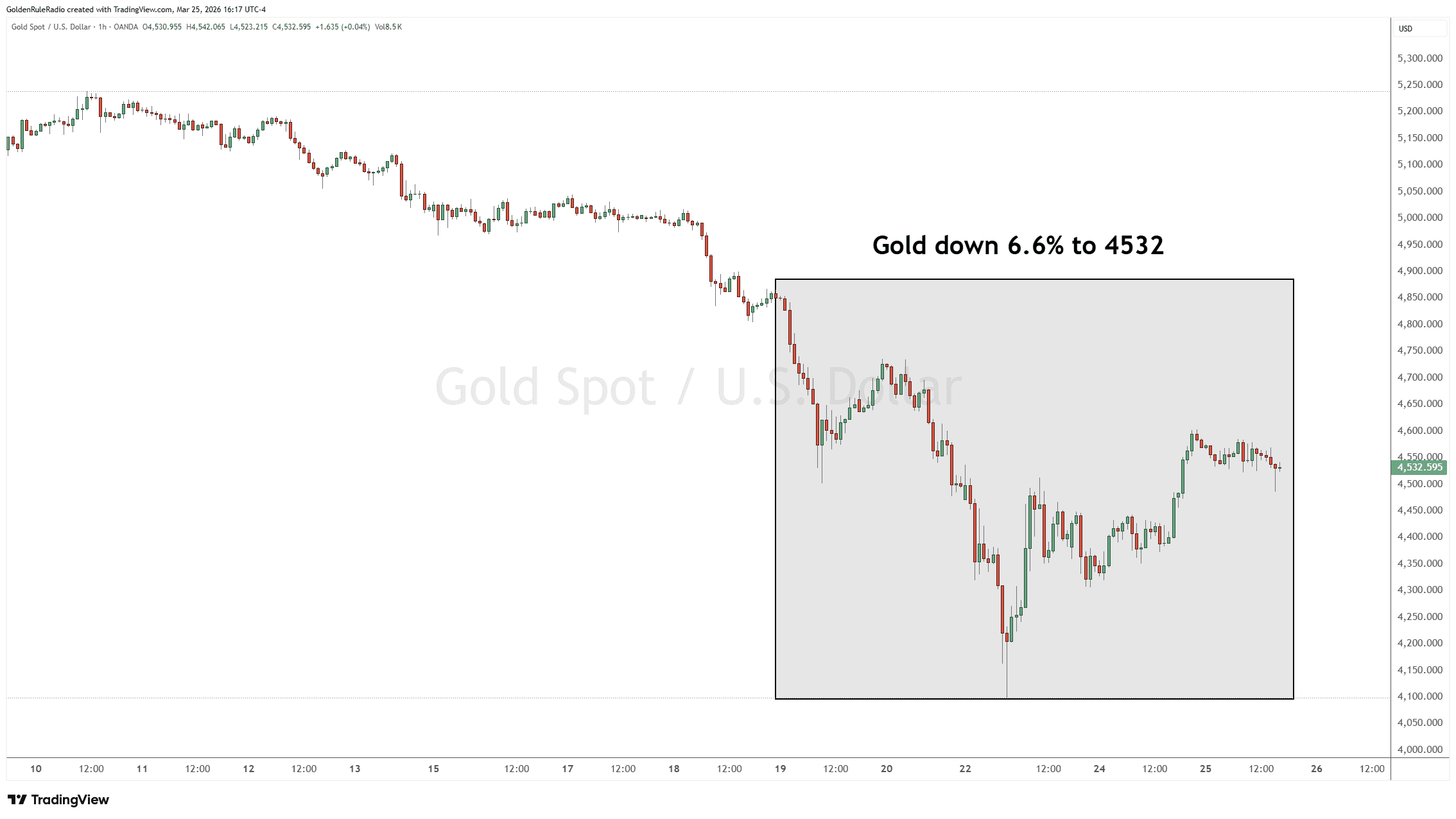 The price of silver is down 5.5%, sitting at $71.80.
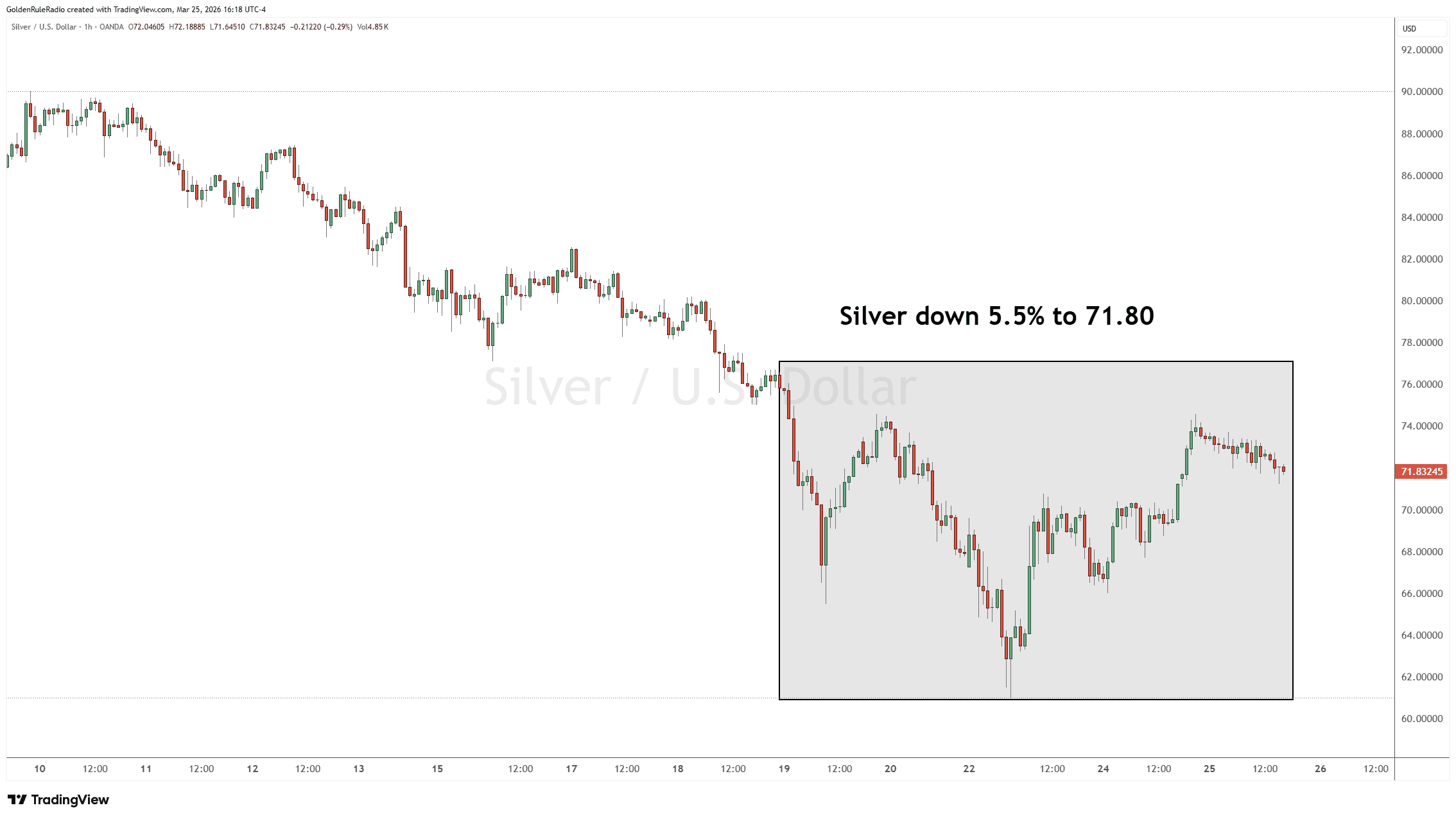 Platinum is down 5% sitting at $1,912.
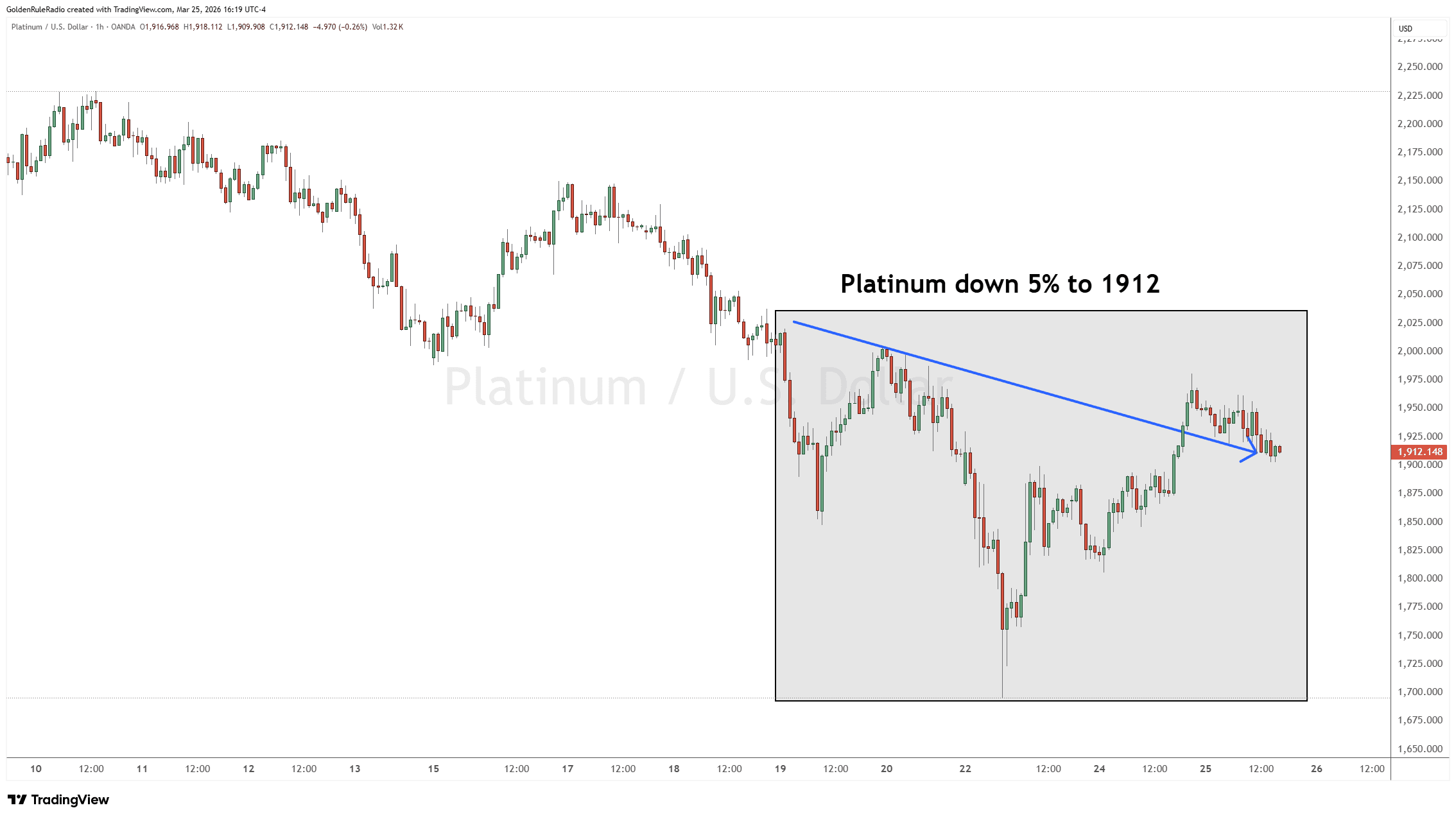 Palladium is down 5%, sitting at $1,397.
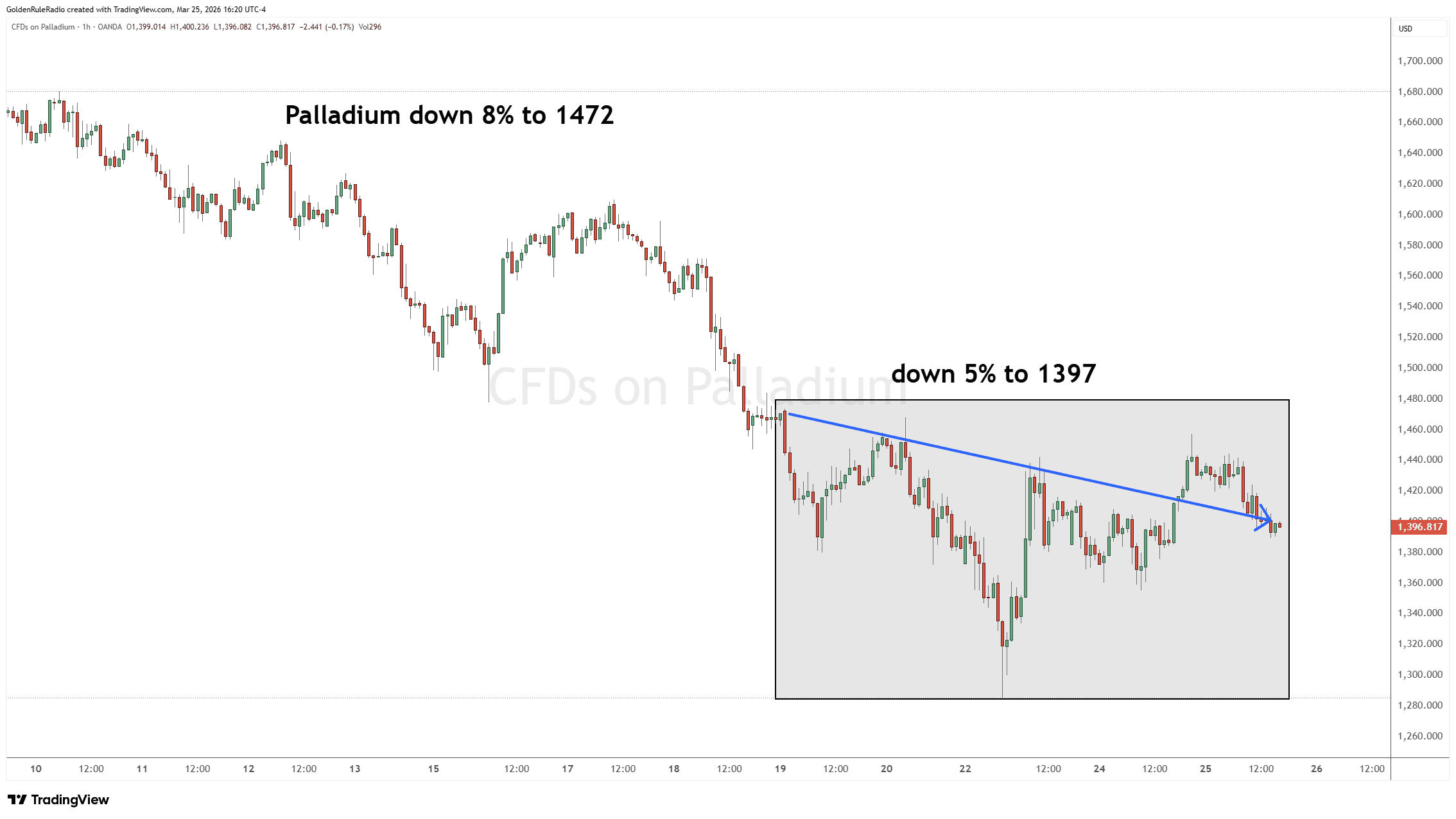 Taking a look over at the paper markets…The S&P 500 is down 0.7% to 6,591.
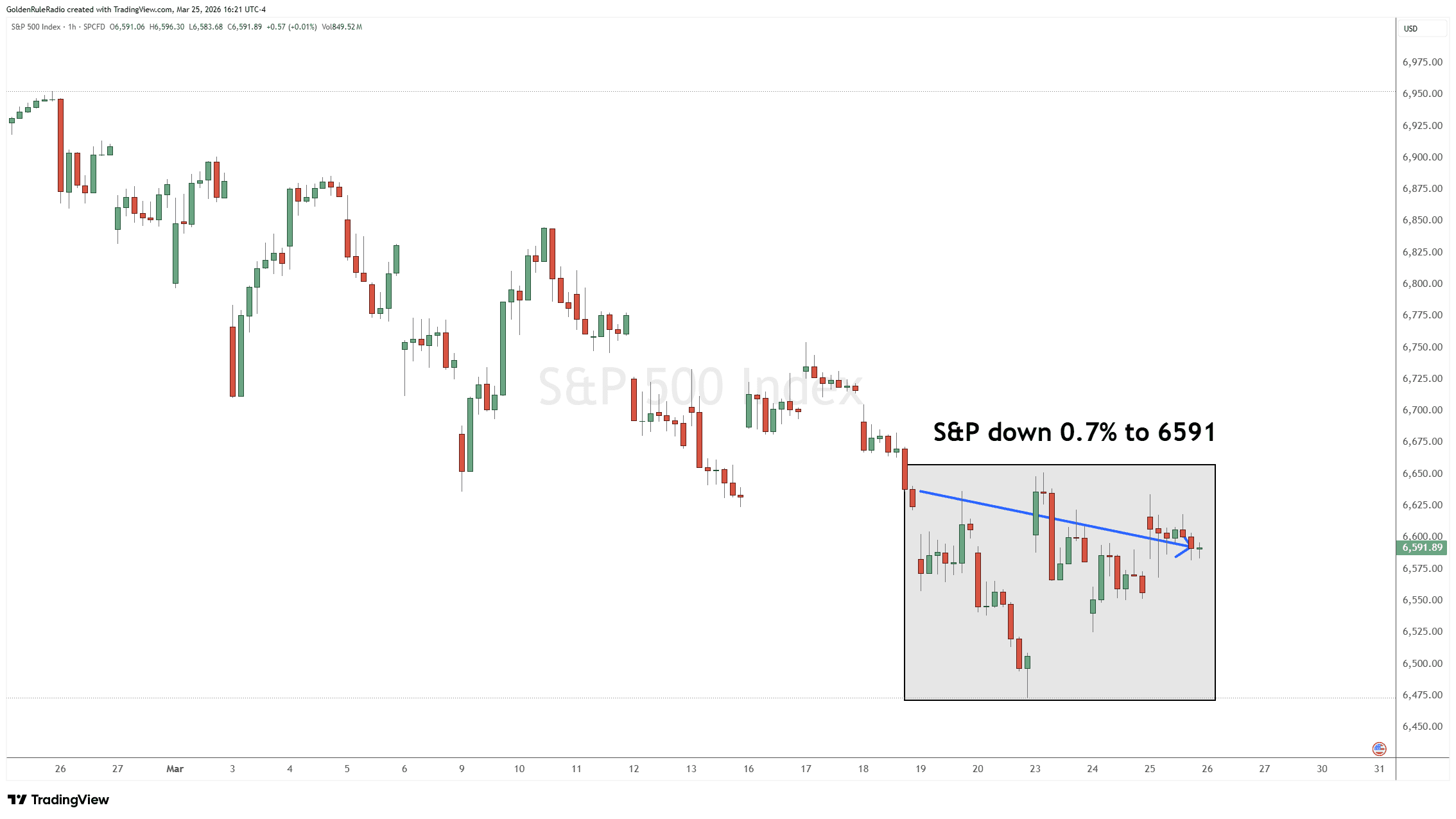 The US Dollar Index is flat, though trending upward, sitting at 99.65 from a week earlier.
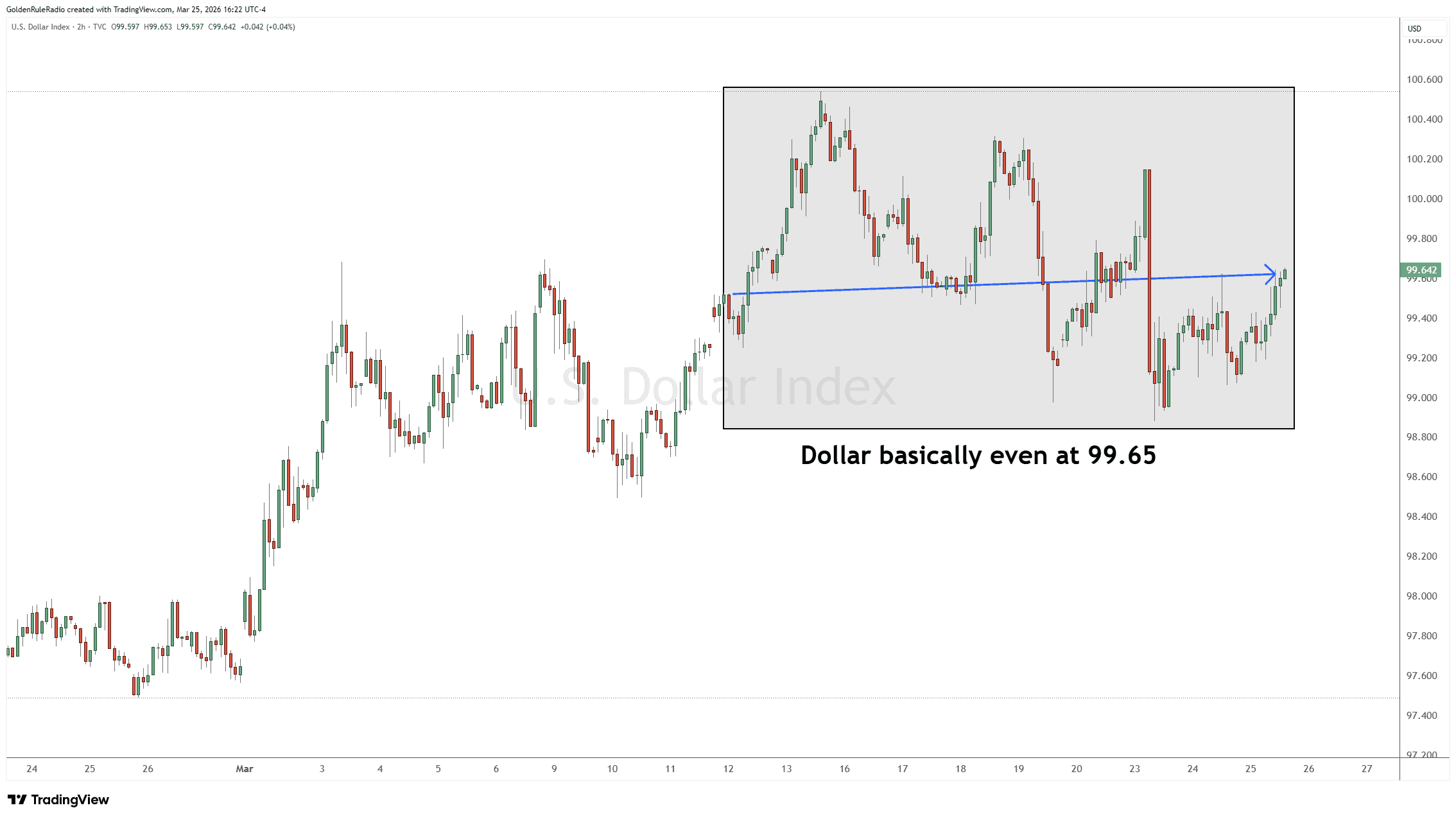 The price of silver is down 5.5%, sitting at $71.80.Platinum is down 5% sitting at $1,912.Palladium is down 5%, sitting at $1,397.Taking a look over at the paper markets…The S&P 500 is down 0.7% to 6,591.The US Dollar Index is flat, though trending upward, sitting at 99.65 from a week earlier.
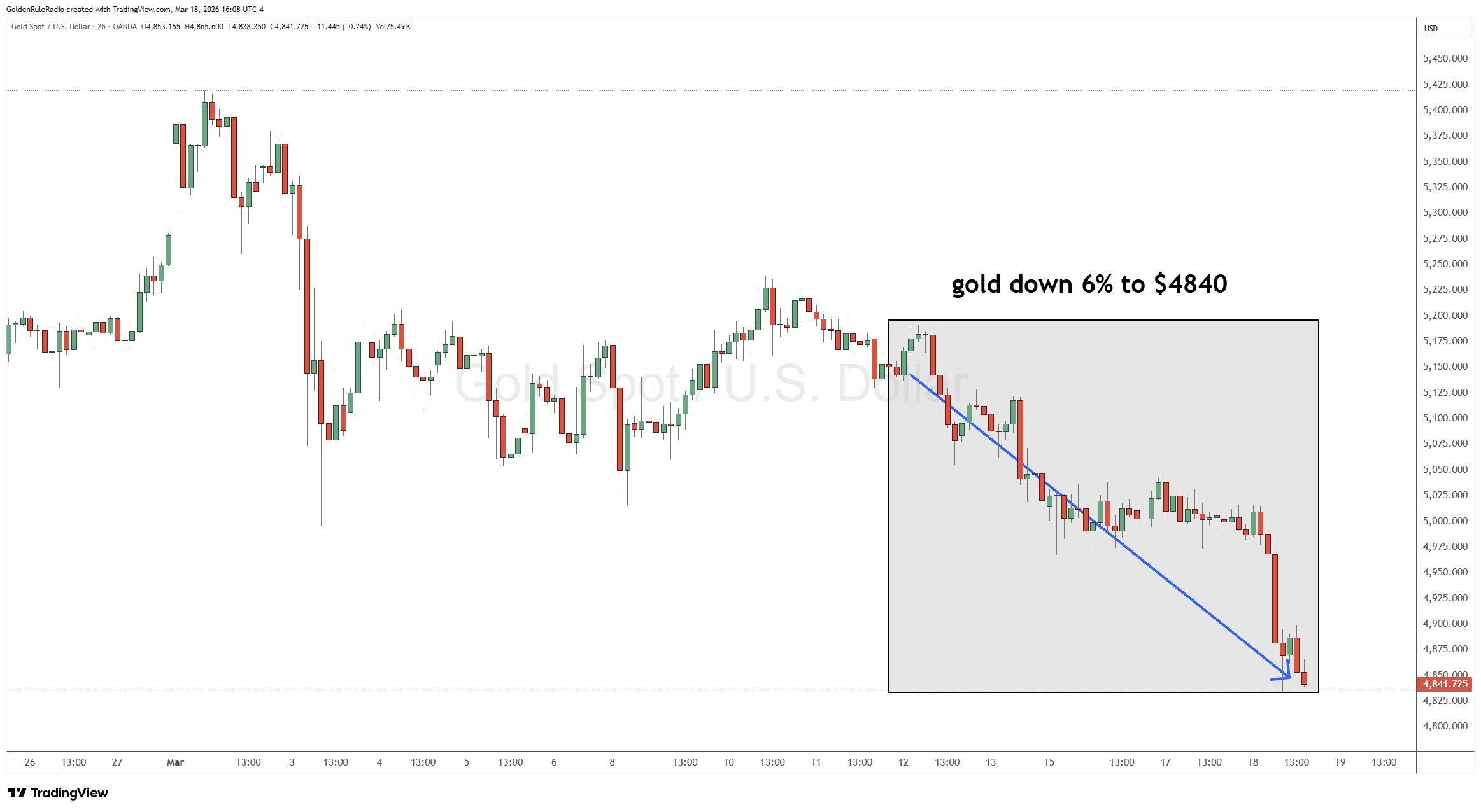 The price of silver is down 10%, sitting at $75.88. It is continuing its short-term slide down to the bottom of its trading range.
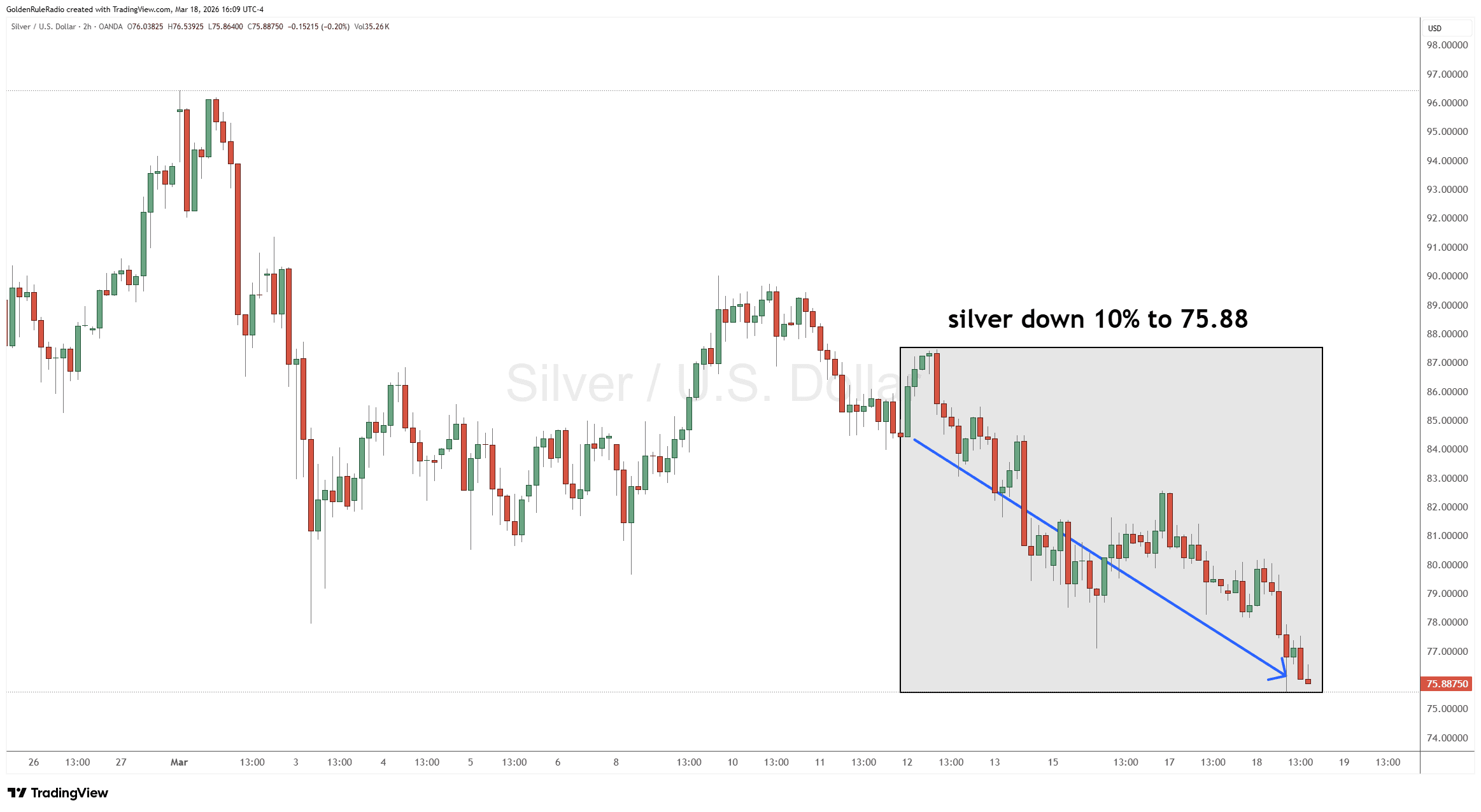 Platinum is down 5.7% sitting at $2,013.
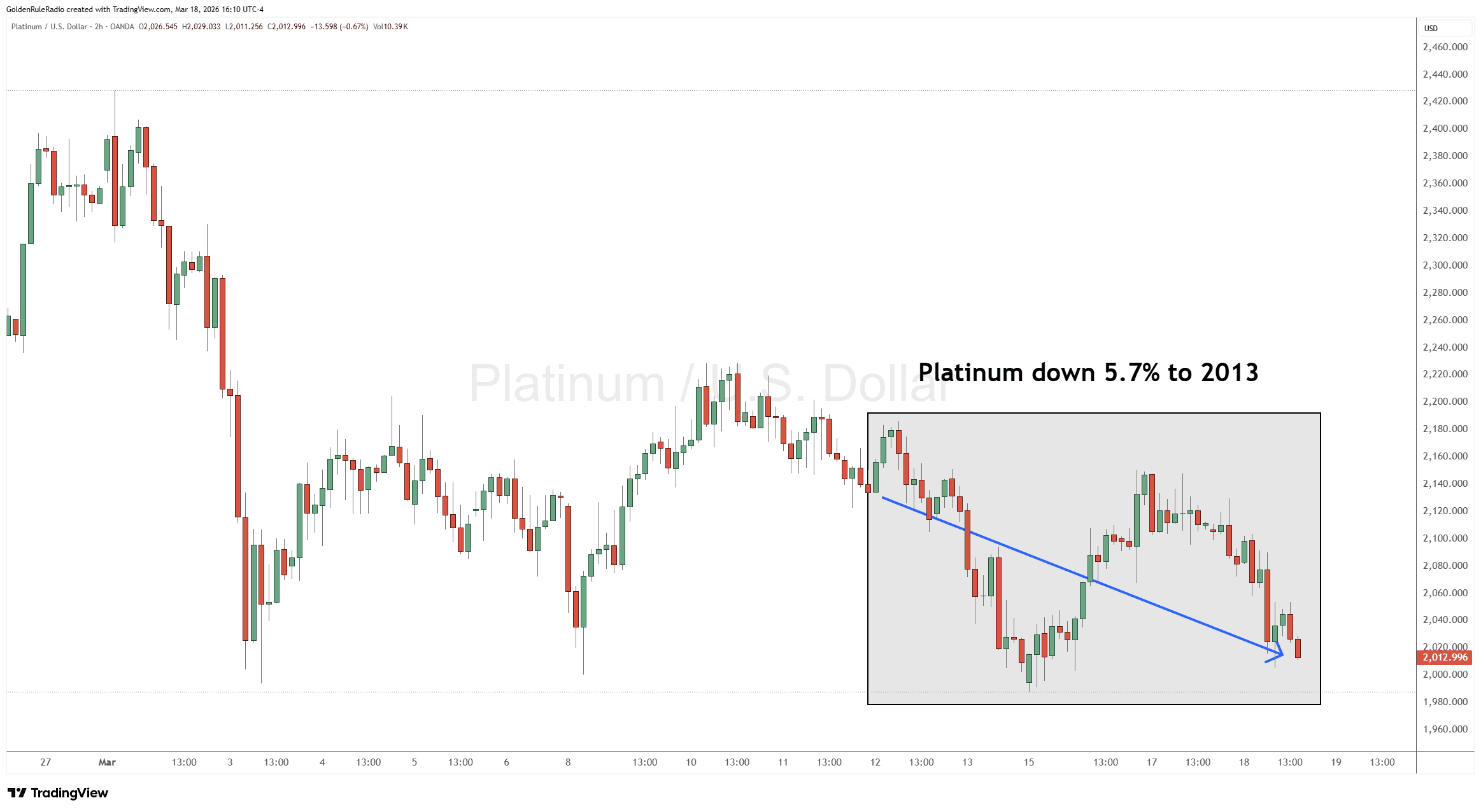 Palladium is down 8%, sitting at $1,472. That’s about $530 below its sister metal platinum.
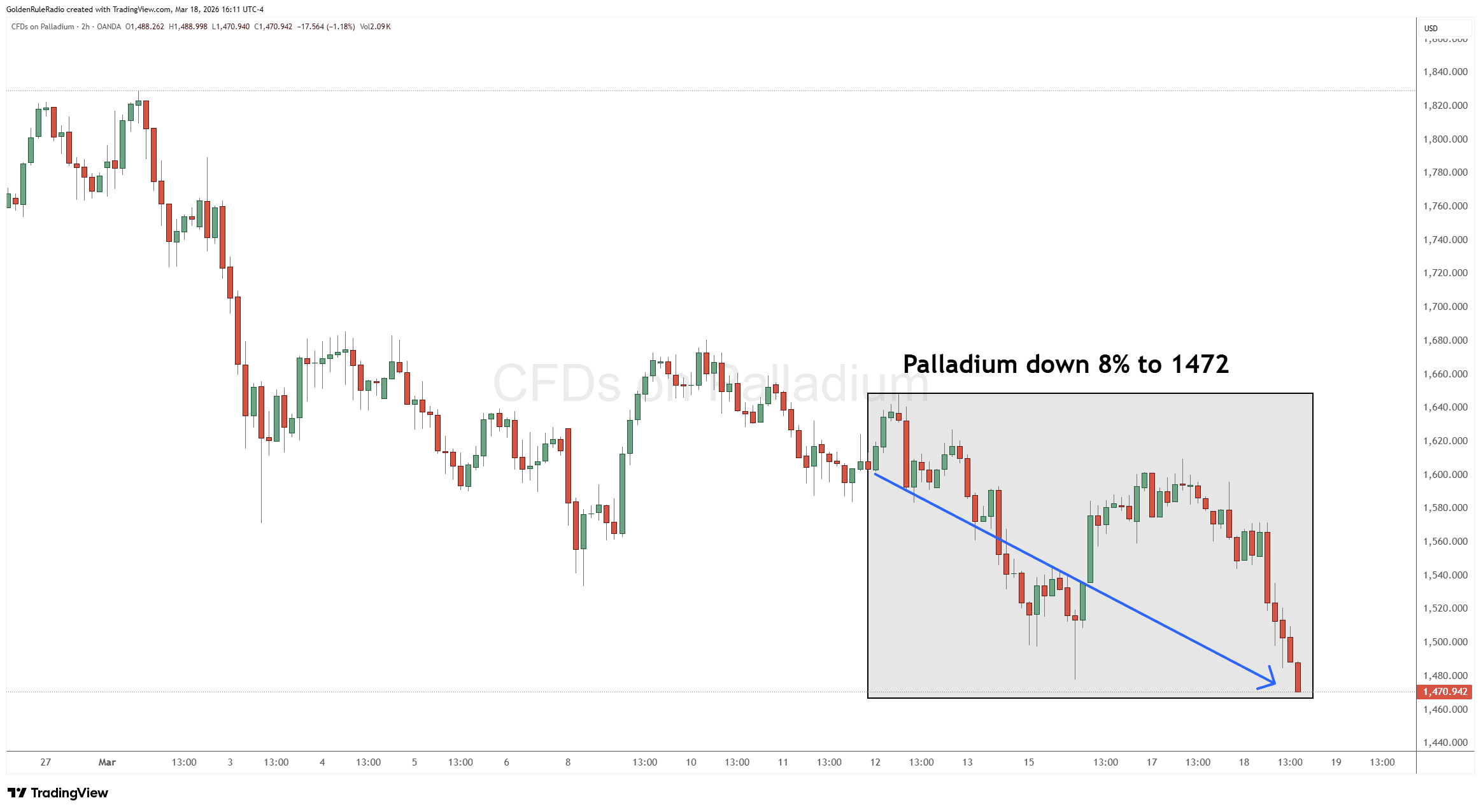 Taking a look over at the paper markets…The S&P 500 is down 1.5% to 6,624 — which seems to be a running theme.
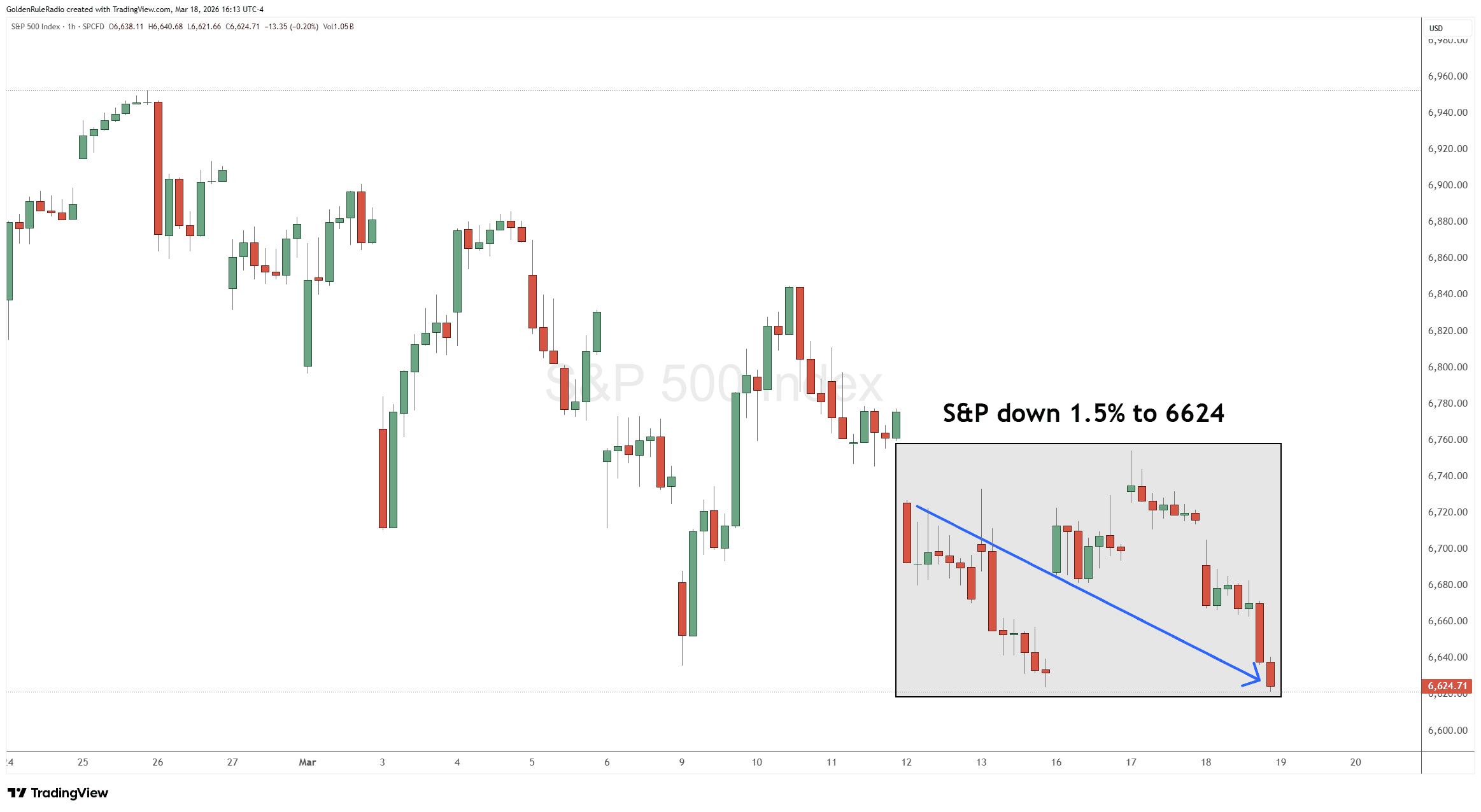 The US Dollar Index is up with everything else down, rising 0.7% and sitting at 100.21 from a week earlier.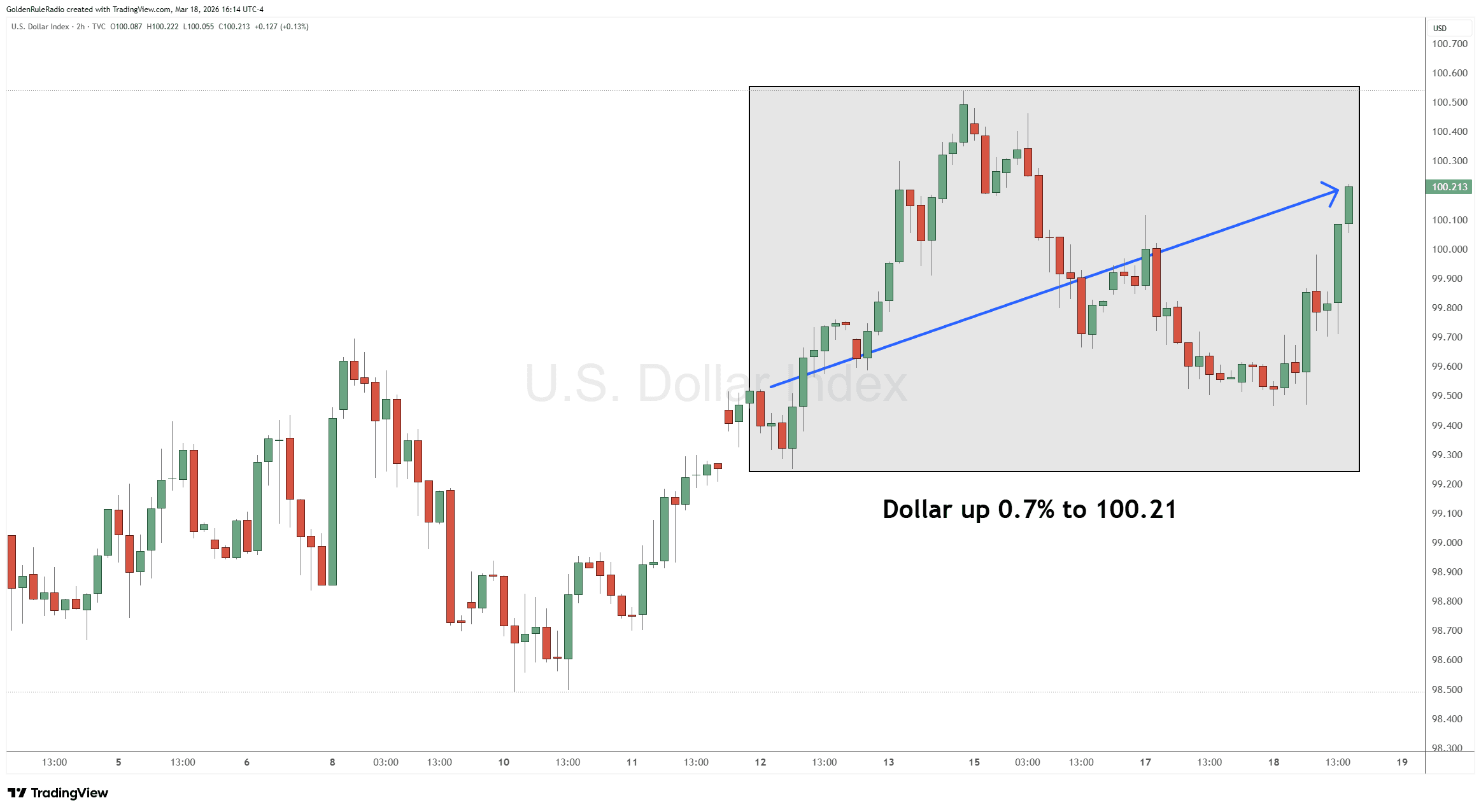

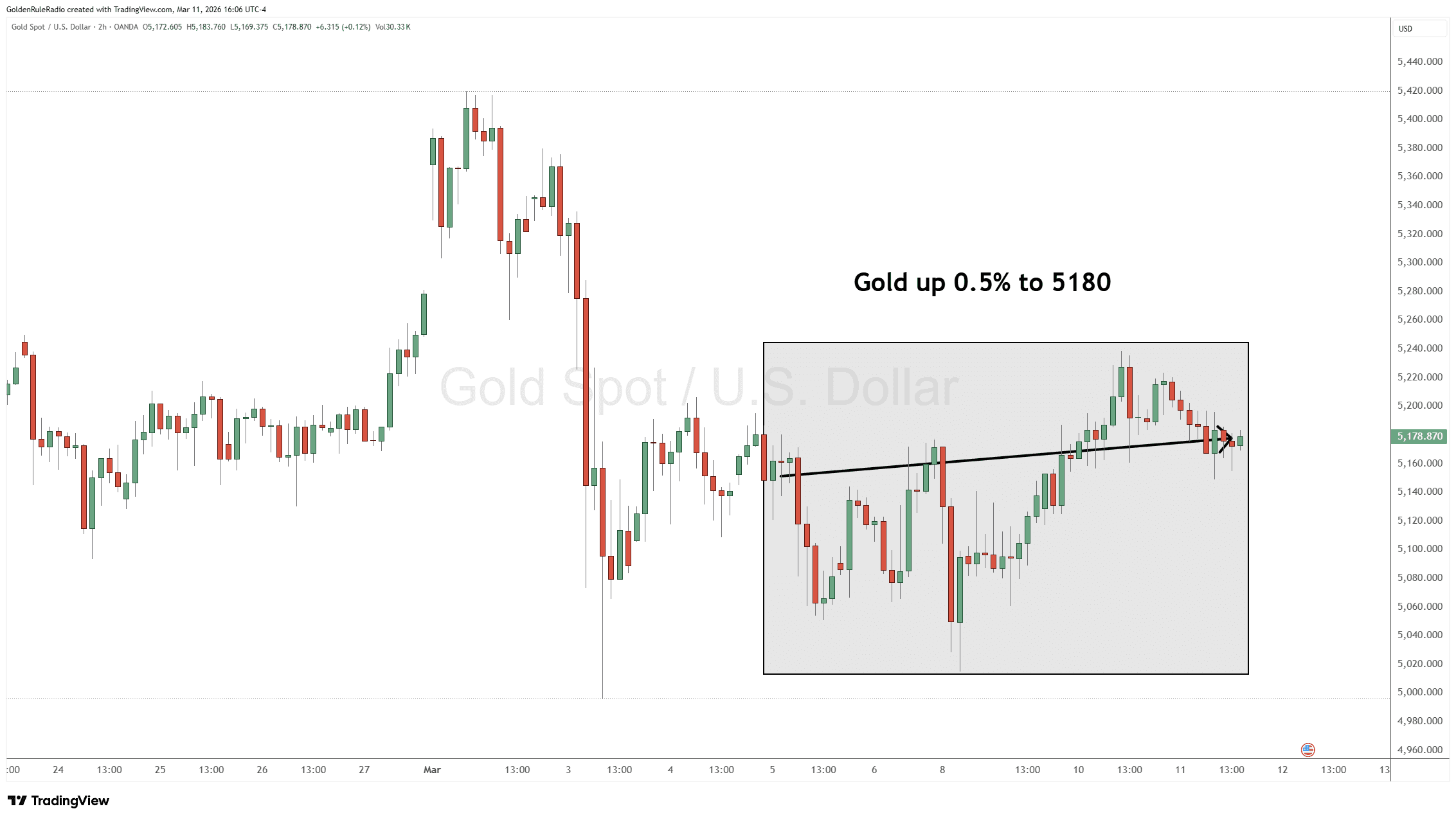 The price of silver is up about 4% at $85.94.
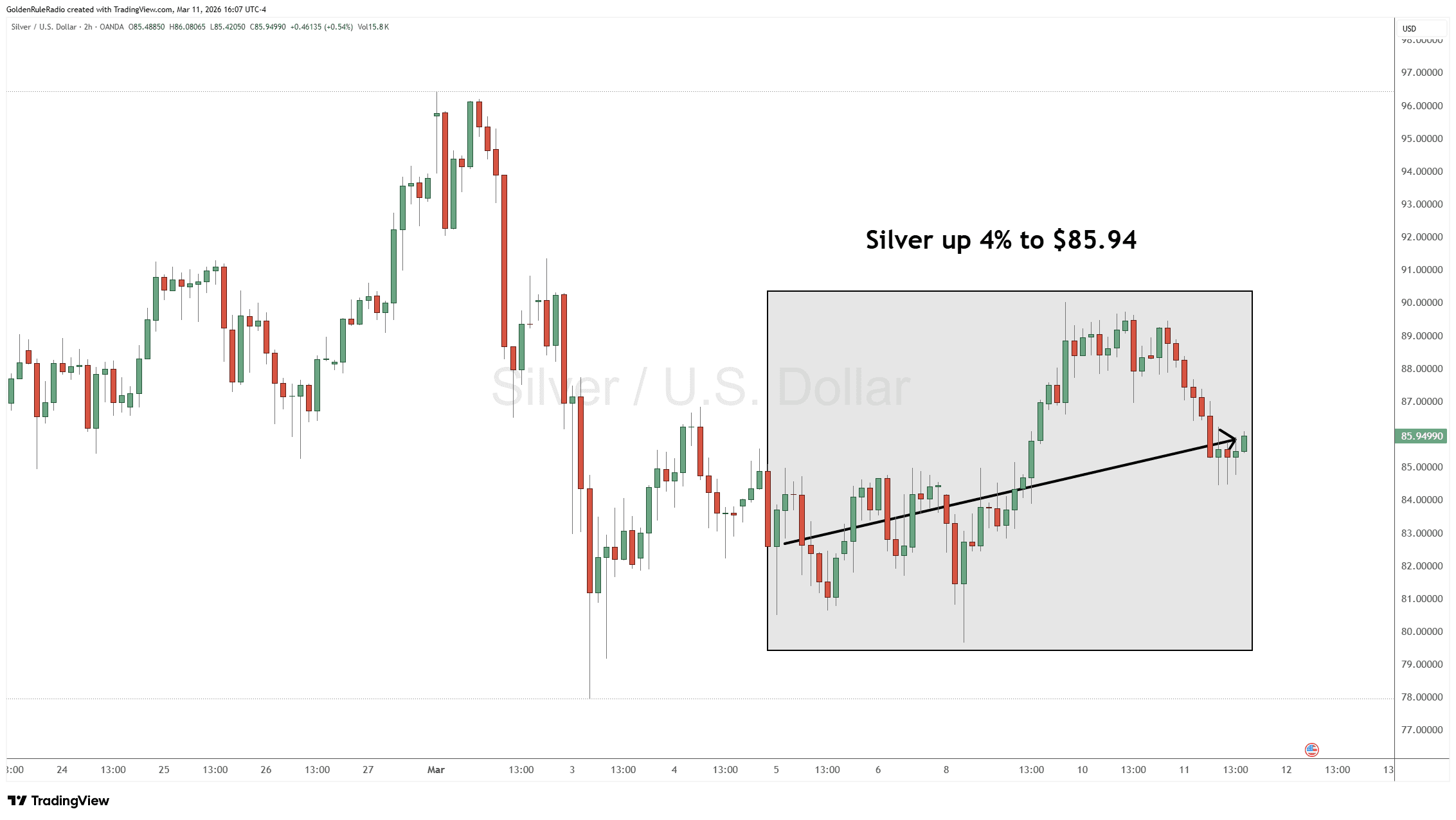 Platinum is up about 2% sitting at $2,166.
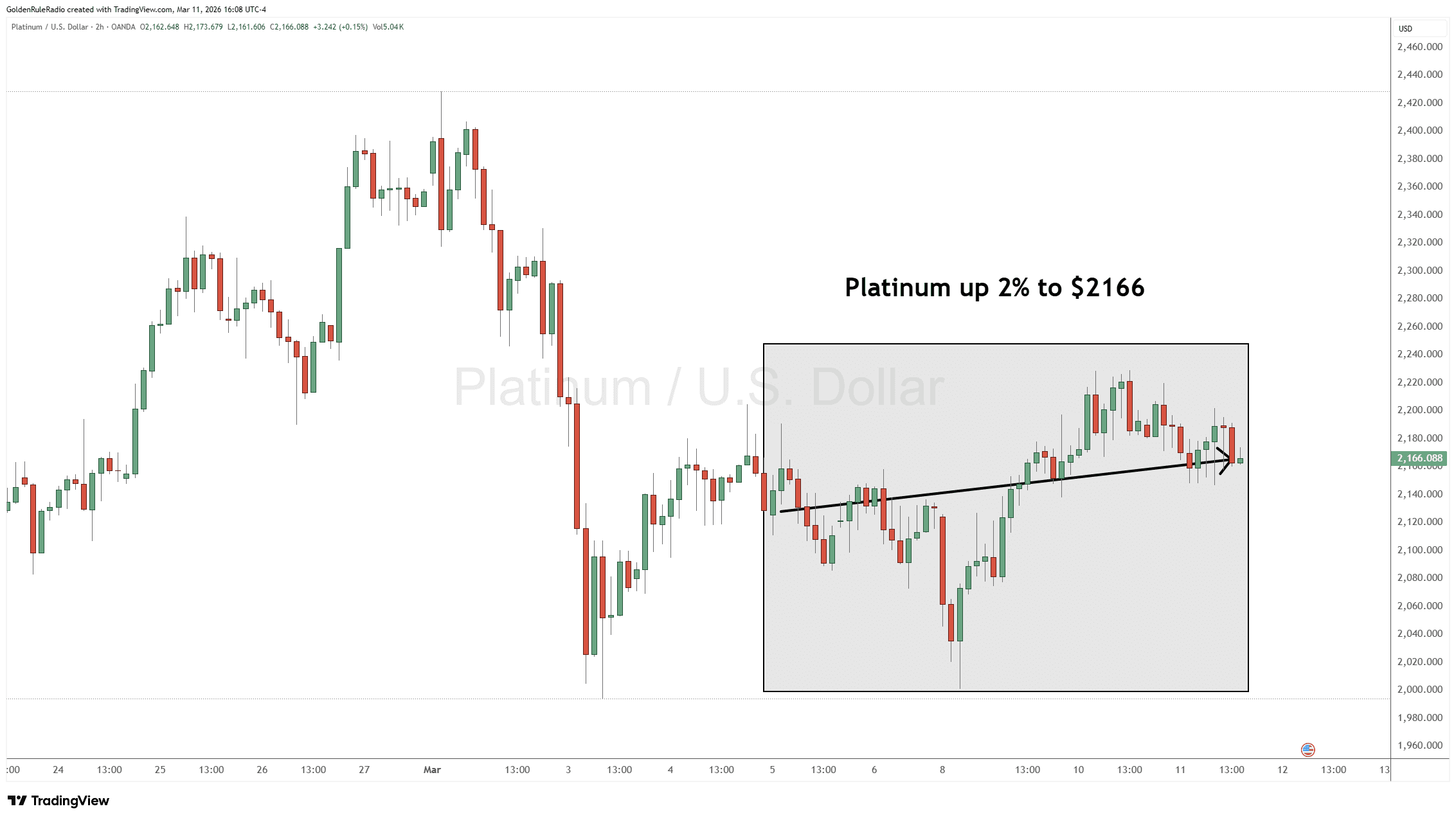 Palladium is down 2% to $1,611, now about $500 below platinum.
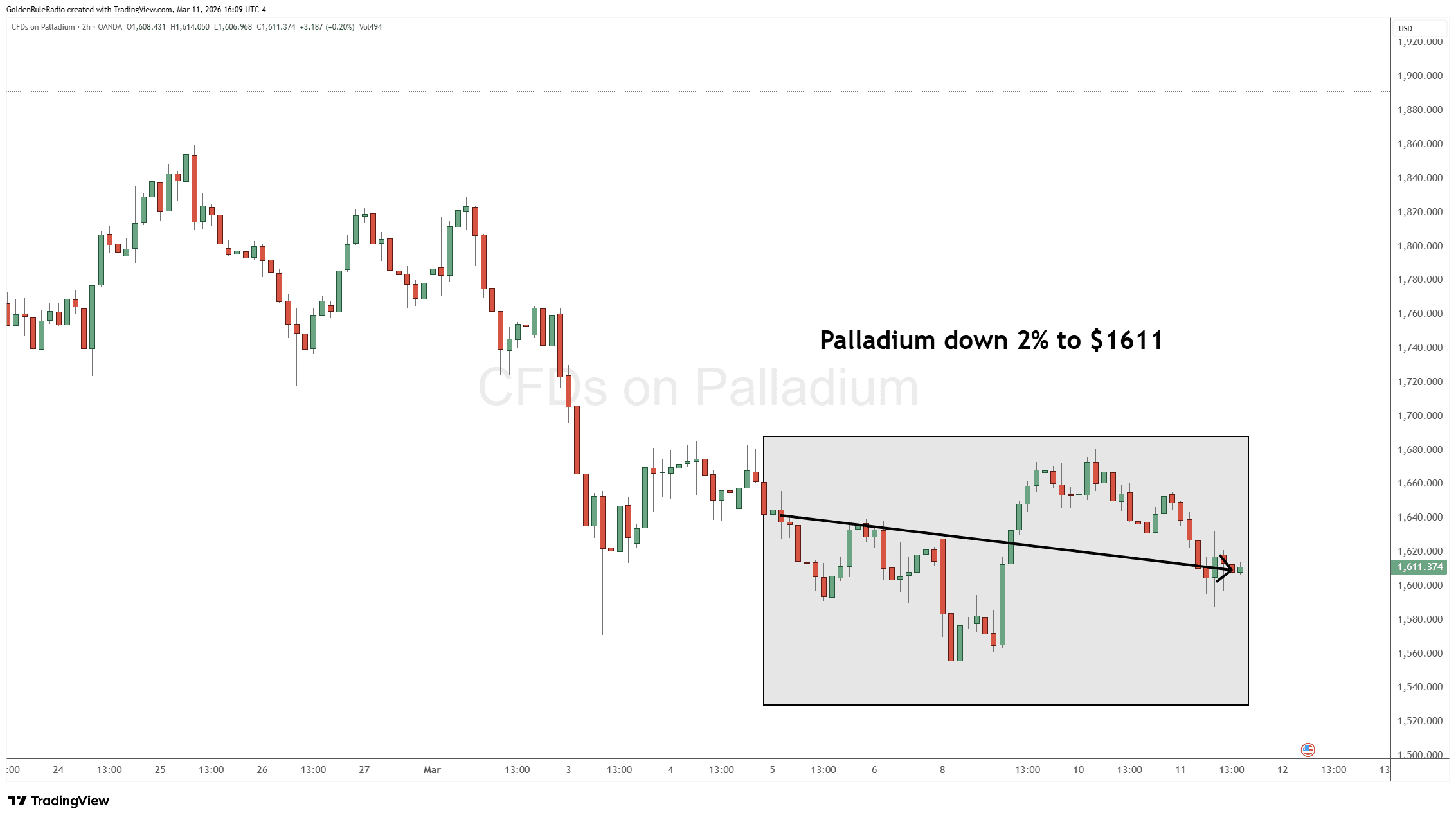 Looking over at the paper markets…The S&P 500 is down 1% this week to 6,775.
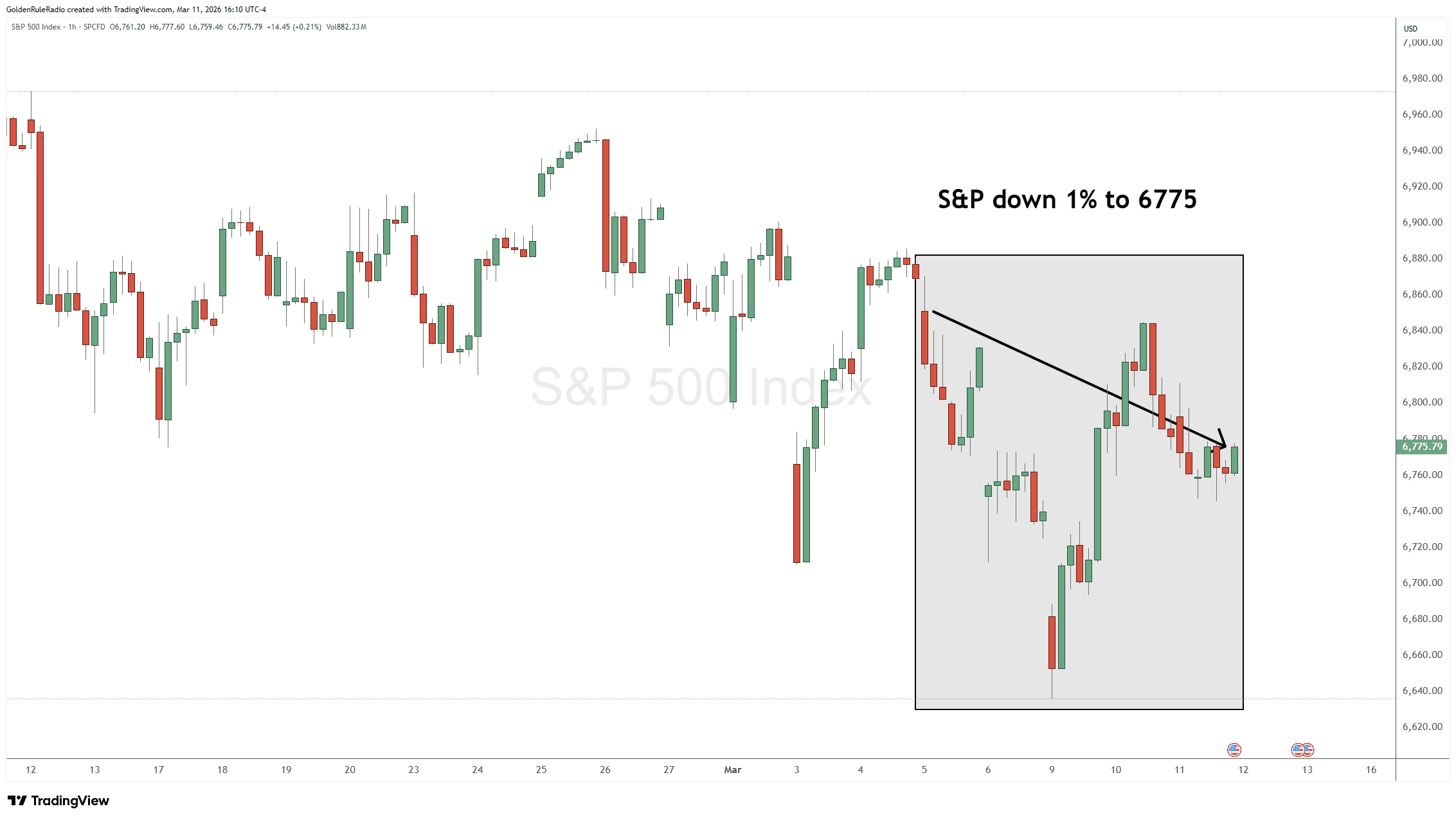 The US Dollar Index is up a staggering 0.1%, sitting at 99.22. At least short term, it's looking strong, but we'll want to see if that's true in the long term as well.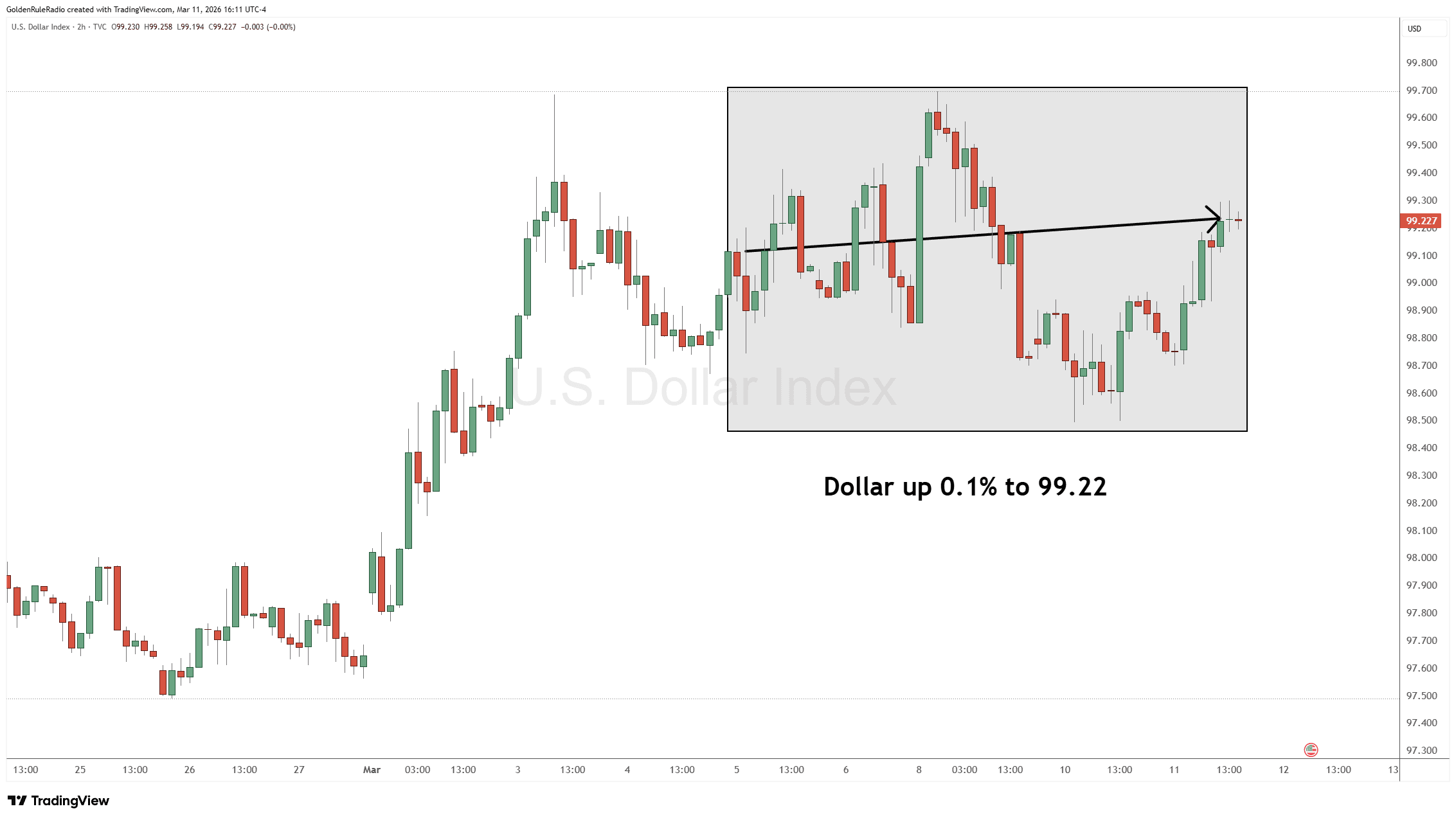
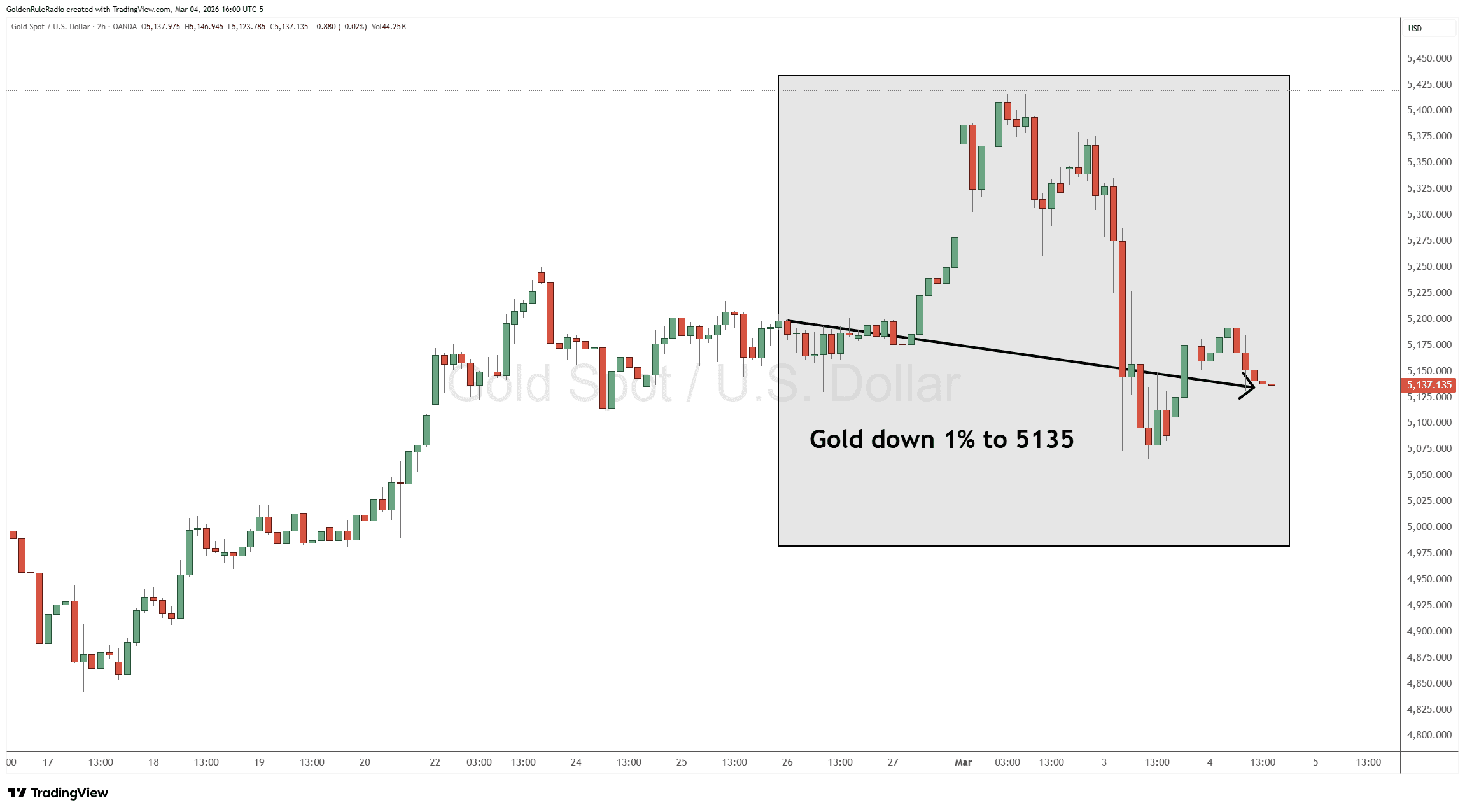 The price of silver is down about 7%, currently sitting at $83.30.
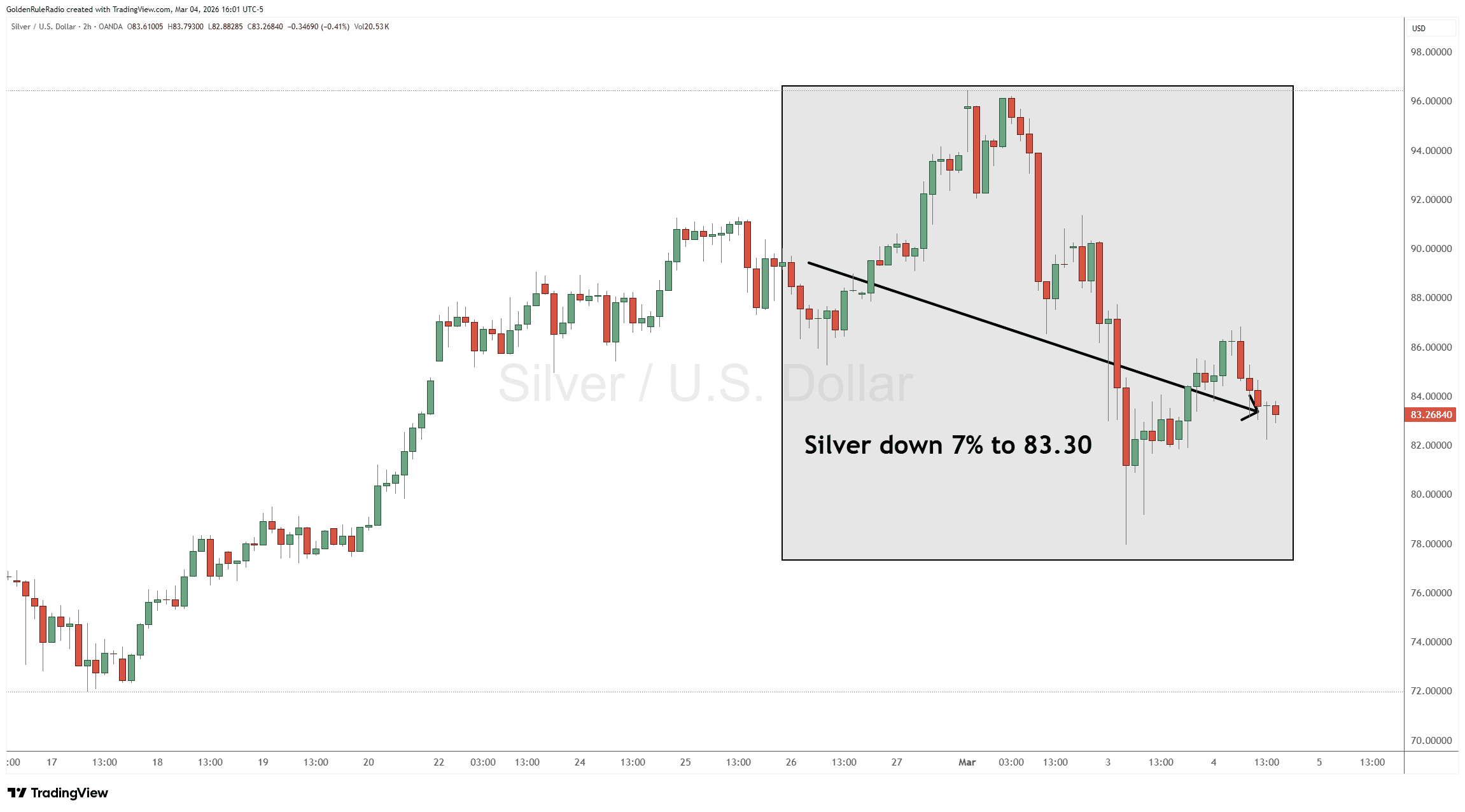 Platinum is down 6%, currently sitting at $2,147. While it’s still holding above $2,000, it did have another down week this week and kind of flattening out just like silver has.
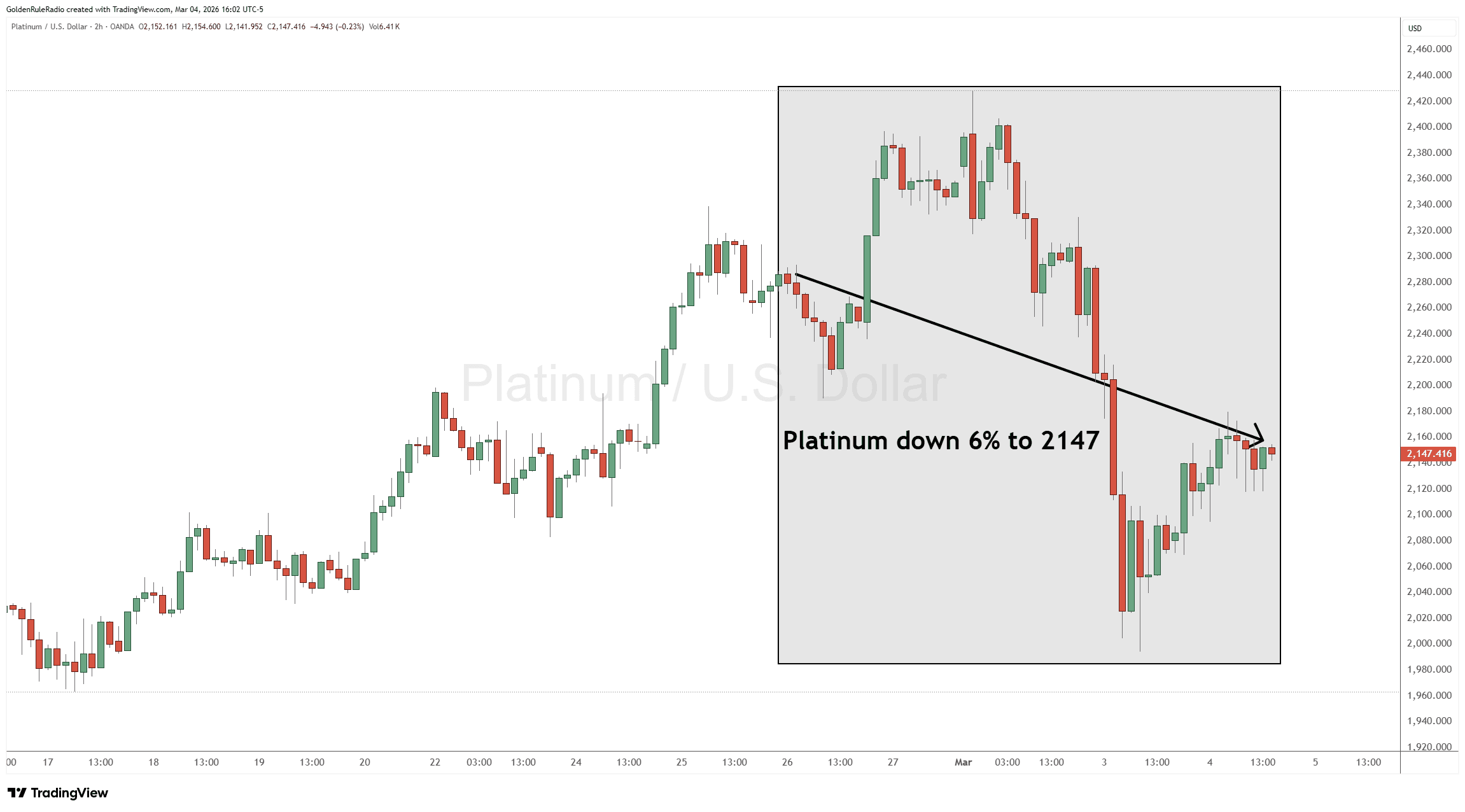 Palladium is down 8%, currently sitting at $1,654.
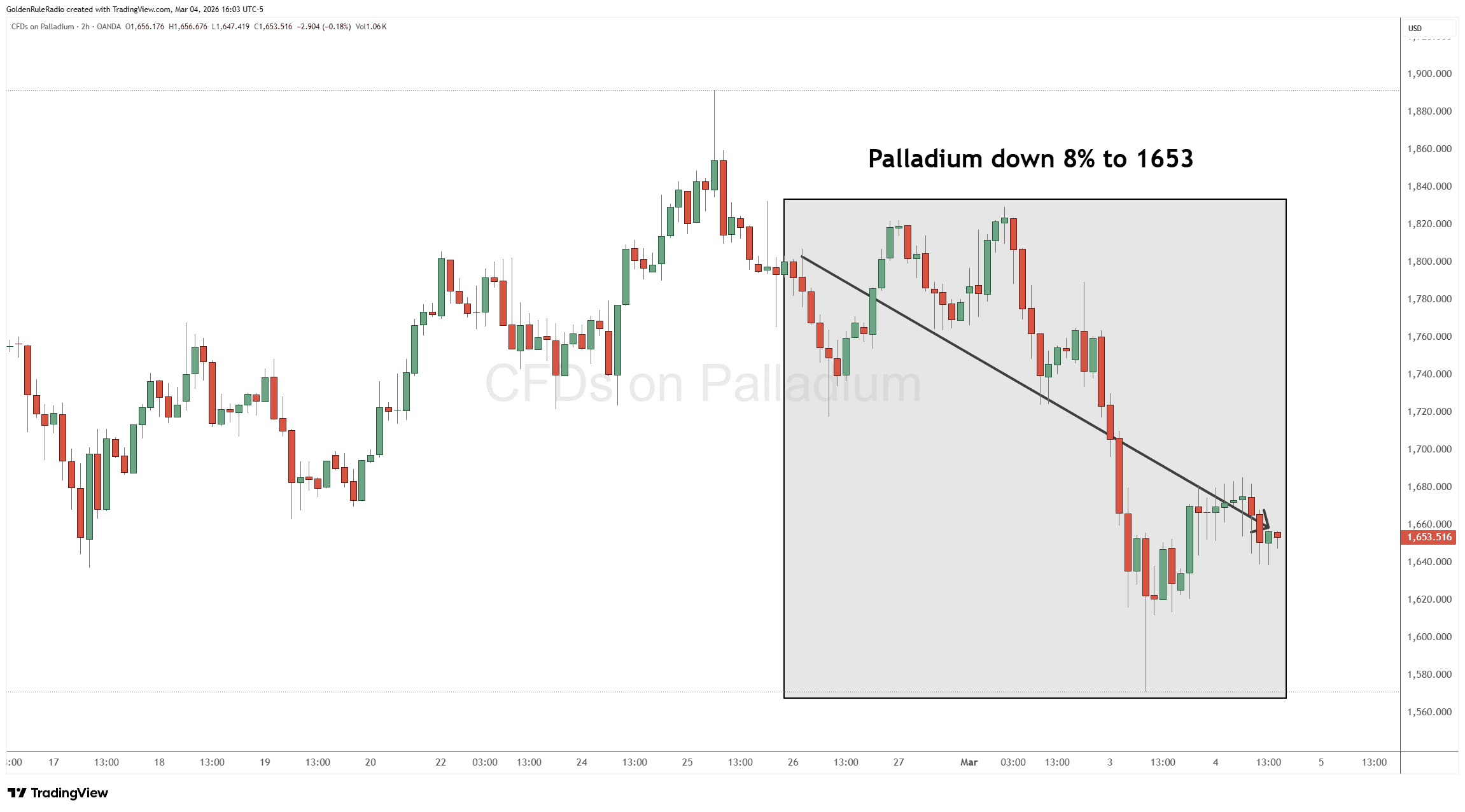 Taking a quick look at the paper markets…The S&P 500 Index is down 1%, sitting at 6,870, and continuing to show a little bit of rollover momentum.
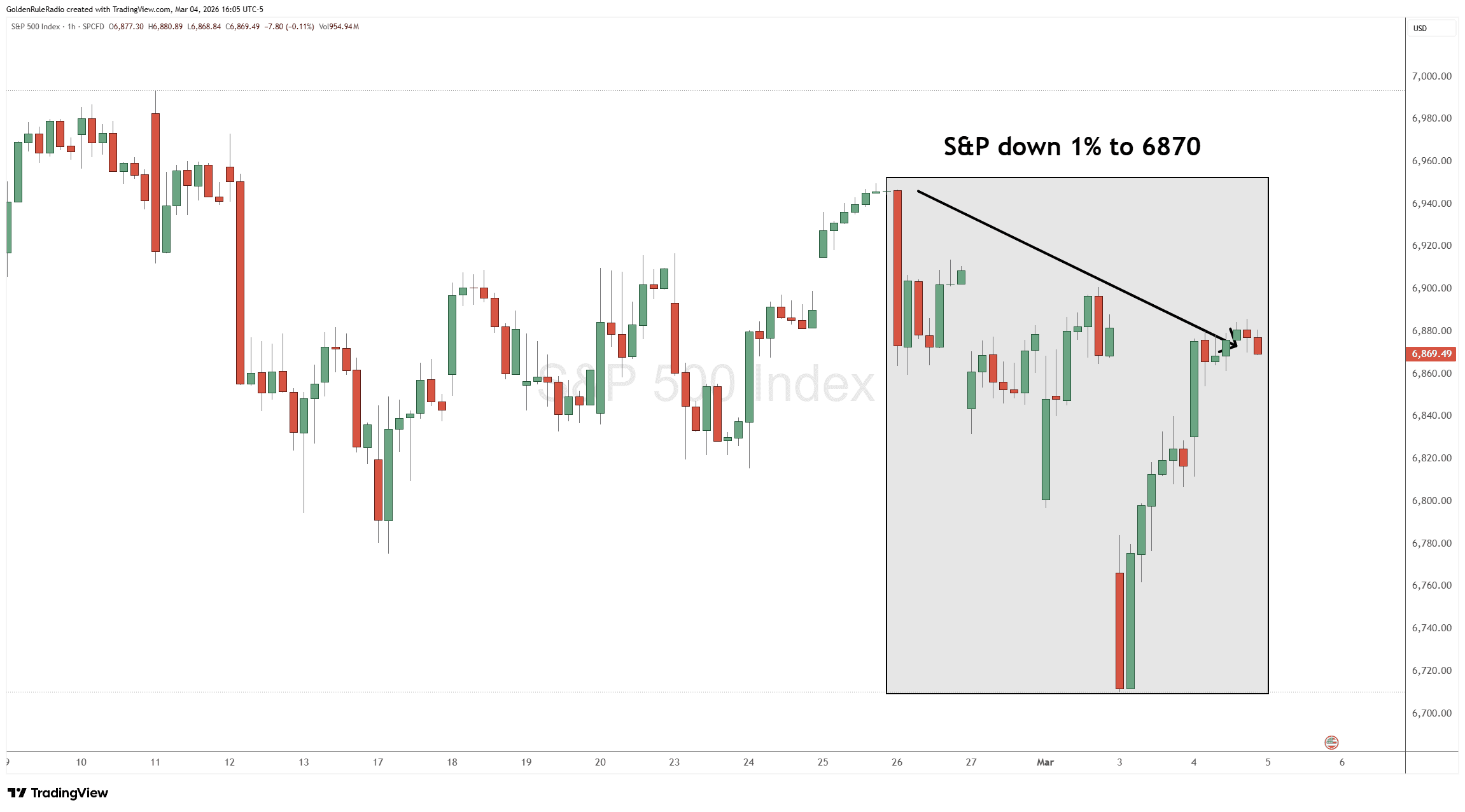 And finally, the US dollar index is up 1.25% from our recording last week, currently sitting at 98.80.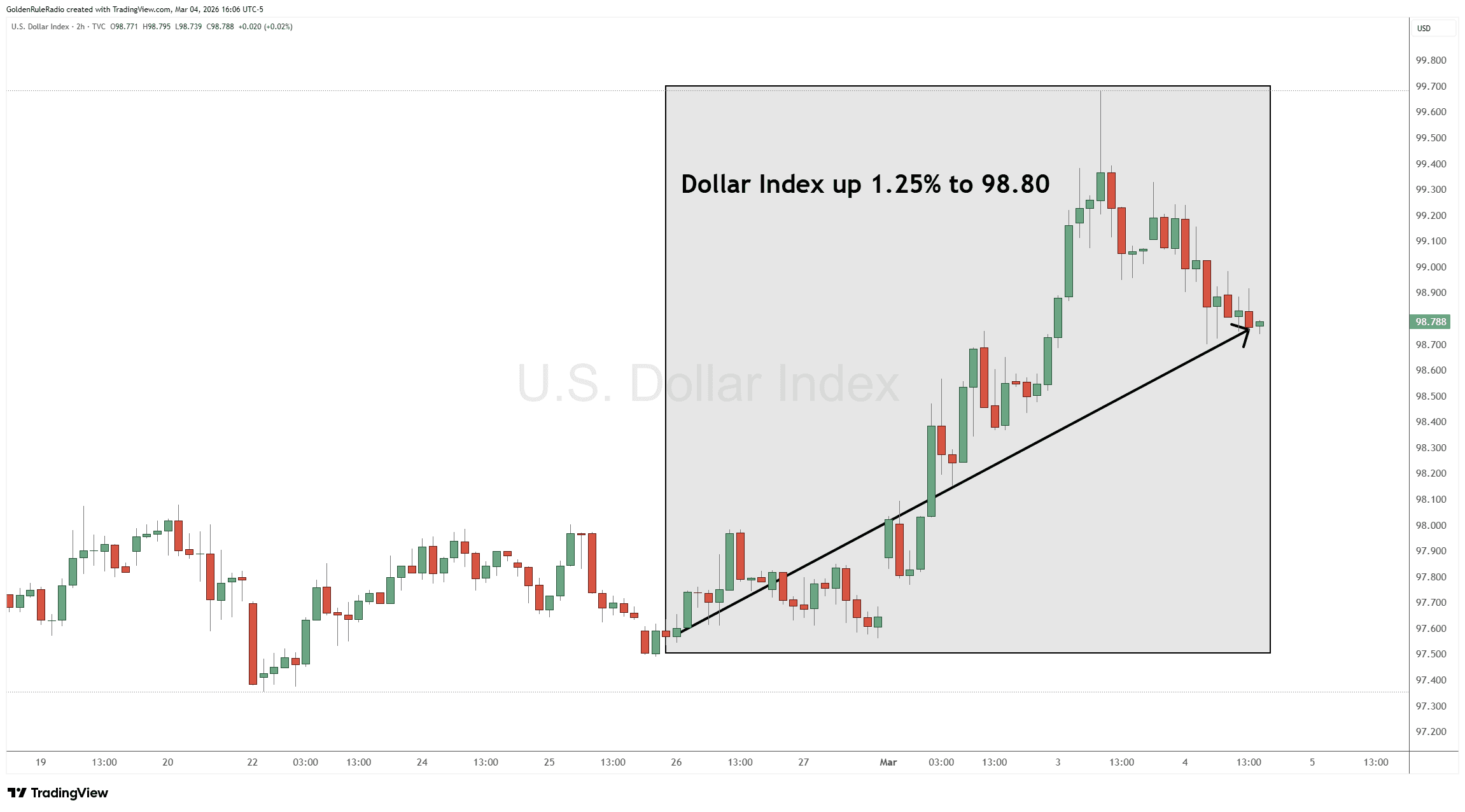
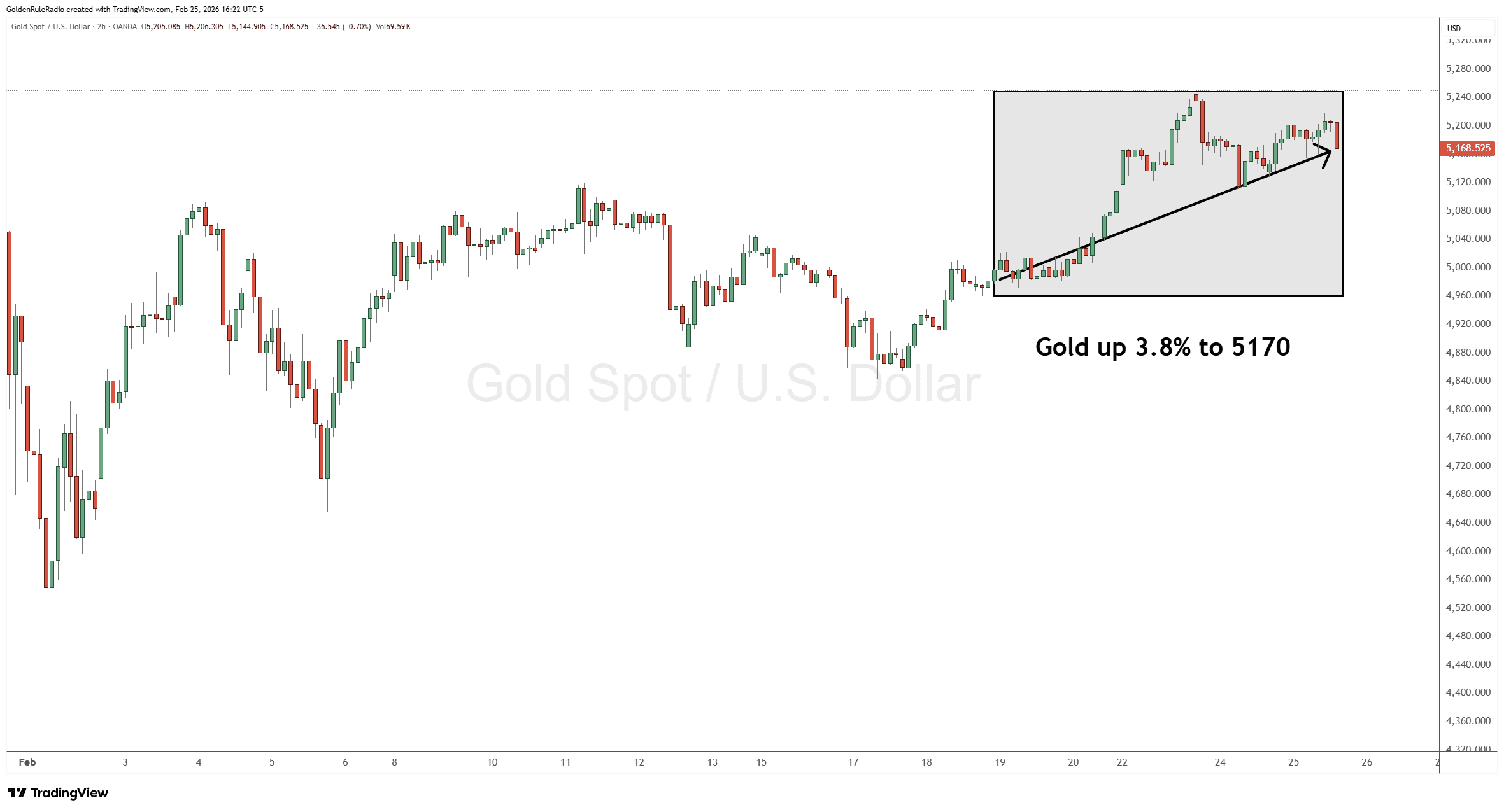 The price of silver is up almost 16% at $89.15. The counterpart to gold is having a little bit of resurgence, but we'll see if that means anything.
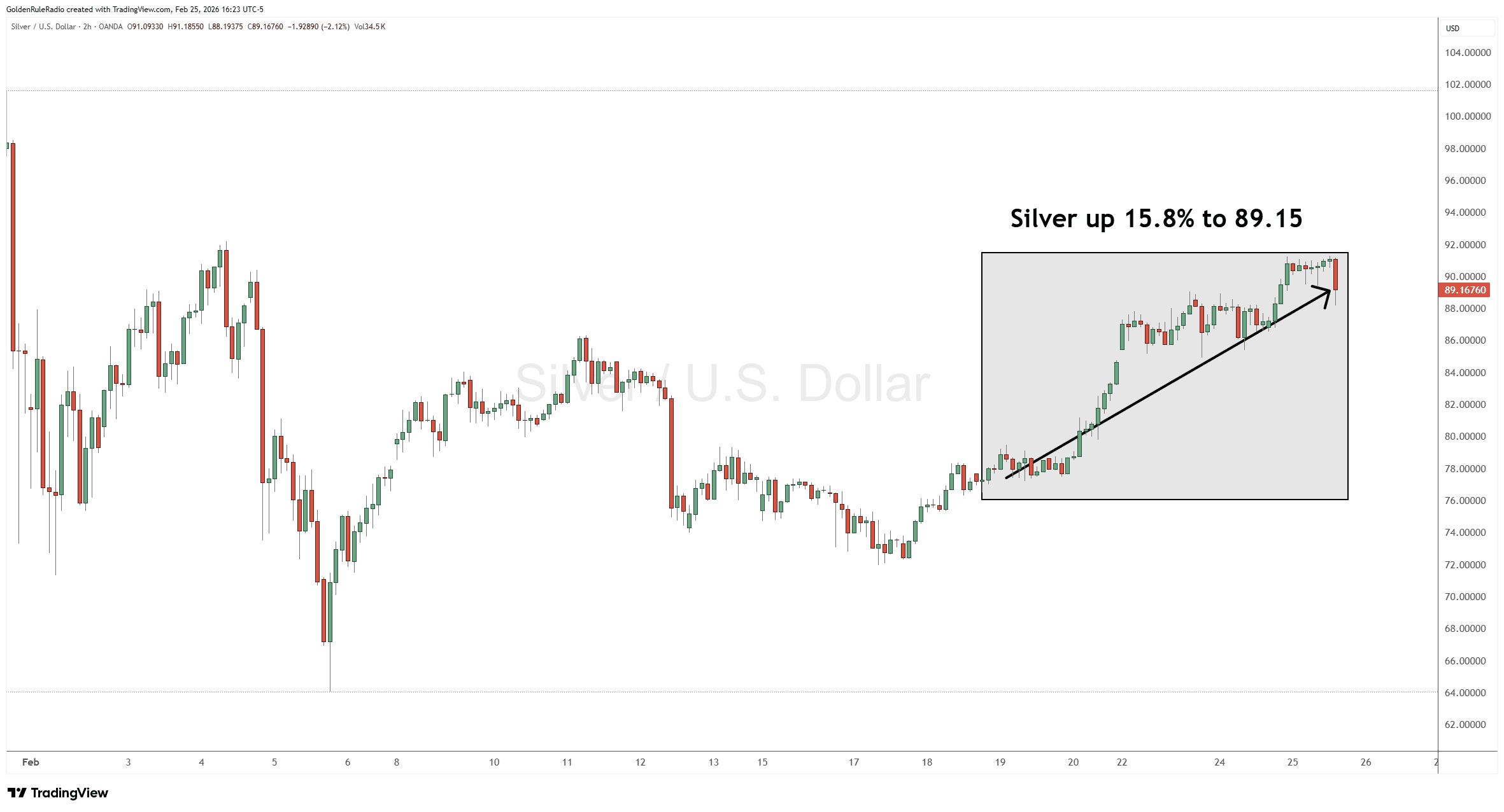 Platinum is up about 10.5% sitting at $2,323.
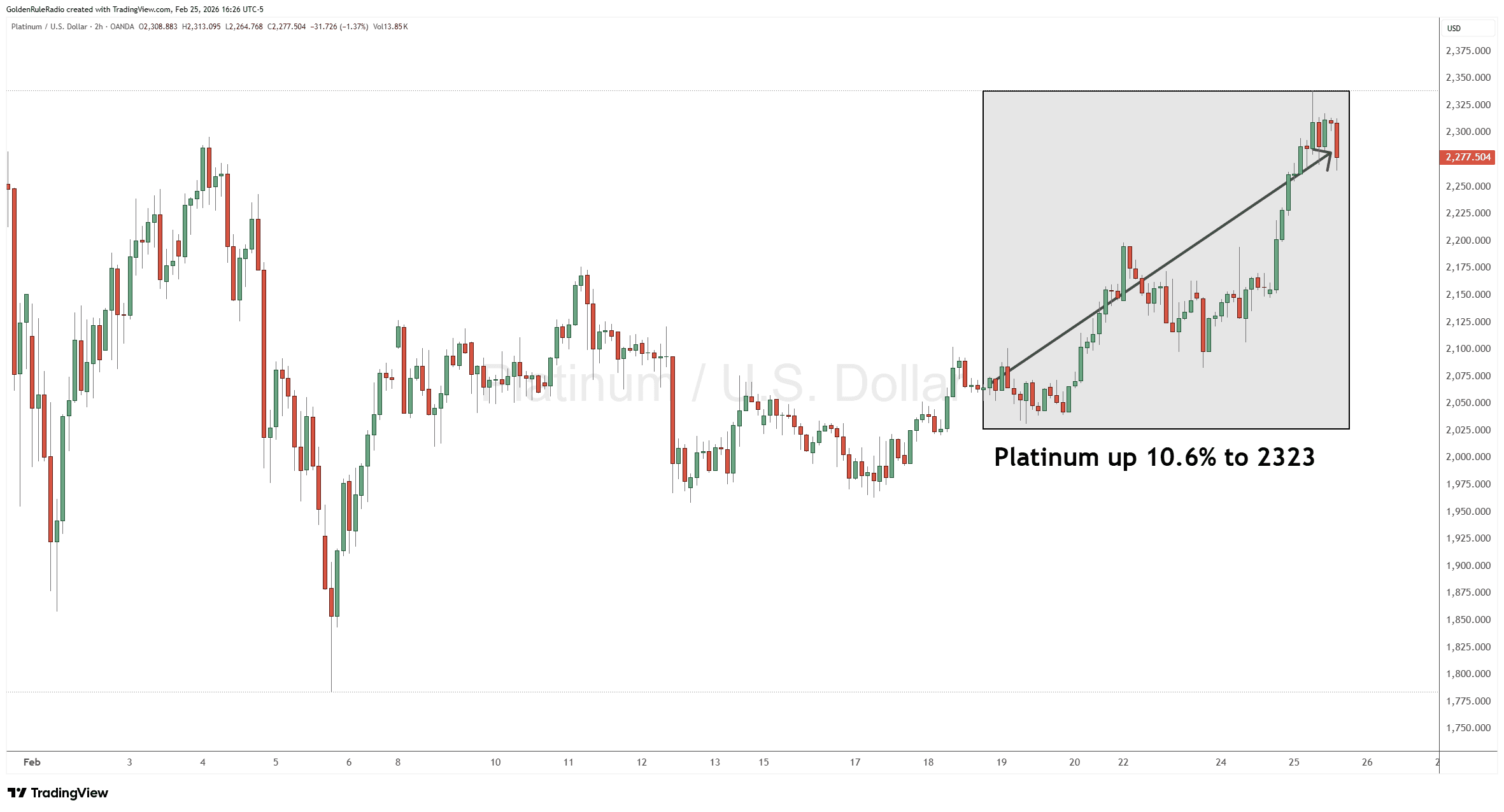 Palladium is up 6% to $1,811.
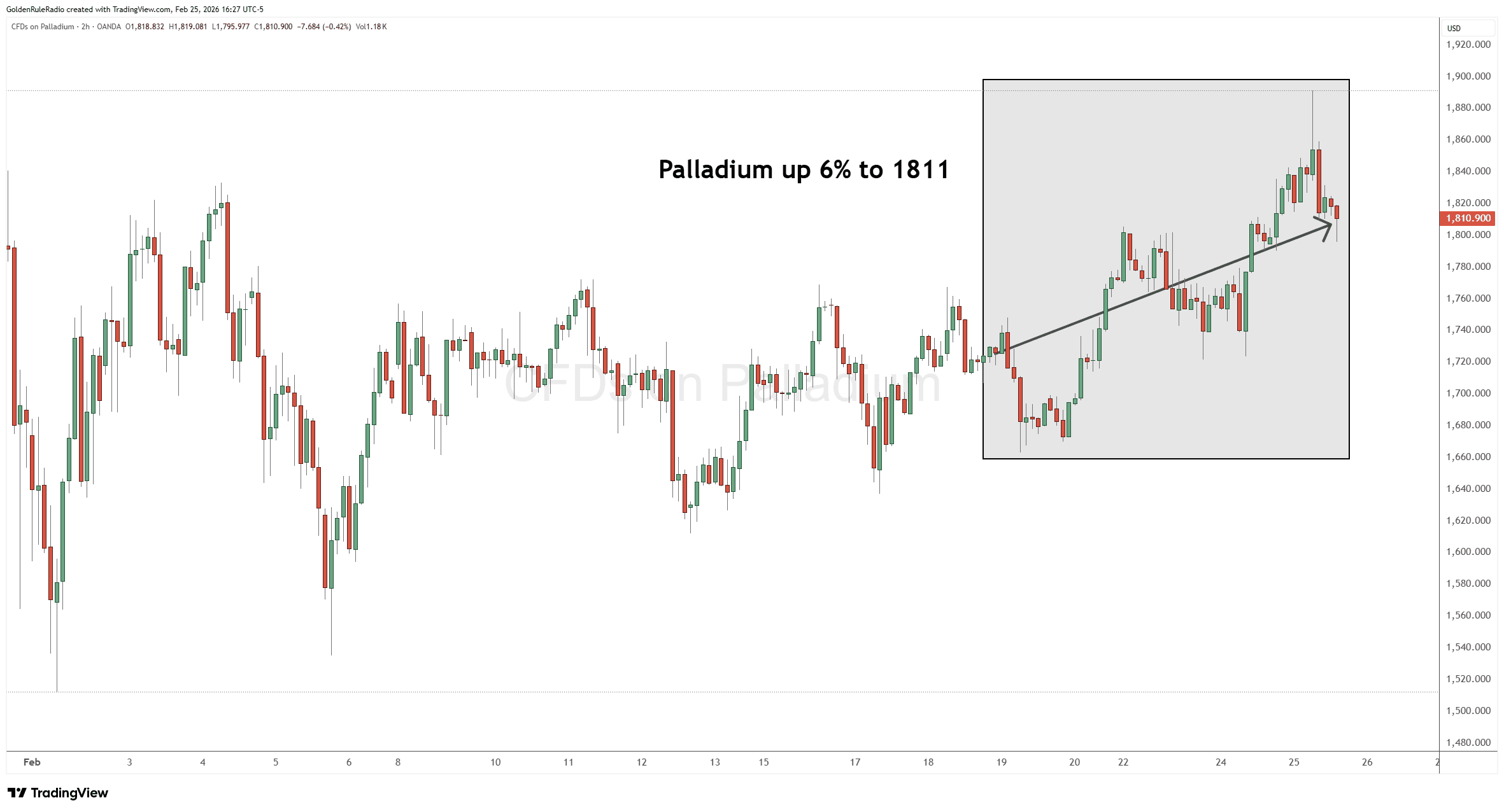 Taking a quick glance over at the paper markets…The S&P 500 is up 1.3% to 6,946 and still looking very choppy like it has over the last couple of months.
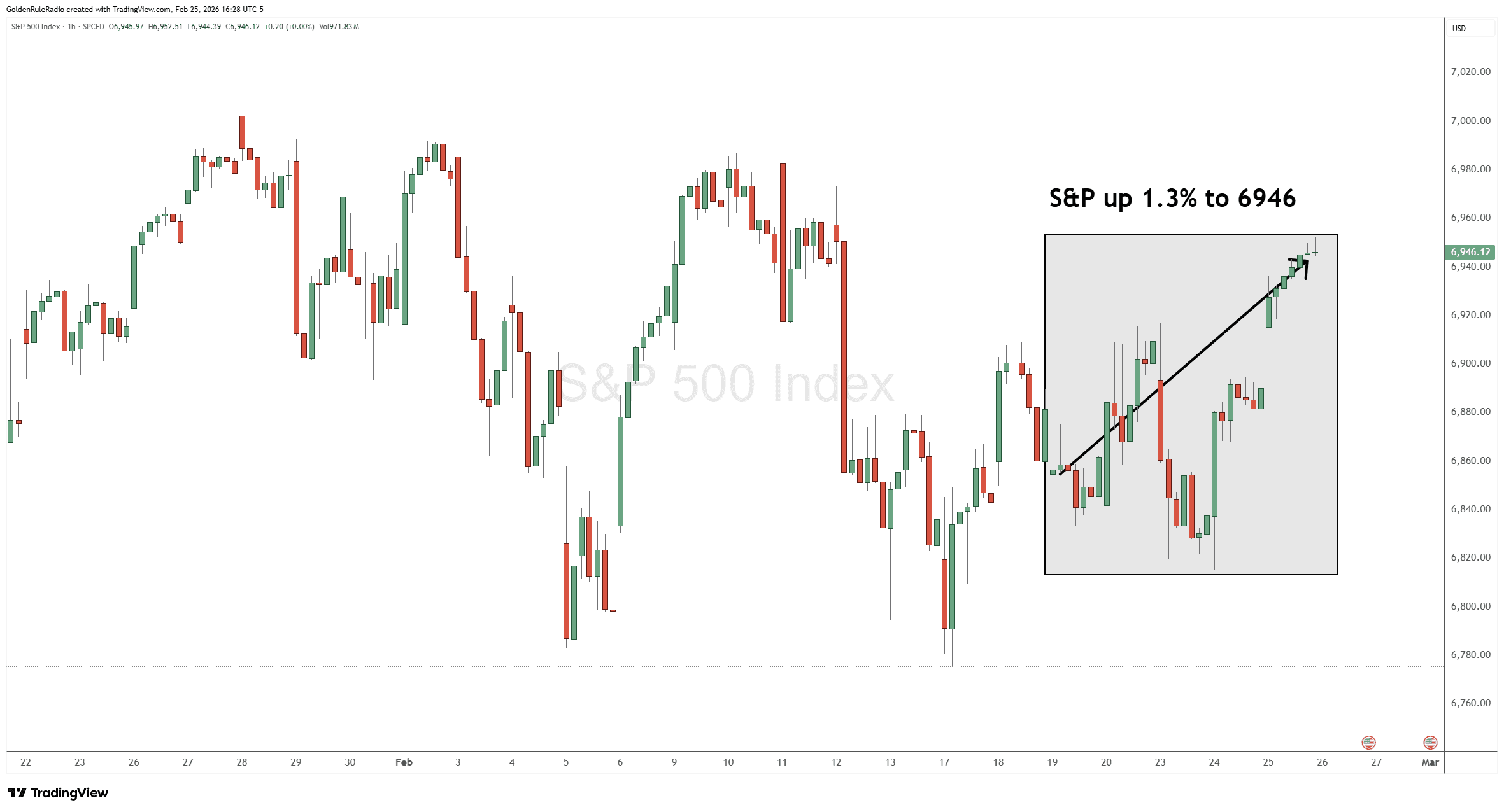 The US dollar index is dead even at 97 from a week ago.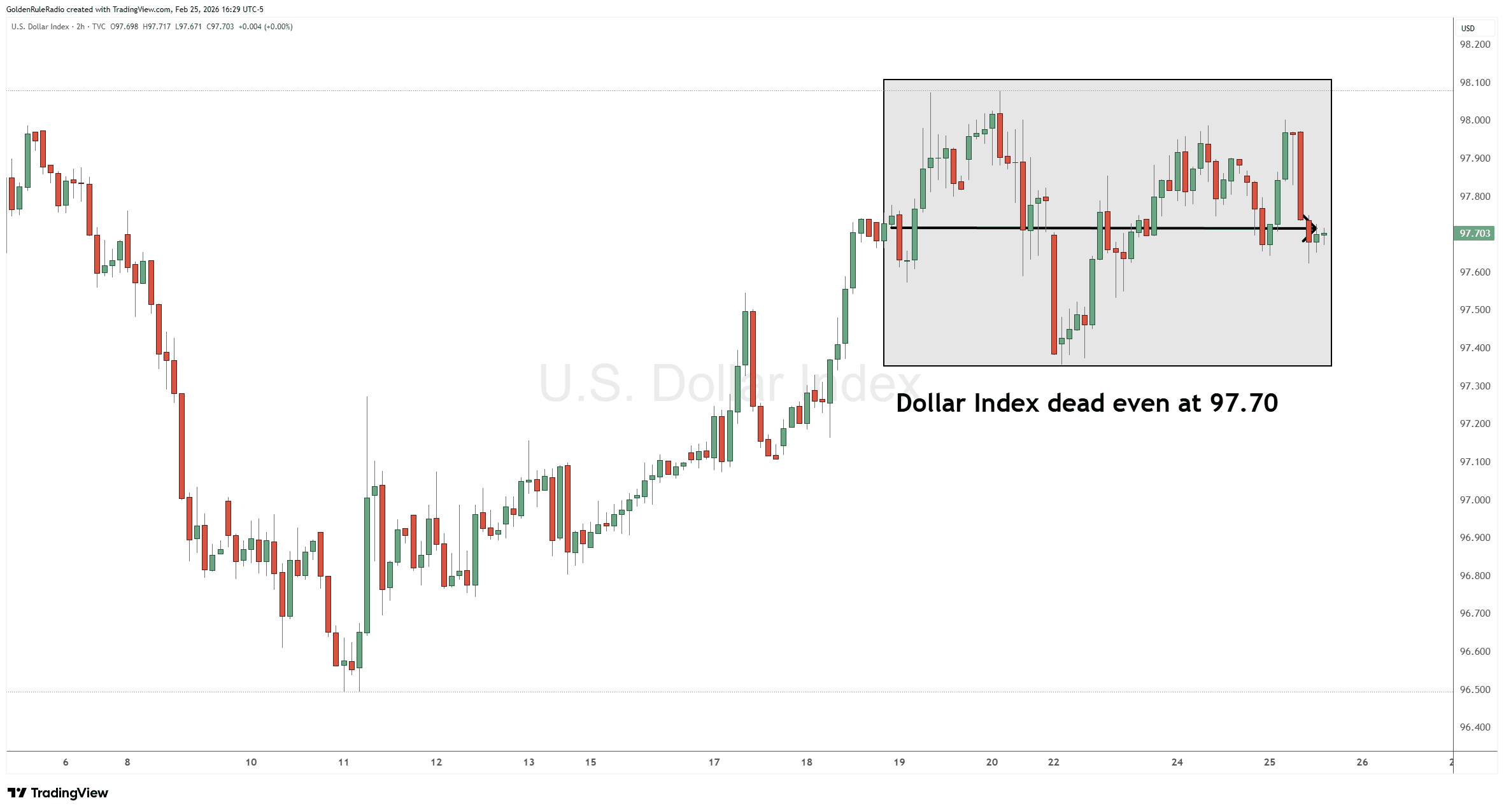

Thursday, January 19, 2023 – 4:00pm Eastern / 2:00pm Mountain


Stay connected to market trends with personalized weekly insights — custom to you!