

Podcast: Play in new window
Gold and silver took a much‑needed break this week. Beneath the quieter price action, the big themes haven’t changed at all: volatility in silver, strong underlying demand for gold, shifting macro and geopolitical risk, and increasingly fragile alternatives in stocks and crypto.
Let’s take a look at where prices stand as of Wednesday, February 18:
The price of gold is down about 1.7% sitting at $4,985 as of our recording.
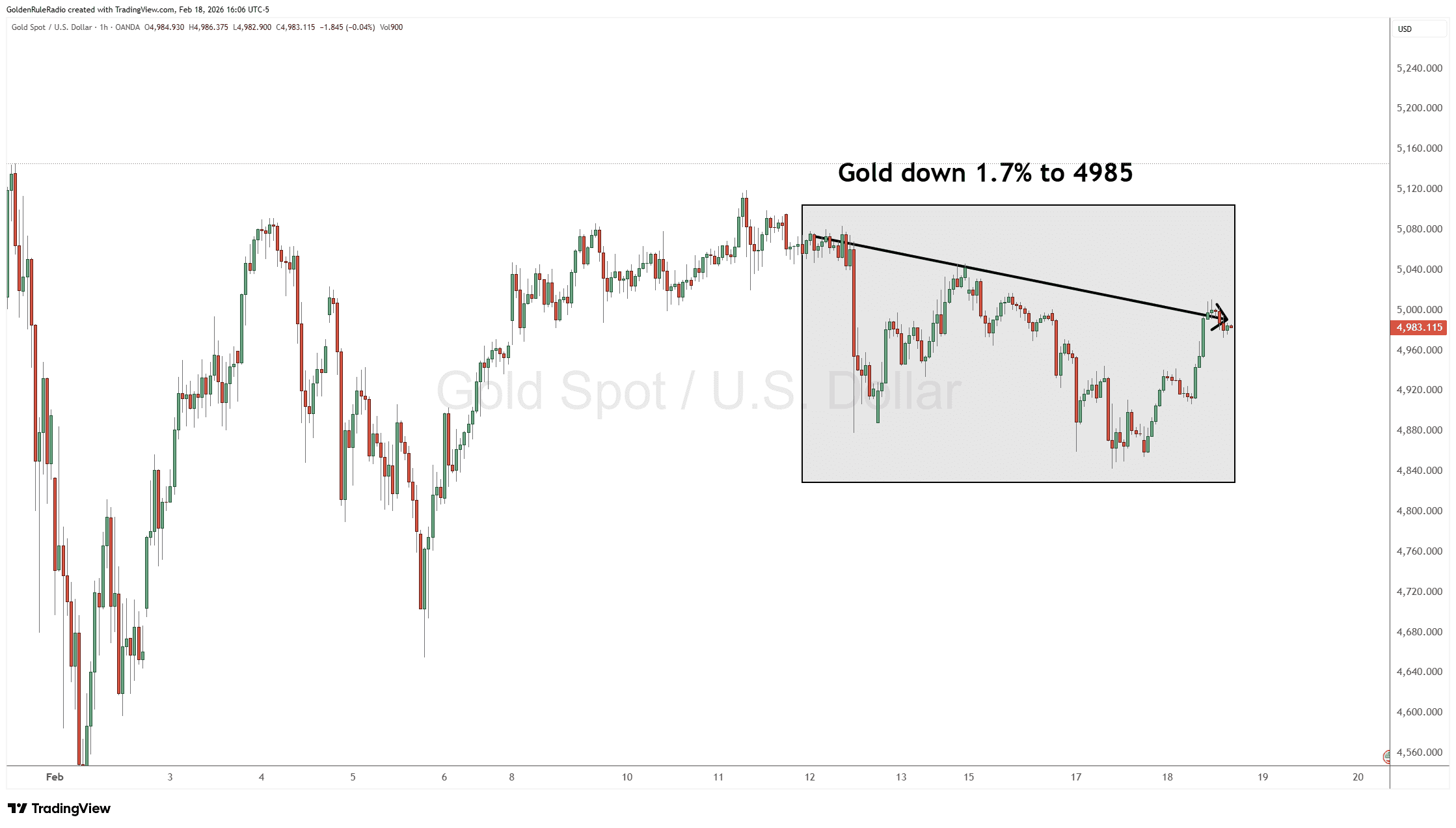
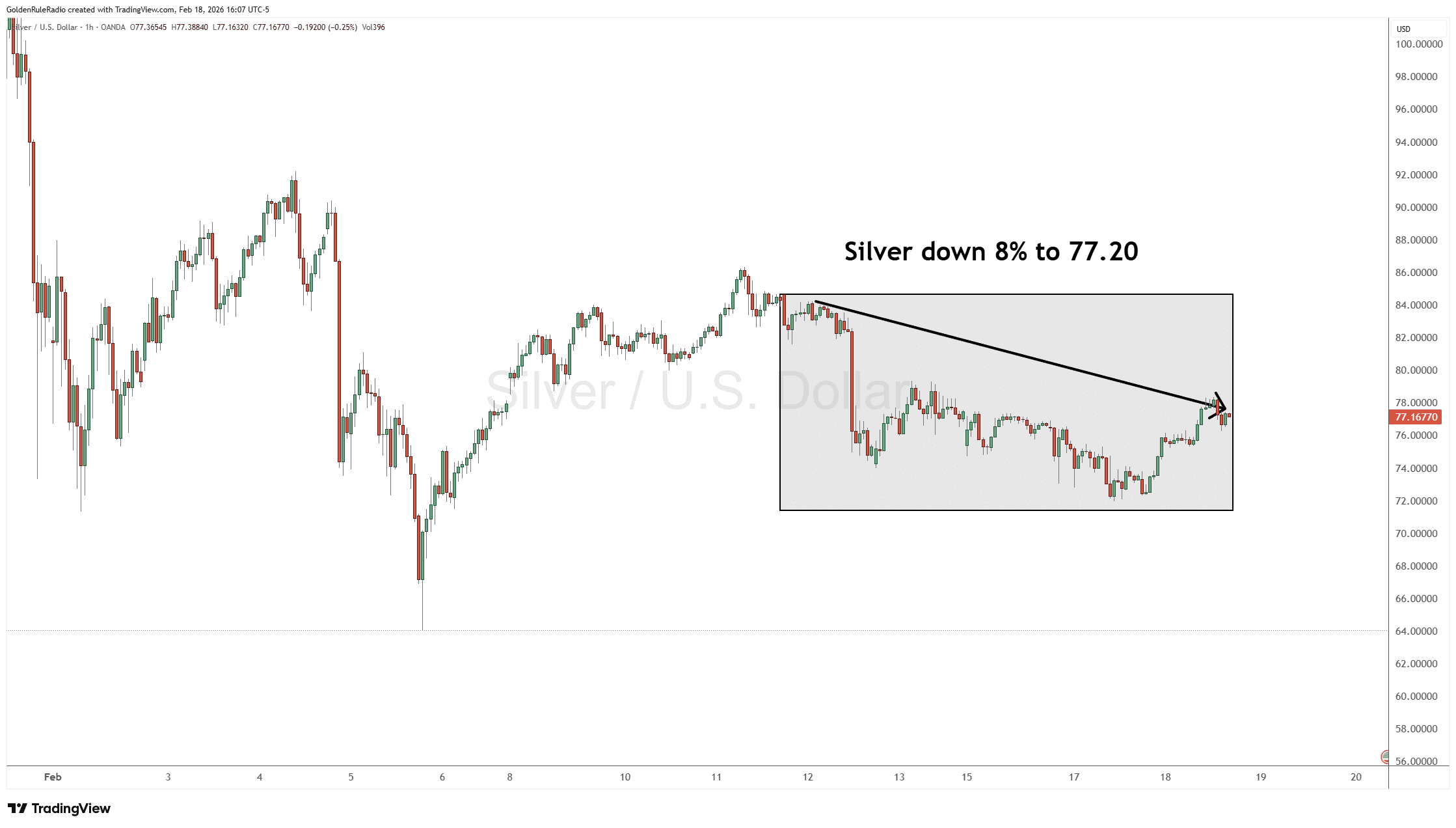
Silver is down about 8% this week, sitting at $77.20. Gold’s sister metal is right in the middle of its trading range.
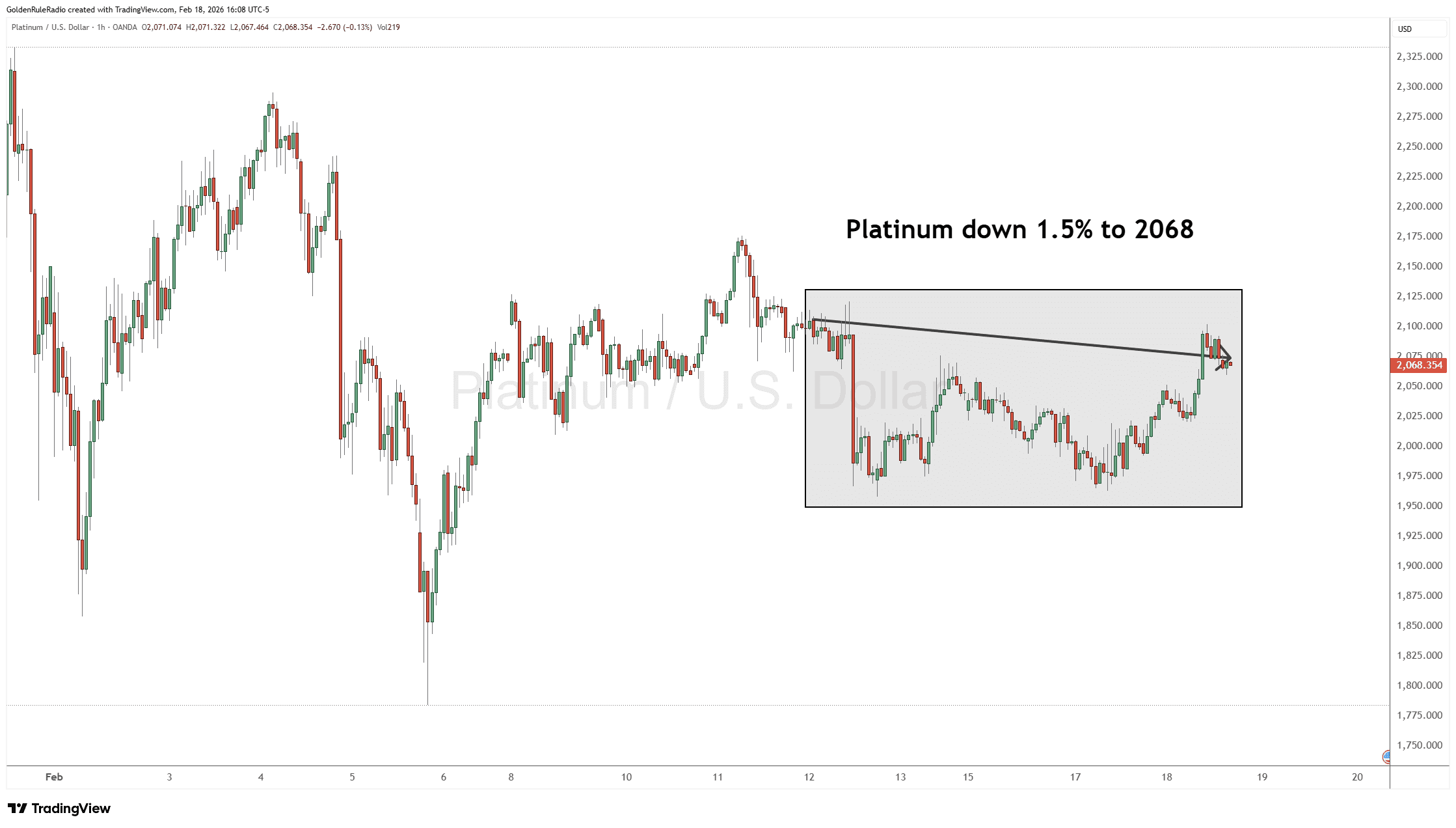
Platinum is down about 1.5% sitting at $2068 — and still holding above that $2000 mark.
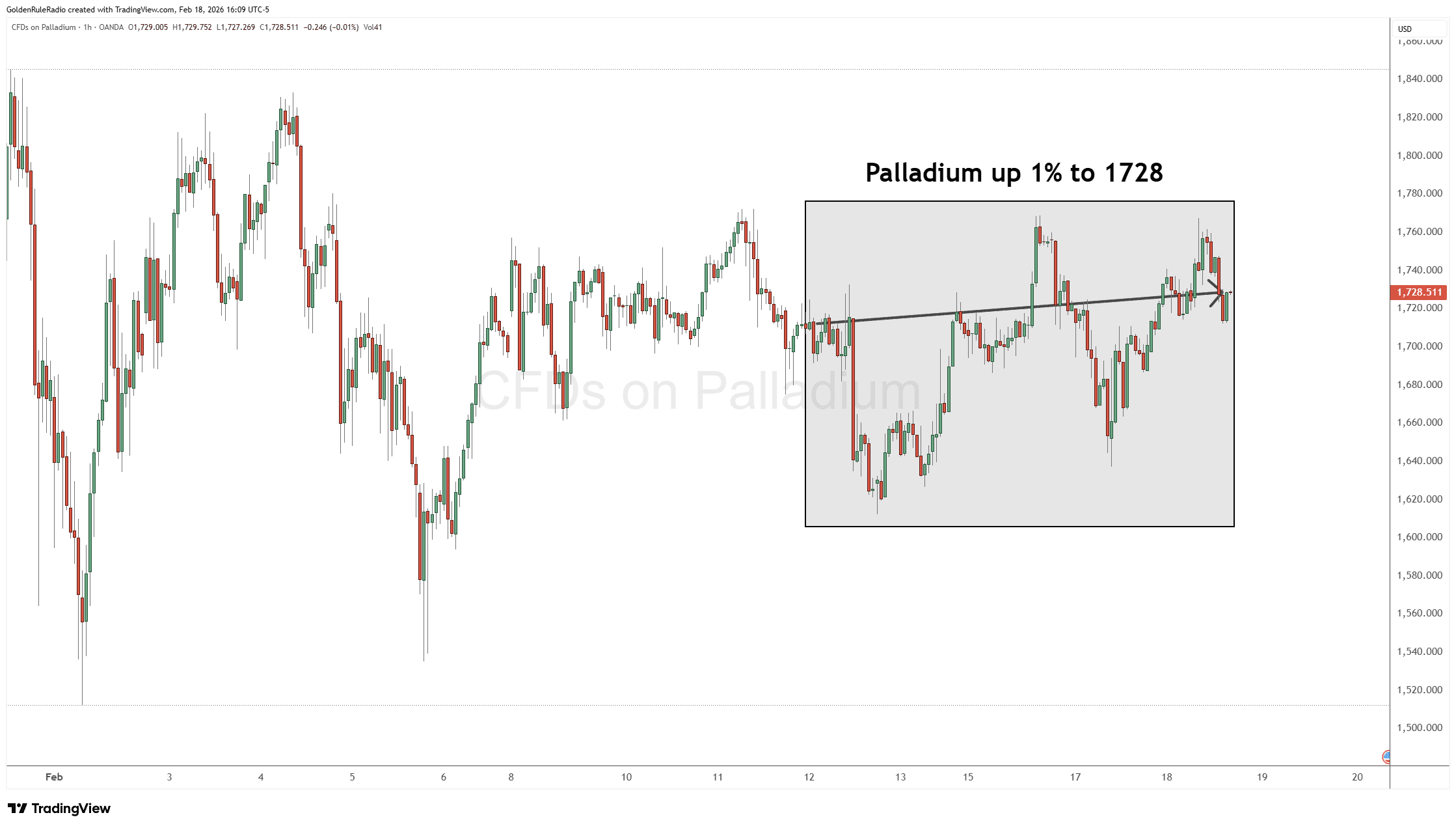
Meanwhile, palladium is actually up 1%, sitting at $1,728.
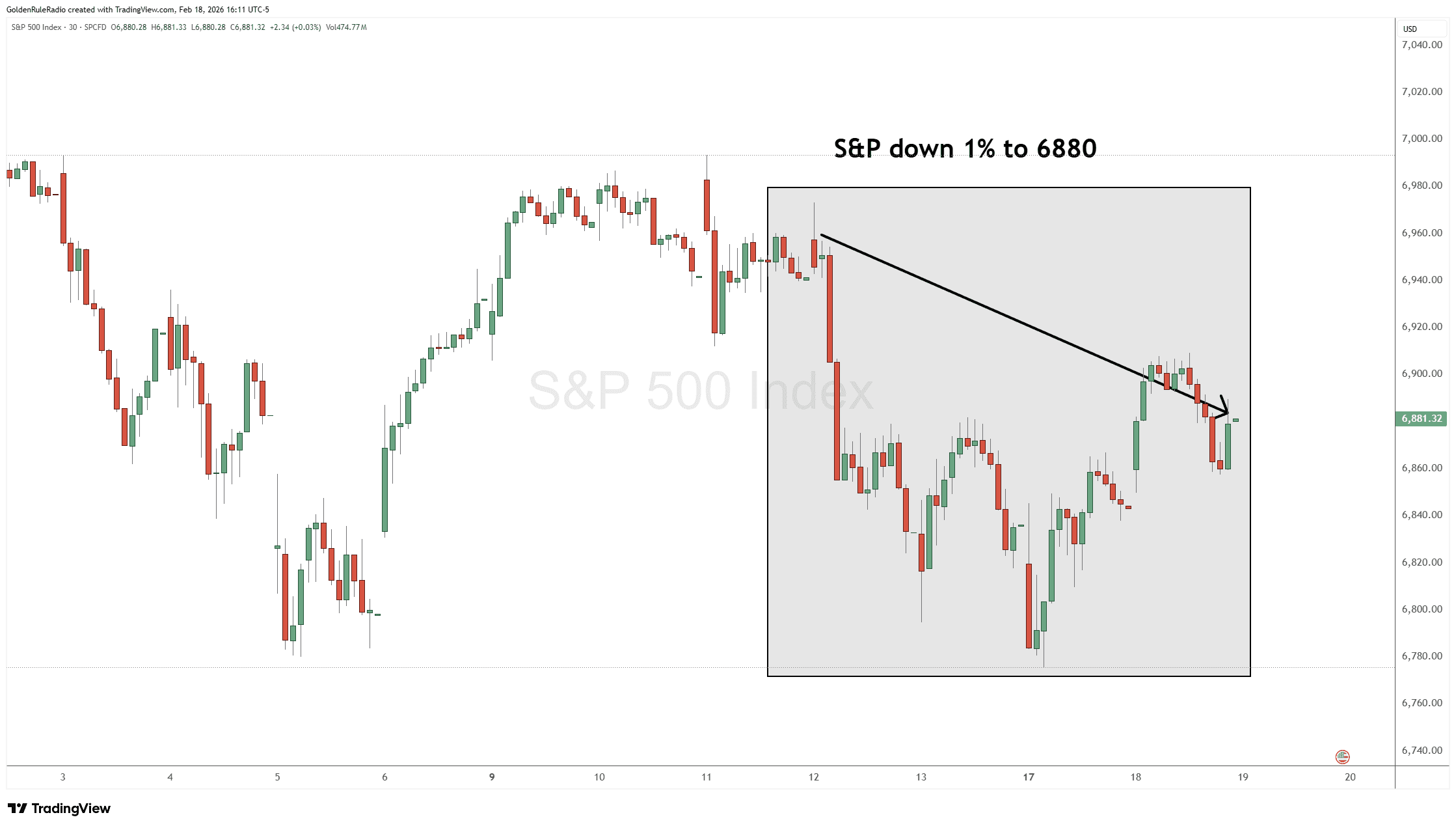
Looking over at the paper markets, which all seem to be rolling over except for the Dow transports…
The S&P 500 is down about 1% to 6,880.
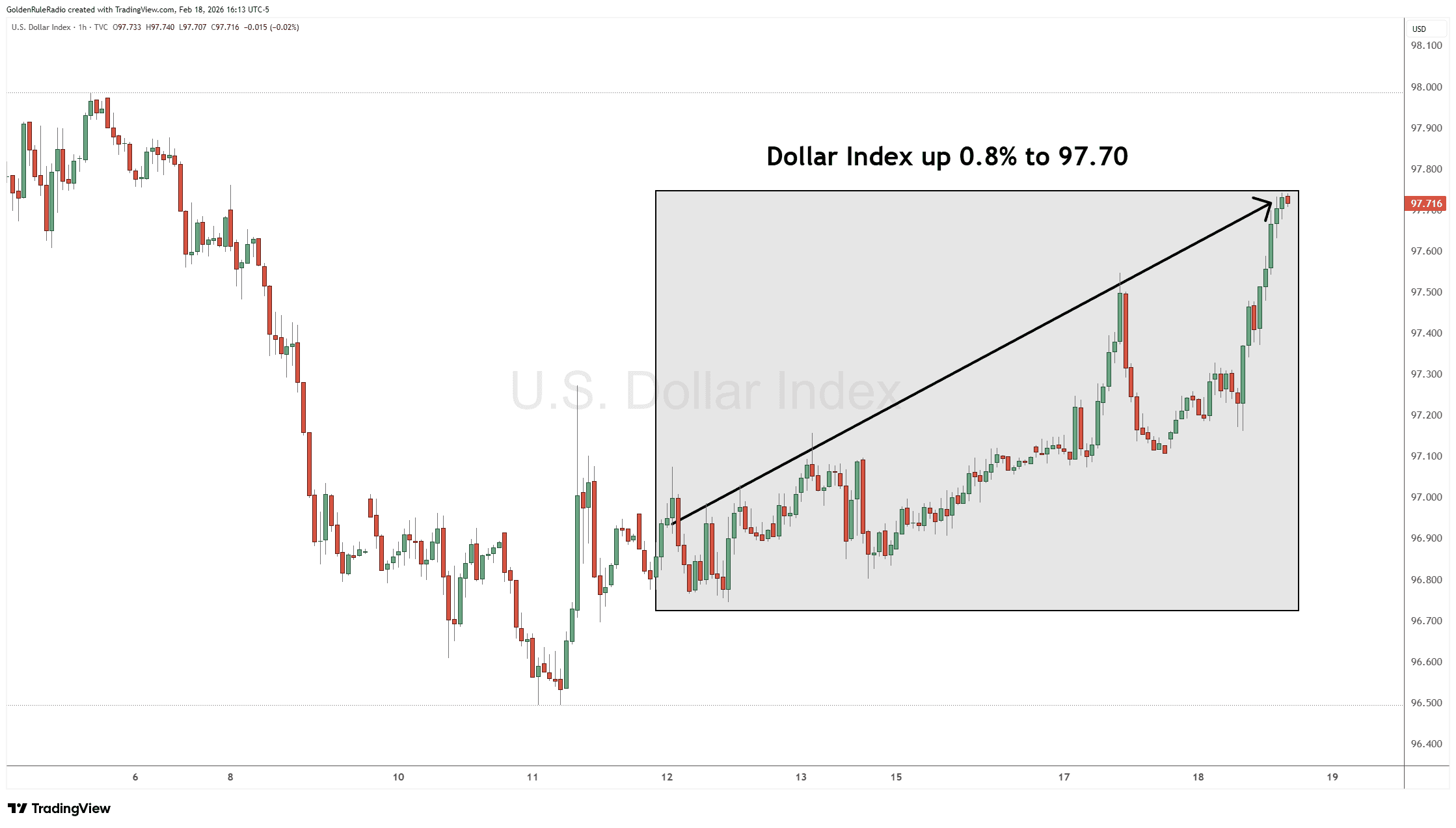
The US dollar index is up 0.8%, sitting at $97.70.
This is the sort of “rest phase” you actually want: prices cooling, moving averages catching up, and the market digesting the massive moves from late 2025 and early 2026 rather than blowing off into an unhealthy spike.
China’s Role in Silver’s Wide Trading Range
Silver’s headline 8% weekly drop looks dramatic, but on today’s chart it’s the “new normal.”
Recent price action has carved out an enormous range, with $67 on the low side and $90–$91 on the high side, and a more realistic working band around $70–$86.
Technically, a sustained break above the low‑$80s could set up a new stair‑step higher‑high/higher‑low pattern, while a slide toward the low‑$60s would signal a downside breakout from the current range.
Much of the demand that drove silver higher came from China, yet markets are now in the middle of Chinese New Year, which temporarily mutes physical buying. The recent air pocket in silver was amplified when Chinese authorities abruptly shut down speculative trading, followed by CME margin changes—events that yanked “every ship” in the market first one direction, then the other. Even priced in yuan, silver saw a brutal initial drop of about 41%, later recovering part of that move but still sitting roughly 30% below its peak before stabilizing in the mid‑range.
The key takeaway is to expect continued volatility in silver until the market chooses a direction and new momentum builds—likely catalyzed by China reopening post‑holiday and policy decisions on speculative flows.
Geopolitics and the Case for a Gold “Plateau”
Gold’s resilience near record levels is increasingly tied to geopolitics rather than just interest rates and the dollar.
The U.S. continues to build a naval and military “armada” around Iran. Any misstep that leads to open conflict would almost certainly fuel further strength in gold, as crude oil has already signaled by “screaming” higher.
At the same time, we’re hoping to see a consolidation phase: a multi‑month plateau where both gold and silver trade sideways, moving averages catch up, and a new base is built for the next leg higher, potentially into the fall. Because the ideal environment for long‑term metals buyers is not a parabolic blow‑off, but a grinding, “healthy” market that alternates effort with rest.
This lets you accumulate ounces and prepare for the next geopolitical or monetary shock — which is bound to happen.
Policy, Debt, and Why Gold Remains Core
The U.S. spends more than it takes in every year and covers the gap with borrowing and currency creation, which structurally pushes the price of “everything real” higher over time.
Even under a “restrictive” Fed, the U.S. has added roughly 2 trillion to the national debt recently, and the likely addition of a more growth‑friendly Fed governor supportive of the current administration’s push for a weaker dollar suggests larger deficits and higher long‑term inflation.
Investor appetite for Treasurys appears to be waning compared with a decade ago, raising the odds that the Fed will have to absorb more issuance onto its own balance sheet in the next cycle.
Within that backdrop, gold remains positioned as:
- An insurance against leveraged real estate, aggressive stock portfolios, and fiscal experimentation.
- A legacy asset—a box of real, tangible value you can hand to children and grandchildren without relying on any counterparty.
- A core one‑third of a “triangle” portfolio (growth assets, cash/fixed income, and physical metals) rather than a small, speculative side bet.
While tactical ratio trades are useful “sizzle,” the “steak” is long‑term wealth preservation in a world where the currency is managed for political goals, not stability.
Cracks in Stocks and Crypto
Tech‑heavy indices like the Nasdaq are starting to weaken after years of AI‑ and crypto‑driven hype, even as Dow Transports and Industrials surge—suggesting sector rotation rather than broad market strength.
This divergence, combined with the fact that gold has more than quadrupled since its 2015 lows while equities show topping behavior, raises concern that we may be closer to a major equity adjustment than many assume.
Bitcoin and Ethereum, meanwhile, appear to have topped for now, with prices rolling over and momentum clearly fading after their latest manic run.
Crypto may be a useful platform for a small set of global users (e.g., the frequent traveler who converts crypto into local currency on demand), but it has never functioned as a reliable, stable currency replacement. Gold, by contrast, is not a speculative technology play; it is an unleveraged, physical, Tier‑1 reserve asset that has navigated every monetary regime in modern history.
This reinforces the big picture: use periods of calm or pullback in gold and silver to quietly add ounces, keep an eye on silver’s wide trading band and the gold–silver ratio for future swaps, and remember that your primary objective is not to out‑guess every headline—but to own real money through a cycle where debt, deficits, and geopolitical risk continue to rise.
Your Next Precious Metals Move
Need advice on your best next move for your precious metals portfolio? The team at McAlvany Precious Metals has a collective 75 years experience investing in the precious metals market. We are happy to speak with you about your goals on a no-obligation, complimentary consultation. Reach out to us at 800-525-9556.