
Grand Global Economic Reordering?
The most important factor determining the fate of asset prices across the board in the very short-term is greater clarity on the outcome of events in the Middle East, as HAI sees it. That means that unless one knows the detailed inner dealings of all sides involved in the conflict, this is, in the immediate term, a wait-and-watch-closely moment.
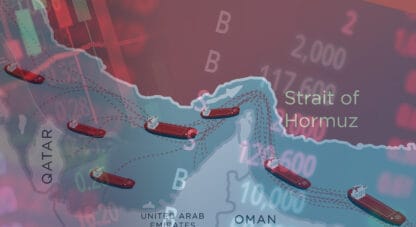
At present, we have a very tentative ceasefire in place, and we have expectations that official discussions toward a potential negotiated settlement will commence this weekend. In the meantime, the Strait of Hormuz remains effectively shut, and it remains in Iranian control.
At the same time, global energy and other critical supply chains remain deeply compromised. The clock continues to tick steadily toward the moment when those critical global supply chain crises erupt into a full-on global financial/humanitarian crisis.
If the conflict is resolved quickly and the Strait is immediately reopened, we are looking at manageable complications. If not, the longer the Strait remains closed, the more like the Covid era the draconian global ramifications will likely become.
While we await greater clarity on both the extent of further conflict (or peace) and a timeline for reopening of the Strait of Hormuz, HAI aims to step back this week, widen the lens, and speculate a bit on how current events may fit within a larger context.
This week, macro strategist at Bloomberg Simon White wrote what HAI believes may well come to be remembered as an important article marking the unofficial end of the singularly dominant, unipolar era of the global dollar system.
As White explained;
“Dollar-denominated reserves—i.e. central bank holdings—adjusted for valuation effects are now lower than gold reserves for the first time since the International Monetary Fund started publishing the data…
“The market has re-alighted on the age-old solution of gold as unimpeachable global collateral —to the detriment of the US currency—after growing distrust in the dollar standard and a lack of viable alternatives to assets separate from the financial system.
“However, there’s a much deeper and long-lasting issue. The quid pro quo that forms the backbone of the global monetary system—that trade proceeds are recycled into dollar assets, allowing the US to fund cheaply, in return for security guarantees and the stability of the global system—can no longer be taken as read.
“Normally we would expect that as the Strait of Hormuz is fully re-opened, dollars should eventually flow back to oil exporters, who in turn should buy Treasuries or other US assets. Similarly, as oil prices normalize and importers get back on their feet, they’ll eventually have surplus dollars to reinvest in the US. That can no longer be assumed, though.
“But it’s more critical than that. If the US is no longer seen as a reliable guarantor of stability and security, then there is a diminishing incentive to trade in dollars and recycle them back into the US. The dollar carousel that has underpinned the global monetary system is coming under increasingly grave strain.
“Common knowledge is often what it takes to upset accepted norms and overturn ingrained thinking patterns… Everyone now knows that everyone knows the rules of the game have changed.
“Owning fewer dollar assets becomes increasingly logical. Now that it is common knowledge, it’s hard not to see the dollar’s dominance continuing to ebb away over time, and gold’s fortunes further revived.”
This article followed the article HAI discussed last week titled, “Iran War Could Be Making of the Petroyuan, Deutsche Bank Says.” In discussing the earlier article, HAI made the clear case that the petroyuan system, through the Shanghai Gold Exchange International, is essentially an up-and-coming China-sanctioned gold-for-oil system.
HAI‘s point is that the global petrodollar system has been the accepted norm for over five decades. That petrodollar system has been eroding since 2008 (and at a highly accelerated pace since the dollar was weaponized in 2022), but that erosion has not been widely acknowledged or marked to market—yet.
The petrodollar system is the “ingrained thinking.” It is the accepted system under which all assets (U.S. debt, the U.S. dollar, U.S. stocks, commodities, and gold) have all been—and are still—priced.
The second derivative to a growing acknowledgement of a breakdown in the petrodollar system and a rise in a petroyuan (gold-for-oil system) is a major repricing of assets. One in which, as Simon White says, gold’s fortunes would be “further revived.”
Now, if Iran doesn’t suddenly relent, lay down arms, and give up control of Hormuz, then, unless the U.S. wants to go nuclear, or wants to risk putting troops on the ground—the U.S. will have to negotiate an end to this conflict.
And if HAI is allowed to be wildly speculative, that negotiation offers a potential opportunity.
It’s a long-held HAI view that a central tenet of Trump’s MAGA initiative is to reshore the U.S. manufacturing base as a vital national security imperative. This administration has made clear on many occasions that it absolutely understands Triffin’s Dilemma. The dark side of global dollar/Treasury reserve status under the petrodollar system is killing the U.S.
The Trump administration believes that it is the structure of the post-1971 dollar-centric petrodollar global monetary regime (with the dollar as reserve currency and U.S. Treasuries as primary global reserve asset) that is largely the cause of the perpetually overvalued dollar, which is ultimately too strong for U.S. manufacturing to be competitive.
Recall the words of Secretary of State Marco Rubio when he said in January of 2025 that, “If we stay on the road we’re on right now, in less than 10 years virtually everything that matters to us in life will depend on whether China allows us to have it or not.”
Importantly, this administration appears to believe that in order to reset onto a sustainable economic course and revitalize the U.S. manufacturing base, the U.S. dollar will have to be significantly weakened structurally. As a result, the post-1971 dollar-centric global monetary regime will have to be altered.
Now, while Simon White and Deutsche Bank may be heralding the pending demise of the petrodollar system, it’s not yet happening fast enough to dramatically weaken the dollar and effectively revitalize U.S. manufacturing.
A potential global deal to restructure the global system, weaken the dollar, and effect a wholesale re-industrialization of the U.S. manufacturing base has been referred to by the Trump administration as the Mar-a-Lago Accord.
At the Manhattan Institute in June of 2024, now-Treasury Secretary Scott Bessent said, “I could see in the next few years that we are going to have some kind of a grand global economic reordering, something on the equivalent of a new Bretton Woods. There’s a very good chance that we are going to have to have that over the next four years, and I’d like to be a part of it.”
On the eve of expected peace negotiations between the U.S. and Iran (and by extension Iran’s backers China and Russia), HAI is wondering whether the U.S. will utilize these negotiations to facilitate a “Mar-a-Lago Accord” to secure the very “grand global economic reordering” Bessent referenced in June of 2024?
It even seems possible that catalyzing an intently sought-after “grand global economic reordering” might have been at least a partial goal of the U.S. engagement with Iran and its de facto backers (China and Russia) in the first place.
Time will soon tell, but to HAI it’s an open question as to whether or not the U.S. and Iran (plus China and Russia) talks will ultimately result in a mutually agreeable global monetary regime change that constitutes an important win/win.
In 2022, referring to the Russia/Ukraine war, former Credit Suisse Managing Director, Zoltan Pozsar, famously said, “when this war is over, money will never be the same.” In hindsight, Pozsar was half right. The Russia/Ukraine war (with the freezing of Russian dollar FX reserves) dramatically accelerated the breakdown of the petrodollar system. In HAI‘s view, however, what started in 2022 is much more likely to be finished and fully acknowledged in the wake of the Iran conflict in 2026. It is after this Iran war that “money will never be the same.”
And in a new, post-petrodollar-dominant world, HAI wholeheartedly agrees with Bloomberg’s Simon White: gold’s fortunes will be “further revived.”
Weekly performance: The S&P 500 was up 3.56%. Gold was up 1.59%, silver gained by 4.01%, platinum was up 3.64%, and palladium gained 2.02%. The HUI gold miners index was up 4.59%. The IFRA iShares US Infrastructure ETF was up 3.64%. Energy commodities were volatile and lower on the week. WTI crude oil was slammed by 14.26%, while natural gas lost 5.33%. The CRB Commodity Index was off 3.08%. Copper was up 5.16%. The Dow Jones US Specialty Real Estate Investment Trust Index gained 3.31%. The Vanguard Utilities ETF was up 1.37%. The dollar index was off 1.33% to close the week at 98.70. The yield on the 10-yr U.S. Treasury was up 3 bps on the week, closing at 4.34%.
Have a wonderful weekend!
Morgan Lewis
Investment Strategist & Co-Portfolio Manager
MWM LLC