

Podcast: Play in new window
- Private Equity & Private Credit: The Doomed Darlings Of Wall Street
- Wall Street Losing Appetite For Gold – Smart Investors Buying
- Watch Dow/Gold Ratio For Best Timing
“I am bullish. And as agnostics in the markets, we can be bullish on just about anything. It’s just a question of what the value equation is, what the value proposition is. Today, I am bullish on gold. Tomorrow, I am bullish on equities. The unfortunate lack of insight into the relative value between assets is the ultimate—it’s the ultimate—opportunity cost of compounding across generations.” —David McAlvany
* * *
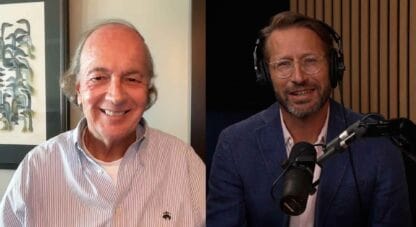
Kevin: Welcome to the McAlvany Weekly Commentary. I’m Kevin Orrick, along with David McAlvany.
David, I’ve known you a long time. I’ve known you 39 years. I think you were 12 when we first started getting to know each other. I was 24, so we were very young, but your dad was a hard and fast gold bug. But every kid has got to go figure things out himself, and sometimes, it’s time not to be a gold bug just so that you can figure it out. So, I would love it if you would just tell that story a little bit.
David: Well, men can have complicated relationships with their fathers. I can certainly speak for myself on that one.
Kevin: You love him to death, but yes, it’s complicated.
David: Absolutely. And the move to Morgan Stanley in 2000 was definitely another expression of doing it my way. And I was there for a short period of time before one of the old codgers—very fascinating guy, concert violinist, technical analyst, didn’t really care about his book of business in the sense that productivity was not why he was there— He loved the art of the chart. He loved the art of the tune. And he showed me one day a chart of the oil markets. And he said, “You get these secular trends, you play the secular trends on a long-term basis. Your clients thank you.” It’s the old school way.
It’s not the way Wall Street is heading any more towards assets under management and delegated responsibilities. But I built this book. When I move, I move en masse and we stay for a long, long time. Oil will not return to a sub $11, $12 barrel for a long, long time. I’m long oil.
Kevin: Boy, that’s long ago.
David: We looked at that. We looked at gold. And that was the first time I started thinking about gold in a different light, as entering into a secular trend. And I’d been dismissive of the metal, thinking of the metal like my dad, like a broken clock right twice a day. And again, overly dismissive, not looking at its merits, not understanding its role, its monetary history, and what it represents as a sort of a counterbalance to risk in a portfolio. And so, I started buying my first ounces with the Dow/gold ratio at 40 to one.
Kevin: I remember you called in from California. You were there at the stock brokerage, and you said, “I want to buy some gold.”
David: And shortly thereafter, we had the CFO from General Electric come to the Ritz-Carlton. Pasadena, California is where a lot of blue blood money is in the country, old industrial money that wanted to retire in warmer climes, big shareholders. And—
Kevin: Of General Electric especially.
David: Exactly. So, I looked and I saw the ratio, not the Dow/gold ratio, but if you picked one company, this is why I was thinking about GE at the time. In addition to him being there, GE’s the only original Dow component—was at the time—
Kevin: Went back to 1896. Yeah.
David: —in existence. So, looking at the sort of proxy for the market relative to gold, and seeing that GE was at the end of a long-term secular trend, bullish trend going into a bear market. And gold appeared again by the charts, and again, just following the man with the fiddle, there was something happening in the hard asset space there in the early 2000s.
Kevin: And the Dow/gold ratio at that time was over 40 to one, wasn’t it?
David: Right. It hit a peak of 43 and I think upper 30s, low 40s is where I started buying gold. And that is a secular trend that will work it’s way through to completion. And then on the other side, guess what time it will be? It’ll be time to look at General Electric. It’ll be time to look at a whole host of things that, having finished their relative bear and maybe even a nominal bear too, we will get the opportunity to compound off of low basis.
Kevin: So, let’s put that in perspective. 25 years ago when we’re talking, it was 42 to one, 43 to one—the Dow/gold ratio—fell to 30, fell to 20, fell to 10. We’re at 10 at this point. What you’re saying is, if it plays out the typical cycle on the Dow/gold ratio where it comes down to one or two or three to one, you’re definitely a buyer of stocks.
David: And I would say that because I have an over-allocation to gold, by choice, gladly, but somewhat uncomfortably because of the scale, I will probably start and exit at five to one because of my over allocation. If you’re not as heavy on the metal side as I am, maybe you wait around for a three or two or one, but I’ll begin the process early. I don’t need the last dollar. I don’t need the last couple percentage points move higher. Those last couple percentage points higher, of course, when you start looking at the math it’s actually quite dramatic, but leave something on the table for someone else.
Kevin: Well, and the markets that you came out of, the Morgan Stanley markets, a lot of times these guys chase momentum. They don’t really look at what they’re buying. And, well, over the last few months they’ve lost interest in gold again because the momentum’s out of it.
David: Yeah. Money managers’ net positioning, accounting for the longs and the shorts on a net basis. It remains below its March 17th corrective lows according to Stonex. The current positioning at 1,830 tons is less than half of its 12-month average of 4,126 tons. So, froth and exuberance are out of the market. When markets get overbought, they do tend to tempt fate with a correction, inviting sellers to take gains. Just basic supply and demand. If you’ve got more sellers than buyers, pricing is to the downside. More buyers than sellers, prices go up.
So, we have had in the last three, four weeks as we’ve been involved in the Mideast, dollar strength and an increase in interest rates in the conflict with Iran. That has added to the metal selloff. A dynamic that’s rather mechanical with daily currency and interest rate volatility either buoying the prices or smashing them from one day to the next.
Kevin: Okay. So, going back to the Wall Street mindset, which is, oh, just buy stocks and hold for the long run. Last night, most of the listeners know that on Monday nights we meet. And I was just sitting there alone, Dave, and I forgive you because I know whatever it was was very important, but I was just sitting there. It’s 10 after five, quarter after five. And I’m telling the folks at the restaurant, it might just be me tonight. I don’t know if Dave’s out of town or not. And then I get a text saying that you’re on your way over, but you came in, now you ride a Ducati. Okay? And I hope that you ride it carefully, but you look like you were—
David: Very carefully.
Kevin: Yeah, but you look like you came in pretty angry last night. So, I think it might be worth telling the listeners why your eyeballs were popping out as you took your motorcycle helmet off.
David: Well, yesterday I endured an endowment investment committee meeting for an institution I’ve advised for 20 years now. It was a fascinating picture of naivete and bias driven by all -too-conventional thinking. A part of the presentation was a dozen slides used to illustrate how irrelevant gold is in an investment portfolio.
Kevin: I’m sure that made you happy.
David: Conclusions included: “Better diversifiers exist. Performance has been lackluster over the periods chosen for the illustration. Volatility argues against it as a hedge. Benefits are too temporary for pensions and endowments to benefit from ownership. And a broad base of commodities is preferred to precious metals specifically,” although no allocations to a broader base of commodities have been or were recommended then, never been strongly advocated.
Kevin: So, I just want to remind the listener that you are saying what they said, not what you’re saying.
David: That’s right.
Kevin: And you were aggravated.
David: They went on to say, “Gold yield’s nothing.” States the obvious. “Therefore, it represents opportunity cost and a drag on portfolio performance. Central bank buying and influence on the price has been negligible,” factually inaccurate, but that’s okay. This is how they carried on.
Kevin: Part of the presentation.
David: “Chinese buying as a percentage of currency reserves is most unimpressive.”The grand conclusion, “the top is in, our condolence to the suckers that are missing the bull market in equities, the bull market in private credit, the bull market in alternative investments.” They actually said, and I couldn’t help but interrupt when they said that private credit, hedge funds, and they did include other commodities, were a superior tool for risk management and diversification.
Kevin: Oh, you got to love that. Private credit, which is coming unfurled right now, is a better hedge than, say, gold.
David: No comments in the context of the hour-long presentation—not a single comment—on the cracks in private credit. No comments on dedollarization or monetary regime change. No comments on stock market valuations, just that the largest pensions and endowments allocate far more to illiquid alternatives like private equity and private credit, implying that a gradual increase to those exposures are really what the best and brightest are doing.
Kevin: Did they even talk about how you can’t get your money out of private?
David: No comments on [unclear].
Kevin: Private credit right now?
David: No comments on redemption caps. Current university endowments are selling their alts, but that didn’t make the comment list. Plenty of comments on Trump-induced volatility from Liberation Day to Mideast adventurism. Plenty of dismissive remarks with an attitude of “these markets are incredibly complex, can never be timed, and therefore, we stay the course and let the benefits of risk assets come to you.”
Kevin: Well, let me ask you though, have these guys ever recommended gold? I mean, gold’s up four- or five-fold over the last, what, five years?
David: Yeah. What was not said? Yeah. We’ve never recommended gold. Our portfolios have not benefited from the move off the 2015 lows at 1,050 to recent highs over 5,000. They had some implicit admissions. “What is the Dow/gold ratio? Nominal stock performance has no competition, except if you’re talking about private equity or private debt, which may be underperforming for the last three to five years, but that means the opportunities in those markets are waiting for us to bend over and pick them up.” Well, I can at least agree with the part on bending over.
Kevin: You can fill in the blank yourself, but I know you did have an outburst. There was one outburst.
David: It was on the comments that hedge funds and private equity are better risk diversifiers than gold. I took myself off mute and I just said, “wait a minute, wait a minute. A better risk diversifier. You’re talking about a higher beta leveraged play in the same asset, and that’s a better risk diversifier.” “Well, we’re really talking about the merits of diversification, so a broader selection of commodities and private equity— And yes, all of those offer greater diversification.”
Kevin: They know the smooth things to say, and maybe it’s just comfort that everybody’s looking for.
David: I realized that the whole presentation was no different than hundreds that I’ve heard from retail financial advisors spouting their platitudes and sort of Yogi Berra folksy expressions that buttress their conventional wisdom and ultimately serve the purpose of—what are they in the business of? That’s right. People management.
Kevin: Entertainment.
David: The takeaway, even at an institutional level: people management is more important than money management. You can’t time the markets, you can’t beat the markets. We’ve got the efficient market hypothesis that tells us such. These guys are way up the pay scale and with far better presentation skills than the average financial advisor, but they’re not money managers. I mean, we’re talking about a firm with over $750 billion in assets.
Kevin: Three quarters of a trillion dollars.
David: And all you get is a few index funds to grab average equity performance and a few hard-to-access private offerings, “which we are lucky to have access to because the minimums are typically so much higher. But because of the aggregation of assets, because of our institutional clout, these private market offerings are accessible to you.” So the primary selling point? I mean, the bottom line is they offer back office support and tax reporting, which makes the institution’s job easier in the midst of accountability to not really even the investment advisory committee, but to the board.
Kevin: Yeah. Well, the thing is, and we’ve talked about this before, oftentimes people will take their money to somebody who just makes them feel good and does everything for them. So the tax reporting, what have you.
David: The whole conversation was around the complications of the financial market. And when people are not familiar with credit spreads and other particular nuances within the financial markets, it can give you this sense of being overwhelmed. Our view on the Commentary is that we want you to come alongside us and learn to deepen your understanding and knowledge of the financial market.
Kevin: Learn with us.
David: So you can be appraised of market dynamics and make wise decisions. We don’t want you dependent. We want you independent. And yet, again, what was reinforced in this conversation yesterday is that the market complexity is such that you just have to trust us and everything’s fine. We can show you everything’s fine. Here’s the benchmark. Here’s how we’re performing in line, slightly above or slightly below the benchmark. Everything’s fine, let’s move on. Any questions?
Kevin: And when the presentation, let’s now call it a discussion because it was a presentation. When the presentation was over and they were off the line, that’s when you guys as a committee got to discuss. And that was why you were late because you had to stress some of the things that you disagreed with.
David: I raised my hand and then sort of let it rip. Starting with a question.
Kevin: I can see that.
David: I started with a question. “This is a public university. I’m in a safe place, right?”
Kevin: You’re asking them.
David: Yes.
Kevin: Yeah, you’re in a safe—
David: “Can I express myself freely?”
Kevin: I’m sure they went, “Oh, here goes Dave.”
David: Oh yeah, this is a safe place. As long as you acknowledge your white fragility. No, I’m kidding—but not kidding—on that last point. I led with, “That was the most disturbing presentation I’ve heard in 20 years. Where was the discussion of macro factors in play within the market? Where were the questions about anomalous correlations and correlation breakdowns? Where was the observations of risk factors, the gray rhinos or the black swans?” No mention of our fiscal position. No mention of trade policies and dysfunctional imbalances. No mention of hedge funds as the largest holders of government debt. It’s now over 8% of that 31 trillion is sitting as collateral on leveraged bets in the Caymans. You think we can’t have surprises in something as boring as government bonds? Just wait until hedge funds have to reverse their trades.” No mention—
Kevin: The volatility does that.
David: No mention of leverage or leverage upon leverage. I mean, risks were all together, disregarded, minimized and dismissed. No mention of bonds trading in sync with stocks, with greater correlations to a move in the cost of capital.
Kevin: Okay. I want to put this in perspective, though, Dave, because you took no time whatsoever to get over to the restaurant on the Ducati. Okay? And my son took his son, my son and my daughter-in-law, they went to Moab. They had a picture from Arches, and I recognized one of the places that you like to climb. It’s a vertical spire. So when you talk about risk mitigation in your own life, you were mad enough last night. What’d you do? 80 or 90 over to the restaurant?
David: There would be no mention of the speed. No, I wasn’t going that fast.
Kevin: And we’re not in Germany, Dave. Yeah, you can’t go on the Autobahn here.
David: But it makes me think of times that I have sped on the Autobahn in Germany with my father. We’re going 110 miles an hour and we get passed like we’re standing still. Everybody knows that the Autobahn’s road conditions are managed impeccably, with German precision. You take the risk of high speed knowing that debris is regularly cleared, potholes never allowed to develop or remain unfixed. The infrastructure supports the risk. The motorway is engineered to accommodate that rate of travel.
Kevin: Well, and we don’t have that in Durango. I mean, in all seriousness, when you’re on your bike and you’re going fast—
David: I’m very careful.
Kevin: We’ve got I think the highest— Don’t we have the highest percentage of roadkill in all of Colorado?
David: Yeah, I operate by rules. I operate by rules. I don’t travel on a motorcycle before dawn or after dusk.
Kevin: Okay.
David: I travel to and from the office on roads that are not heavily trafficked. And that typically means that I’m going 20 miles an hour.
Kevin: Well, and all joking aside, you are safe. Yeah, you’ve got a family.
David: Yeah. And as I’ve always told the family, you dress for the slide, not the ride. So I don’t look fashionable on a bike. I always assume the worst, with the assumption that everyone’s trying to kill me.
Kevin: I’m thinking of Anchorman. Anchorman had many leather-bound volumes of books. Remember that? Yeah. You have many leather-bound outfits that you wear. You show up in as much leather as you can.
David: Let’s not talk about my leather pants.
Kevin: Yeah.
David: All right. No, the presentation, what it ignored, it ignored the infrastructure failures. It ignored the gaping potholes in the market today. The debris strewn around every bend in the investment road. And they just said, “Go faster.” The vehicle is capable of higher speeds. Test the next gear, the thrill of returns regardless of risk, whatever the risk may be over the next rise in the road. Everyone else is traveling at this speed.
Your peers are increasing velocity, and if you’re not careful, they will leave you behind. You cannot afford to underperform. And that is a true risk for anyone who’s managing people, not money, is that you underperform the market and get fired because you didn’t bring in enough returns. That is a greater professional risk for the money manager. And again, I would say these are not money managers, these are asset allocators and people managers. And it’s just mind-boggling to me that they can get away with the simplicity of the portfolio they have—not simplicity in a good way—the simplistic nature of a few ETFs and a few private market offerings that are hard to access.
Kevin: Well, it’s basically programmed for perfection. You can’t have anything go wrong at these speeds.
David: Yeah. So what is around the next bend? What is around the next rise, or over the next rise? As the sun sets on a period of record performance, and we surpass previous equity market peaks, shouldn’t we—shouldn’t we—be mindful of the waning visibility at dusk? You can’t see as clearly, maybe that’s an admission of my age, but you can’t see as clearly at dusk.
Animals are beginning their daily migrations across the motorway. This is deer and donkeys and rabbits and raccoons, maybe even black swans and gray rhinos. Should we maintain top speed as the conditions change or are unstable? Everyone else in the convoy is traveling at the same uniform speed, so why diverge from the trend? That’s really the conclusion we’re left with. “We’re on the side of winning trade. Let’s just keep it going. Would you like to be left behind? Who wants to arrive at the destination late?”
Kevin: One of the things that we’ve asked our clients to ask their own financial advisors is, “Have you actually been through the last crash or the crash before or the crash before?” And Dave, even though you went through a period of time—
David: Another question, I would say, “what do you do to actively respond and mitigate risk under those circumstances? I’d like some examples from 2001. I’d like some examples from 2008. I’d like some examples from 2022.”
Kevin: Even 1987. I mean, you go back as far as you can.
David: “Do you have parameters that guide? Do you have rules that you follow that create a natural checklist for when you need to reduce risk in a portfolio, or are you always going to be invested, which means we will just have to suffer through significant decline?”
Kevin: So let’s go through that checklist right now, where are we with valuations and the things that you would’ve looked at before the other crashes?
David: Valuations have told us for 12 months that we’re passing into a more fraught stretch of road, an area where accidents are known to occur. They don’t always occur, but the statistics are stacking up that way. Three standard deviations from the mean for the Shiller P/E and the Buffett Ratio tell you that this period of growth is longer in time frame and farther in nominal prices than 99.7% of all periods of financial history, 99.7%.
Kevin: But pay no attention to the deer crossing the road.
David: And it’s true, that does not mean we can’t go farther on this journey. We’ve talked about the possibility of a crack-up boom where equities move even higher. We have some sort of a blow-off top before we have a correction, if we ever have a correction. Now, it’s difficult to argue that we don’t have mean reversion at some point, but, for the sake of argument, let’s assume that inflationary dynamics take hold and the S&P is trading at 10,000 instead of seven. Is that possible? Yeah. So it is true that we can go farther on this journey to a fourth standard deviation, but statistically speaking we know this is the stretch of road where accidents happen.
Kevin: Well, ask Warren Buffett, right? The Buffett Ratio has been a great indicator in the past.
David: Buffett Ratio has never been higher than in the last three months. The Shiller P/E or the CAPE, cyclically adjusted price-to-earnings ratios, the 10-year rolling average of the P/E, only higher once and not since the dotcom bubble burst. The S&P has now had a third week of 3% gains. Since 1950, that has happened only twice, and both were ripping counter-trend rallies.
Kevin: Well, and you have a repeating theme, Dave, that it’s always based on liquidity. I mean, liquidity is what fuels this.
David: Yeah, because the prices can continue to melt up as long as liquidity is ample. And when we see daily gyrations— Last week we talked about the Mideast and conflict-oriented yo-yo: oil’s up, oil’s down, stocks are up, stocks are down, dollar’s up, dollar’s down, gold is up.
Kevin: [Unclear] closed. Right. Yeah.
David: And the look-through is to see, what is the reaction of the Fed? Because if they tighten liquidity, there’s broader implications. If they loosen liquidity, then we have a free rein to continue to speculate. We have the free rein, the permission to continue our game of increased leverage.
Kevin: Party on.
David: Liquidity now holds the key. David Rosenberg observed last week that the Fed is saying it has no intention of cutting rates. Okay. Well, that’s negative for the market. So as there’s inflationary concerns, oil goes higher. Guess what happens to gold? There’s this notion that rates will go higher and that’s a gold negative. But Rosenberg goes on to say, “It’s because the central bank has already been easing through the back door with its renewed balance sheet expansion, increasing at a 10% annual rate over the past four weeks.”
Kevin: So that’s your liquidity. It’s getting a liquidity boost without lowering interest rates.
David: And he finishes by saying, “This liquidity bulge has added rocket fuel to the end-of-war market euphoria. Never mind Donald Trump, Jay Powell has your back.” If liquidity dynamics support risk taking, there are hundreds of billions, there are trillions in managed assets which see opportunity and they will continue to skew risks—geopolitical risks, fiscal risks, market structural risks, leverage, and any other category or specific expression of risk.
The markets have celebrated the end of the Middle East conflict by ripping to new all time highs. And the Cassandras, again, are invited to walk the social gauntlet of shame. Is this reality? Is this really what’s happening? I mean, with verbal interventions and TACOs served daily from the Oval Office, market speculators are putting the pedal to the metal.
Kevin: Speaking of that, because I was just thinking, you tied this into traffic, the Autobahn, what have you. And a lot of times you think the guy who’s tailgating at high speeds—Yesterday I was coming in and I saw a large truck. I couldn’t believe the acceleration on this truck, but he was tailgating almost right against the car in front of him. And granted, he was highly engaged in his driving and he probably isn’t going to run into the back of the car. But the guy behind the guy who’s tailgating is the guy that usually gets it. And that’s the ignorance there sometimes. When you see somebody tailgating, the best thing you can do is back way away because you’re going to be the guy who’s surprised when they finally slam on their brakes. That seems to apply to markets as well.
A lot of times it shows up in a derivative type of investment that you didn’t think would be— You brought up annuities last week. Who would think that private equity and private credit would be— It’s like, “Well, I don’t own any private credit.” Well, you do if you own annuities.
David: Well, you had the Bank of England and the Fed looking at the potential for contagion effects with private credit across the whole economy, across the whole financial system. And they summed the commercial bank exposure to private credit at about $185 billion. And when we think about the scale of the market back in 2008, and mortgage-backed securities and asset-backed securities, what was considered to be sort of a localized problem, certainly very US-specific, if there were risks or problems endemic, they wouldn’t stretch beyond our borders. Financialization has changed that by creating complex networks that are interconnected. And what is today’s private credit problem is tomorrow’s insurance and potentially commercial bank problem. $185 billion is no small sum. I grant you, in the world of trillions, perhaps we can take it in stride, but we don’t know.
Kevin: But it’s tied to other $185, $200, $500 billion types of investments.
David: It’s not that high speed determines that an accident will happen. It’s that at high speed an accident is harder to avoid. It’s harder to control and is much more catastrophic in nature. When you’re on the Autobahn and there’s an auto crash, there’s not much left of the vehicle. They send out the fire department as fast as they send out an ambulance. There’s not likely to be a survivor. So what variables are you controlling? And that’s where it’s difficult for an advisory committee to say, “Well, what should we be doing then?” Because there’s an uptrend in equities, certainly as you count from middle March to the present moment. Why can’t we just lean into it? And there is sort of a counterintuitive approach to managing that kind of risk. I mentioned midday travel versus traveling at dusk or dawn on the motorcycle. Do you slow down when you go around blind corners or over hilltops? You’d do that in a car just as much as you would on a motorcycle.
Are you driving without distraction? Again, these are all things that you can control. Are you avoiding being behind the wheel when you’re tired? We are now hurdling through space like eager young drivers that love the exhilaration of velocity and feel the need for speed. This is the nature of the markets today. Accidents happen when something unexpected occurs and you’re going too fast, you’re over-committed, and there’s nothing you can do because of your velocity.
Kevin: Well, but human nature is human nature. You brought up young drivers. The reason young drivers are so expensive to insure is they’re almost guaranteed to get into an accident or two unknowingly. And I’m thinking about these guys who are managing this fund, Dave. In a way, isn’t it sort of encouraging to you that they don’t like gold? Because it sounds to me like they’re more into presentation patterns and convenience than actually dealing with real facts, reality.
David: Yeah. I think they take great pride in doing a great job. And as long as the market’s working in their favor, it appears to affirm that everything that they’re doing is the right thing. It’s when things don’t go right, that’s the question. What do they do then? And if their portfolios are very different than anyone else’s, again, they’re running a risk in an upmarket that they’re underperforming and they’re willing to take the risk of performing in line with a market on the downside so as to not lose their jobs. Because they know that everyone suffers together and no one points a finger as long as it’s proportional losses spread across the entire investment community.
Kevin: Hey, nobody saw this coming.
David: You can’t be blamed. You can’t be blamed. So the endowment meeting was disturbing for its lack of realism. I’m not looking for negativity. I just want some professional acknowledgement that there are times when it’s important to pump the brakes. There are times when risks increase and special vigilance and attention needs to be paid to exogenous and endogenous factors.
Kevin: Yeah, but aren’t you encouraged that they didn’t see it?
David: I was deeply encouraged. I was encouraged—
Kevin: Not for the institution.
David: No, no, no. I was encouraged by the fact that an institution with the better part of a trillion dollars still needs help spelling the word gold. I was encouraged that gold is misunderstood. I was encouraged that precious metals are marginalized by the mainstream on Wall Street, and they continue to find the boring aspects of a counterparty-free asset so boring. I was encouraged not only by the 750 billion with zero interest in gold and silver, but the millions of people brainwashed by their peddled pablum with zero exposure to the space, zero exposure to the space. Someone comes in late to every market, someone capitulates and flips from disinterested to dumb in their newfound passion as long as they’re not alone and they can travel at high speed with a larger convoy. They will get on board at some point and they will pay a much higher price.
That’s the nature of market trends. We get to a parabolic move in any asset, and it’s when everyone is buying it. And this is why I’m not buying that this is the end of a bull market in precious metals. We’re talking about institutions with significant assets under management that can’t even spell the word precious metals.
Kevin: Okay. I’ll always hold some gold, and we talked about the Dow/gold ratio, but would you keep going to those meetings and these presentations, Dave? Because if they start buying a lot of gold, I’m thinking that’s our timing. Don’t you think? It’s our timing to get out.
David: So you look at the average percentage holdings across portfolios, and it has grown. It’s still low single digits, but it has grown. But what the average doesn’t account for is that I am in the average and you are in the average, and we skew the numbers higher by our concentration in the asset class. It’s still not a widely held asset.
Kevin: Okay. But we talked about how the tonnage dropped from 4,000 tonnage to—
David: 1860.
Kevin: —1860, just in the last few months. So interest has come back out of the market, at least from Wall Street’s perspective.
David: And again, that’s just looking at the money manager’s net positioning.
Kevin: So that’s COMEX.
David: We could look at— Exactly. COMEX futures. And so these are leveraged positions. They’re in and they’re out and they like to trade momentum. So I started with the COMEX numbers as a way of saying the Wall Street crowd that played the metals price action in the fourth quarter, in the early part of the first quarter, they’ve moved on. Momentum was what they were playing. Momentum set in motion by three and a half years of successive central bank buying.
Kevin: That’s where the demand was.
David: Not crowding out by retail. Momentum slowed, and they jumped ship. That is encouraging. I don’t like overcrowding. I don’t like beaches swarming with tourists. I don’t like cruise ships, boats, packed to the gills like sardines. I don’t like big cities for more than a few days, and I don’t like when anything becomes consensus. That’s usually when people have stopped asking hard questions. I don’t like crowded trades because mean reversion is a market fact. Infinite growth is a fiction. I love making money like just about every other human being, and there is a lot of money to be made at the end of both cyclical and secular trends. That’s when things are just ripping.
Kevin: And we’re not there on gold.
David: As you compound off of lower historical basis, this is where you begin to see a significant difference. We have so many clients who own gold at $300, $400, $500, $1,000, $2,000 an ounce, and they’re aggressively compounding their wealth. We have seen cyclical moves, cyclical meaning just short-term in nature. Secular, by that we mean longer-term trends. And this long-term trend is really best captured by the Dow/gold ratio, starting at 40-to-1—43-to-1, to be exact—on its way in the direction of 1-to-1. Maybe we see 1-to-1, maybe we won’t see it, and we only see 2-to-1, 3-to-1, 4-to-1, what have you.
Kevin: That’s still an amazing move from 42 or 43-to-1.
David: Yeah. What I was grateful to witness yesterday on the endowment call was that neither the cyclical nor the secular trends in the metals are understood at all, at all, at least by this segment of the Wall Street crowd.
Kevin: Yet they still felt compelled to say that the market top was in on gold.
David: When gold is moving higher, it’s signaling very important structural trends. And to acknowledge that calls into question the basis of their asset allocation models. It’s dangerous territory. It’s like dealing with heresy within a particular belief system. To entertain the conversation is really difficult. It’s better to just be dismissive.
Kevin: Well, it opens up other areas. If you’re wrong on one thing, you’re going to be wrong on a series of things with that philosophy.
David: So I think they’re confused over cyclical and secular. These guys have just now called what they believe is a secular top in gold while not understanding the cyclical nature of the correction and never having participated in this market for any stretch of it at all. So I think to avoid embarrassment for having missed an incredible market dynamic, they write it off and they dismiss it completely.
More embarrassing still is the lack of appreciation for the long-term benefits of being a market agnostic. We don’t have to be right on gold. We don’t have to be right on the stock market. We talk about the perspective triangle and take a humble approach to managing money, seeing that there’s different mandates for different parts of your portfolio. When you’re looking at gold in its relationship to risk assets, and equities in particular, today gold at a 10 to one Dow/gold Ratio leaves gold in the buy box. It’s still in the buy box.
Kevin: It could go to five to one, three to one, one to one.
David: This is not a crowd that understands this relative value relationship. They only exist in the world of nominal returns. They don’t appreciate that the move from 40 to one to 10 to one means that stocks have lost 75% of their value over the last 25 years, relative to gold.
Kevin: Relative to gold.
David: So we look at nominal highs, new nominal highs. And to you and I, it’s meaningless. We have an unstable currency unit. We could see the Dow at 100,000—
Kevin: Why measure in the dollar when it’s going away?
David: We could see the S&P at 15,000.
Kevin: Sure.
David: These numbers are less meaningful because we don’t have a stable anchor. We don’t have a reference point for value. Thus, we must choose something that gives us a deeper perspective and insight. And this relative relationship does just that.
Kevin: Well, when these ratios change, though, there is a day where you will be bullish on stocks, not necessarily bullish on gold. It doesn’t mean sell it all.
David: Today, gold at a 10 to one ratio leaves gold in the buy box. At five to one, at three to one, at one to one, you reduce. You sell ounces in exchange for traditional equity allocations.
I am bullish. And as agnostics in the markets, we can be bullish on just about anything. It’s just a question of what the value equation is, what the value proposition is. Today, I am bullish on gold. Tomorrow, I am bullish on equities.
The unfortunate lack of insight into the relative value between assets is the ultimate—it’s the ultimate—opportunity cost of compounding across generations. And this is what is disturbing to me. These are endowment assets with a long life, the very best suited, with no timeframe in mind, to be able to capture this compounding effect across asset classes.
So particularly with assets that are geared for perpetuity, these secular relative value trades are unmatched in their ability to compound wealth. And it starts with basis. And it restarts the next cycle with basis. Near the end of a secular cycle, your compounded returns can stretch from 15 to 50% annually. And then in the long and patient process, you start all over again as a fresh cycle of opportunity emerges.
Kevin: Okay. So for the listener that would visit us, maybe on a Monday or a Wednesday, when you guys are having your mini multi-hour meetings together for money management, most people don’t understand how hard you guys work at hashing out— You’re talking about staying objective.
It’s very hard to stay objective because we’re emotional beings, but you guys hold each other in check and a lot of times it sounds more like an argument than it does a discussion. And the reasoning behind that is to break down. It is, in a way, iron sharpening iron, isn’t it?
David: Yeah. Risk management is tied to rules, parameters, and disciplines, which dictate what we do next, regardless of what our ideas are, because when the market moves against you, it can, as we talked about last week, it can mow you over.
Kevin: And it hurts.
David: And we’re not keen on doing that.
Kevin: It can hurt too.
David: Absolutely.
Kevin: You might be tempted to defend your position even if it’s a losing position. And this is where you guys balance each other out.
David: Yeah. The lessons of loss from 2013 and 2014 for our management group will never be lost again. They will never be forgotten. And we had inadequate risk management tools, inadequate disciplines, and tied too much to a thesis.
Kevin: Yeah. So a dozen years ago, there was a lot to learn after that, huh?
David: Yeah. So few people appreciate what we are doing. Certainly our clients do, but Wall Street, by and large, remains clueless. The game they continue to play is not unlike musical chairs. And for our part, we’ve already secured our metallic throne. We’re comfortable. We remain comfortable waiting for the music to stop. And the question is, what will you pay when the music stops? And I think our institutional colleagues are going to find that out.
Kevin: Okay. So this is going back—because you were agitated yesterday—this is going back to, “Please keep going to these meetings even if you disagree with the presentation.” Because someday you’ll probably be more than happy to sell them metals when the Dow is one-to-one or two-to-one, because I would guess that that’s about the time that they’re going to be buying, the exact wrong time.
David: Yeah. Many of the things that we read go beyond the financial markets, reading quarterly reports and company specific— The ways in which they remain accountable to their investors. We study behavioral finance, we study sociology, we study psychology, and meetings like this are very insightful into the current market psychology and sociology.
Kevin: Right. And you try to stay humble. This is not trying to trash one crowd for another. There is a humility that’s forced on people who, in the long run, manage money. I mean, long run money, and you’ve got to maintain that humility as well. But you’ll be happy to sell them gold at a high, won’t you?
David: When they are finally ready to buy, I will be willing to sell—at a price. And when they are ready to sell, exiting their equity allocations, I’ll be—
Kevin: You’ll be a buyer.
David: —ready to buy. And again, the Dow/gold ratio. I began this journey at 40 to one, and I am loving the ride. Road conditions don’t matter for the driver with restraint. I’ll get there when I get there. I don’t know how long this plays. I don’t know if we get to a Dow/gold ratio in six months or six years. Whatever pace, I think I’ve got the patience. We are so grateful for those of you who are on the road with us.
* * *
You’ve been listening to the McAlvany Weekly Commentary. I’m Kevin Orrick, along with David McAlvany. You can find us at mcalvany.com and call us at 800-525-9556.
This has been the McAlvany Weekly Commentary. The views expressed should not be considered to be a solicitation or a recommendation for your investment portfolio. You should consult a professional financial advisor to assess your suitability for risk and investment. Join us again next week for a new edition of the McAlvany Weekly Commentary.