

Podcast: Play in new window
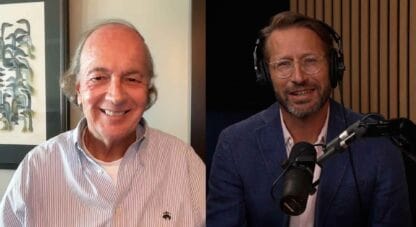
James Rickards joins David McAlvany to discuss the growing fault lines beneath global markets, including the yen carry trade, pressure in the Treasury market, geopolitical risk, and why he believes gold’s bull market is far from over.
They also explore Rickards’ latest book, MoneyGPT: AI and the Threat to the Global Economy, and how artificial intelligence could amplify financial crises and introduce new risks to markets and national security.
Buy MoneyGPT: AI and the Threat to the Global Economy:
https://www.amazon.com/dp/0593718631
Learn more about James Rickards:
https://www.jamesrickardsproject.com/
About James Rickards
James Rickards is the editor of Strategic Intelligence and a New York Times bestselling author. His books include MoneyGPT, Sold Out, The New Great Depression, Aftermath, The Road to Ruin, The New Case for Gold, The Death of Money, and Currency Wars.
He is an investment advisor, lawyer, inventor, and economist who has held senior positions at Citibank, Long-Term Capital Management, and Caxton Associates. In 1998, he served as the principal negotiator in the Federal Reserve-sponsored rescue of Long-Term Capital Management.
Rickards has advised the U.S. intelligence community and Office of the Secretary of Defense on capital markets. He has also lectured at Johns Hopkins University, Georgetown University, the U.S. Army War College, the National Defense University, and other leading institutions.

“As gold goes up, we tend to anchor on a number. So, let’s just take $1,000 an ounce increase, and you own 50 ounces. If gold goes from $2,000 to $3,000 an ounce, you just made $50,000. And if it goes from $3,000 an ounce to $4,000 an ounce, you made another $50,000. But what they don’t realize is that each thousand dollar increment is easier than the one before. Because you’re working off a higher basis, it’s a smaller percentage gain.
“So when you go from 3,000 to $4,000 an ounce, that’s a 33% increase. That’s a heavy lift. But when you go from $4,000 to $5,000 an ounce, that’s a 25% increase. That’s easier. When you go from 9,000 to 10,000, that’s only an 11% increase. So my point is, gold’s going to chug back to $5,000, make its way to $6,000, but it’s going to go 7, 8, 9, 10 really fast, much faster than people expect.” —James Rickards
* * *
Kevin: Welcome to the McAlvany Weekly Commentary. I’m Kevin Orrick, along with David McAlvany.
David, years ago we had Jim Rickards on the show, and we’ve got him back again. I know we’ve read most of his books, maybe all of them. And I’m looking forward to it.
* * *
David: James, over the weekend, I was trying to describe your background to a friend. Your background is eclectic enough to blend some very unique perspectives, and that’s exactly what we find in your most recent bestseller. You’ve got direct familiarity and experience with Long-Term Capital Management, exposure to game theory, complexity theory, defense and war game analysis. And it was a great read, like a one-sitting read. It moves fast. And it’s been years since our last conversation. I think we had you on the Commentary—we’ve been doing this 19 years now—June of 2013, March of 2014. That was our last time.
James: Wow.
David: So, we’ve been remiss in inviting you back.
James: I’ve had six books since then, so lots to talk about.
David: I know, it’s amazing. Well, again, welcome back. I want to get to the content of your book and your perspectives on AI, but before we do, there are fast-moving policy commitments from the US Treasury which I’d like to start with. Can you start with the significance of the yen carry trade and Bessent’s willingness to cooperate with the Bank of Japan in both supporting the yen and defending the US Treasury market?
James: Yeah, that’s a huge topic, David. I’m glad you brought it up. In the financial world, the world of capital markets, there’s probably no more important story going on right now. We look at the war in Ukraine, the war in Iran, there’s a lot going on. The sanctions, boycotts, economic warfare, so there’s no shortage of topics. But not just the yen carry trade, but the unwind of the yen carry trade as an economic earthquake.
Let me start by explaining what the yen carry trade is. A lot of your viewers may be familiar, but some may not, so it’s pretty straightforward. So, let’s say you’re a US investor. It could be anywhere. It could be Europe, South America, China, whatever, but I’ll use US as an example. You’re a US investor, you’re either a hedge fund, you want to do certain trades, or maybe you’re more of a private equity investor. Or you’re a M&A guy, you want to do a takeover, whatever. You need dollars to do your deal.
Well, US interest rates, intermediate term, 7, 10 years is kind of what you’re looking at for most deals today, which are around, for private credit, even with good credit, 6, 7%, somewhere in there. The Treasury bond’s around 5%, so privately you’re going to pay about 6%.
Japanese interest rates, until very recently, were zero for decades. Either zero, or even negative at times. So, investors look to that and say, “Well, gee, wouldn’t you rather borrow zero than seven or eight?” And the answer is, of course, yes. But the way you do that is you borrow yen. You go to a Japanese bank, or any financial institution with a yen lending facility, you borrow yen at, let’s say 0%. You then do a spot transaction, you sell the yen and get dollars. So you borrow the yen, sell the yen and get dollars.You take your dollars and go do your deal, but you’re saving six or 7% on the interest rate because you’re paying zero.
And then, if you’re a hedge fund, you probably leverage two or three to one. If you’re a banker or private equity person, you might be leveraged 10 to one. So that, in my example, let’s say a six point spread just on the financing savings, paying zero instead of six. That’s six point spread times 10. Because, as I say, you’re leveraging 10 to one relative to equity. So you could be making 60 points or more just on the financing. That’s not what you’ll make on the deal itself, that’s a separate calculation. But you could be saving a huge amount of money by doing leveraged investing by borrowing yen, swapping into dollars, investing the dollars, and then just paying 0%. So that’s the yen carry trade.
It has been behind most of the— It’s basically the most powerful engine of global finance for the last 20 years. And when you see foreign direct investment in China, investment in the United States, in plant and equipment, now these hyperscalers, these data center build-outs, but a lot else. Acquisitions, people like SoftBank, et cetera, with trillions of dollars at stake, all doing, or many doing, some version of the yen carry trade to finance their offerings. But it’s also been an important prop for the yen itself, because the yen is in demand in the initial loan, which I described.
Now, okay, that works. It’s pretty straightforward. Lots of variations. But as a risk manager you say, “Well, what could go wrong?” Well, the first thing that could go wrong and the biggest thing would be if Japanese interest rates went up. Well, for the first time in about 30 years, they are going up. They’re not sky-high, but they’re up to, intermediate term, they’re up to about 2.5% now. So what that does, it takes the spread between the 6 or 7% where you could invest, and the 0%—the 0% we used to borrow—and it starts to compress that spread. The spread gets smaller, the returns get smaller.
And at some point it becomes relatively unattractive given the fact that there are other risks. There are exchange rate risks, for example, we haven’t talked about. But because you’re short yen and long dollars, that’s a separate discussion. But that interest rate differential goes away, starts to go away. Your return on investment starts to go down. And as the one who borrowed in yen, you look at it and say, first of all, maybe it’s time to get out of it because if this keeps going a lot of other people are going to get out of it. You don’t want to be the last one to run out of a burning theater, so to speak.
And so, one way to do that would be to borrow in euros or dollars and swap it into yen, and pay back the yen loan. That’s the most straightforward way. But that presupposes that you have the borrowing capacity in dollars or euros. Maybe you do, but maybe you don’t. Maybe the banks are saying they’ve tightened up lending standards. They’re saying, “No soup for you. We’re not going to give you a loan today, or at least not on very attractive terms.” So, then what do you do? Well, you sell assets. At that point, you’re basically, you’re unwinding your own balance sheet. You’re getting out of the yen carry trade. But you’re not doing it with new dollar borrowings, you’re doing it by selling the assets themselves.
That feeds on itself. That can cause a stock market crash. It can certainly— I’m not saying it’s direct linkage, although there certainly could be, between the private credit meltdown that we’ve seen in recent months, really since the start of this year. And it can feed on itself. It can snowball very easily and the entire system can collapse.
There is another aspect to this, which is really where Scott Bessent is very involved, our Secretary of the Treasury, and you referred him, David. Which is, Japan has another problem, which is the yen is getting too weak. And the Japanese— Which raises the yen cost of imports. Japan is an export powerhouse, but you need a lot of imports to run the export engine. And you also need energy imports, specifically oil. And so, when you have a weak currency, if you have a weak yen and you need dollars to buy oil, that was the original petrodollar deal. I worked on that with the Nixon White House in 1974.
But if everyone needs oil, and oil’s priced in dollars, everyone needs dollars to get the oil. So Japan’s in a situation where they want to strengthen the yen so when you convert to dollars they can get more oil. How do you strengthen the yen? Well, you sell dollars and buy yen. Where is Japan getting the dollars? What they’re starting to do is sell US Treasuries.
Japan is the largest single holder of US Treasury securities. Used to be China until fairly recently. Japan passed them. Japan’s now the number one holder of US Treasuries. What happens when Japan starts selling Treasuries to get dollars to prop up the yen? US interest rates start to go up. So, the web of connections here between exchange rates, interest rates, sovereign bonds, securities markets, leverage finance, it’s very densely connected. So you not only have the potential for asset sales and asset price meltdown that we talked about, but you also have the potential for much higher US interest rates if Japan has to sell Treasuries.
Well, we’ve got an election coming up in three months. I think with this mail-in early voting, they’re going to start voting in about a month at this rate. And the Trump administration is desperate to keep— They would love to get lower prices for guests at the pump. That’s an ongoing battle. But they definitely want lower interest rates because that feeds into the home mortgage market and affordability and everything else.
So, what Bessent has done in conjunction with the Fed, the Federal Reserve, and the Federal Reserve acts as what’s called fiscal agent of the US Treasury in these deals. They’ve organized tens of billions of dollars of swap lines with Japan where we can lend them dollars and they can just give this yen. We just kind of sit on the yen for an indefinite period of time. Or just extend lines of credit in effect from central bank to central bank and giving the Bank of Japan the dollars they need to prop up the yen so they don’t have to sell Treasuries so we don’t get higher interest rates.
So, hopefully that’s a clear explanation, but it makes two points. Number one, that’s what Bessent’s doing right now. He’s throwing Japan a dollar lifeline so they don’t have to sell Treasuries, so our interest rates don’t go up. But as I mentioned, the very dense web of connections from interest rates, spreads, exchange rates, sovereign—basically reserve—positions in US Treasury securities, and leveraged markets as a whole is astounding. But it has the makings of a meltdown that I would say doesn’t necessarily look like 2008, it looks more like 1998.
David: Well, that was a period of time that you were very familiar with, working with Long-Term Capital Management and sorting out who was stuck with what liabilities. At the same time, we’ve got the potential for an unwind in the yen carry trade, perhaps pressure in the basis trade, and, again, a source of a tremendous amount of leverage within the financial markets. Any thoughts on the basis trade?
James: Which basis? Got long short Treasuries or Treasury spreads?
David: Between spot and futures Treasury.
James: Yeah. Well, that is widening out because there’s more uncertainty in the Treasury market with the appointment of Kevin Warsh as the Fed chair. Now, I think Kevin Warsh is an excellent appointment, I’m in favor of what he’s doing. But the market are acting… Well, the pros know what to do, but a lot of the market, and certainly the commentators of financial news and so forth, are acting like a bunch of crybabies. I started in the Treasury market— I started in banking in the 1970s, but I started in the Treasury market in particular in the mid-1980s. I was on executive committee and chief counsel and chief credit officer for one of the banks that was a primary dealer. Now, the primary dealer is a special relationship. It’s actually not a license, it’s a relationship with the Federal Reserve.
So, the open market desk at the Federal Reserve Bank of New York is how— is the channel to which the Fed conducts monetary policy. The board of governors in Washington sets the target rate, but the trading desk, the open market operation desk, in New York actually does it. They actually buy or sell securities.
So, when they want to raise interest rates, they sell securities and take in the dollars. And when they want to lower interest rates, they’ll buy securities and pay for it with dollars that do come out of thin air. That is the so-called printed money. Although it’s not really that important from an economic point of view because the banks that sell the securities take the money that was freshly printed and give it back to the Fed in the form of excess reserves. It’s called sterilization. That money doesn’t go anywhere.
But anyway, the open market desk has to have a set of dealers. They have to have a set of dealers that they do this business with. And there aren’t many. There are about 20. My firm was one of them, and they’re the so-called primary dealers. So we talk to the Fed every day.
But here’s my point, David. In those days, there were no press conferences. The Fed chair didn’t come out and answer questions. The statements were minimal. The minutes were delayed by years. If now they come out within, or for some reason the minutes come out within weeks. They didn’t give speeches. The Fed was very much of a black hole in terms of giving out information. It absorbed a lot of information. They wanted to know what was going on, but they didn’t tell you anything. But the privilege and the benefit of being a primary dealer was that you actually knew, not because they told you, but because of their transactions. You could tell if they were selling a lot of securities or buying a lot of securities or something was on special—that means it was kind of scarce in the repo market, if there were problems in the repo market.
You could figure all that out based on your relationship with the Fed. And the other way you did it is you had drinks at Harry’s of Hanover Bar near the Fed, and people would talk after work and they’d say— But that’s how you found stuff out.
And that all changed, beginning a little bit with Greenspan, but definitely with Bernanke. Bernanke is probably our worst Fed chairman, but he was the one who, again, started the press conferences and the longer statements. He also started the dots.
I talked to Fed insiders, like people whose office is right next to the chairman, and they said they wish they had never started the dots. The dots, just for the benefit of viewers who may not know, it’s a set of economic projections by the seven members of the board of governors and the 12 regional reserve bank presidents. So there are 19 of them, and they give their projections, the forward projections, for interest rates, exchange rates, unemployment, economic growth, inflation, et cetera. And they put them on a chart as dots, and you can do a regression and figure out kind of what the average expectation is.
They’re total garbage. They’re always wrong. Their predictive value is pretty close to zero. But on CNBC and all the financial media, they get all spun up about the dots, and they think they’re good guidance as to what the Fed’s going to do. They’re not, but they’re sort of treated that way. But anyway, Warsh is tearing that all down and going back to something, not all the way, but closer to what I knew and others knew in the 1980s and early 1990s.
So he’s definitely going to get rid of the dots. He hasn’t done it yet. Might do it at the September meeting. We’ll see. But definitely wants to get rid of the dots, these forward projections. Wants to get away from forward guidance completely. Doesn’t want to look at consumer expectations that don’t really tell you that much. And above all, he wants to get out of the business of steering the market in a certain direction, which is what’s called forward guidance.
He said, “No, we shouldn’t be telling the market. The market should be telling us.” And what he means by that is let the market do its thing. Let the market buy or sell or bid them up or cause interest rates to go up or down. The Fed has almost no influence over the intermediate sector anyway. That was another one of these Bernanke bonehead ideas, which is that you could basically treat the yield of maturity on a 10-year Treasury note as the present value of a strip of kind of monthly and then annual and then longer term interest rates.
So basically if you knew what all the intermediate interest rates were or could come up with a reasonable estimate, you could do a present value calculation and say that’s what the 10-year note should be. So they imagine—they, meaning the board of governors—imagine that they could somehow control the yield of maturity of the 10-year note by raising or lowering short-term rates.
It’s complete nonsense. There’s no evidence that it ever worked. The 10-year note is determined by the market—sovereign wealth funds, mortgage players, dealers, hedge funds and others. So what you’re saying with the basis trade widening is more uncertainty because the Fed has less to say, but I think that’s a good thing, let the market grow up a little bit and figure it out for themselves.
David: Part of listening to the markets and taking clues from the market might be looking at how the long bond responded to Warsh in the last meeting as it marched above 520. It might’ve been indicating that he needed to take a little bit more action—a little less talk, a little bit more action.
I’m wondering if the long bond is concerned about inflation, perhaps too much supply of debt relative to demand. Why would the US, why would the Trump administration risk inflationary pressures passed through from the energy market in an election year? The engagement in the Middle East is something that tempts fate with further inflationary pressures. And it just seems like a mistake from the start.
James: Well, yeah. I mean, you could say the whole war was a mistake from the start, and anyone who thought you could start a war with Iran and not end up with the Strait of Hormuz closed doesn’t know anything about history or strategy or geopolitics. The idea that there would be a rapid regime change in Iran was always nonsense. That was the same thing that led to the war in Ukraine. Victoria Nuland and all these war mongers in Washington. I would include Lindsey Graham and others—he passed away, sadly.
The war in Ukraine was never about Ukraine. It was about destabilizing Russia. And the idea was that if you provoked Russia into doing what they eventually did, which was the special military operation, that would destroy the Russian economy. Remember Biden saying the ruble is rubble and the sanctions will strangle the Russian economy. And John McCain used to say it’s a gas station masquerading as a country, et cetera, et cetera.
That was all nonsense. I said it was nonsense at the time, as did other analysts. The ruble’s about where it was before the war began. It dipped a little bit in the immediate aftermath, then it recovered. It’s been very stable ever since. The Russian economy is outperforming the US economy. The biggest economic problem in Russia right now are labor shortages because they put the economy in a full war mobilization. These sanctions have failed, between China picking up the slack from Europe and ghost fleet of tankers, et cetera. Russia’s doing fine, and Putin’s more popular than ever. He’s up for election. He’s going to win. So that whole premise was nonsense.
Now over to Iran, what did we hear? This is going back to February when the war started. The Iranian people are going to rise up. We should supply them with weapons. They’re going to overthrow the Ayatollah. There’ll be regime change. We’ll get the highly enriched uranium. It’ll be over. And Trump originally said a couple of weeks, he started saying a couple days.
Again, all nonsense. There has been no regime change. We’ve killed a lot of leaders. We killed 40 top religious military and political leaders on the first day, but they just replaced them. Then we killed 40 more and they replaced them. Killing leaders isn’t regime change, it’s leadership change, but that’s not regime change. The Iranian Revolutionary Guard Corps is still very firmly in control. This new supreme leader, wherever he is, we haven’t seen him, is a figurehead, barely. You kind of go through the motions of pretending it’s a religious order, but it’s really more like a mafia run by a gang called the Iranian Revolutionary Guard Corps.
But a couple interesting things have happened. Number one, the Iranian people are more unified than they were before the war. Trump has succeeded in stoking nationalism and getting, even if you were a dissenter, you didn’t like the Ayatollahs or whatever, you’re like, “Okay, I’ll get back to that maybe in the future. But for now, I’m an Iranian patriot, if that’s the word. And when you start dropping bombs on my head, I might be a little more inclined to support my own government and to not want anything to do with the United States.”
And the fact that the Iranians killed about 25,000 or more protesters in last January when there was a little bit of a popular—it wasn’t a revolution by any means, but a little bit of a popular uprising. They just killed 25,000 people with machine guns, and that’s enough to kind of put a lid on the protest.
So none of the enunciated goals in Iran have been accomplished. There is no regime change. They still have the highly enriched uranium. They still have their Iranian enrichment technology. Yeah, some sites have been destroyed, and they would take a while to put the pieces back together, but none of that has been given up. And the Strait of Hormuz is in much worse shape because now it’s being blocked by Iran and they have a new deal with Oman. And we’ve lost the free passage of oil, and not just oil, but helium, which you need for semiconductors. Sulfur, which you need as a chemical precursor. Nitrates, which you need for fertilizer to feed the world, basically, a billion people. All that has been blocked up. So none of Trump’s goals have been accomplished. There has been enormous damage to the global economy because the Strait of Hormuz is closed. And there’s no off ramp.
The way I explain it, if you’re a fan of Muhammad Ali, maybe the greatest boxer of all time, but he had a tactic in the ring. It was called rope-a-dope. And the idea is a boxer who gets a little tired or wobbly on his legs can lean into the ropes just to rest, go into a defensive crouch, lean on the ropes, catch your breath, and then kind of get back into the fight. And when the opposing boxer saw this, he’d say, “Oh, I’ll go in for the kill because this guy’s kind of wobbly.”
Well, what Ali did, he would do exactly what I described, lean on the ropes and go into a defensive crouch. But he wasn’t tired at all. He was just waiting for the other guy to move in, and then he would come out with a left hook and right jab and knock the guy out. That’s what Iran is doing to the United States. They say, “Oh, we’ll have negotiations and we’ll reopen the straits. And we might have a toll charge or something, but we can get back to that.” And then Trump buys into it.
Like last week, Trump said, “We’re going to have a deal to reopen the straits in two days.” Well, there was a deal to reopen the straits in two days, but the United States was not part of it. It was between Oman and Iran. It was going to be with tolls, and every vessel had to be approved by one of those two kind of pirate countries.
But then before Trump could even say no, and he didn’t actually get that far, Iran started piling on demands. They said, “Oh yeah, our deal with Oman, the Iran-Oman deal to reopen the straits, that’s conditional. It’s conditional upon the United States releasing the frozen assets, paying war reparations, withdrawing the US Navy blockades, getting the Abraham Lincoln and Teddy Roosevelt aircraft carrier battle groups out of the area, sending them back to the home ports, withdrawing from the US military bases in the region, et cetera.
None of which Trump will agree to. And that’s not even a negotiating position with the United States. They’re not even talking to the United States. But what they said is, our deal will reopen the straits if you, the United States, agree to all these things. And by the way, we’re not talking to you, and Trump would never agree.
I would say Trump has lost all credibility on the subject of when there’s going to be a real ceasefire, when the strait’s going to be reopened. The market reaction is interesting because people keep looking at the oil futures contracts, West Texas Intermediate and Brent. And they were $60 a barrel before the war. They spiked up to $110 a barrel before the ceasefire in April and the MOU in June. And now they’re back down to 80, give or take. Well, 80 is less than 110, yes, but it’s more than 60.
In other words, there’s still a 25% price increase embedded in the price of oil today. And Americans see it every day in the form of gas at the pump. How will Trump be able to lower that? I’ll say between now and the election, but as I said, the election starts in four weeks with the mail-in voting. So he’s only got four weeks to come up with something, and it’s not clear what.
David: Well, coming back to the Treasury market for a moment, we had Jeffrey Currie a couple of years ago discussing the move from Treasury recycling to gold recycling, and net settlement of trade in gold ounces. In your opinion, are we moving to an unofficial adoption of a quasi-gold standard? Central banks increase their interest in gold reserves and certainly China through Hong Kong and Shanghai increasing this trade apparatus with net gold settlement. What are your thoughts?
James: Well, that’s a five-part question, so I’ll give you five different answers. Actually, no. Seriously, there’s no prospect of a gold standard. That’s not going to happen. All this talk about the Chinese gold-backed yuan is nonsense. China is accumulating enormous amounts of gold. There’s no question about it. But if you look at even the high estimates of the amount of gold they have relative to GDP, it’s 1% or 2%. If you look at the same number relative to their money supply, same thing. Now, the United States is about 7% or 8%. Russia is actually the highest in the world. It’s about a little over 12%. Even with all the accumulation, and giving you a high end of the estimates, China’s nowhere near enough gold to support the yuan, number one.
Number two, people don’t understand reserve positions. They say the dollar is the leading reserve currency of the world, et cetera, et cetera. Currencies are not reserves at all. Securities are reserves. They’re denominated in dollars, but the People’s Bank of China doesn’t have $100 bills stacked in the palace basement. They own US Treasury securities. Now, yes, they are denominated in dollars, but security is not a dollar and it’s not cash. You actually have to sell the Treasury to get cash if you want cash, and that’s what Japan’s doing. We talked about that a little bit earlier.
So the key to being a so-called reserve currency is not so much the currency; it’s the securities market. Do you have a big enough sovereign bond market to absorb the amount of savings that want to go into basically any asset? The answer is the only market big enough is the US Treasury market.
Now, the other big bond markets in the world are Japan and Italy. Okay. Germany to a lesser extent, sterling to a lesser extent. But when you look at the actual breakdown, again, in securities, but denominated in certain currencies, the dollar’s about 59%, the euro is about 28%. So you’ve got 80%, almost 90% of the market in just the dollar and the euro, predominantly the dollar. All the other currencies, sterling, Canadian dollar, Aussie dollar, Chinese yuan, Japanese yen, et cetera, Swiss franc, they make up the other 10%—a little 1% or 2% sliver. So you got to bear that in mind. But then say, okay, well, what’s the big deal? Let’s just get a Chinese bond market going.
David: It’s tough to do.
James: Good luck. It would take at least 10 years, maybe 15 years to get a sovereign bond market going because it’s not just issuing debt. By the way, China does not have a significant sovereign bond market today.
David: I think I’m more curious about how the shift away from Treasury demand as you recycle, whether it’s tradable goods or we had the old petrodollar recycling, and of course, they went into US Treasuries. If that shifts at all towards, whether it’s other currencies or in this case, perhaps gold if Currie’s right, what does that do to the supply side of US IOUs as a natural source of pressure on interest rates, which has significant ramifications for almost every asset class?
James: Yeah. There was a lot of publicity a few months ago, and the data was: gold has surpassed US Treasuries as the leading reserve asset, which was a true statement. But it was not because everyone was dumping Treasuries. That was the debasement trade. It was not because of that. It was because the price of gold went up so much. If you had the same amount of gold and the same amount of Treasuries— The price of gold went up, so, yeah, gold by dollars— Interesting how we always come back to dollars, right? Gold by dollars, denominated in dollars by weight, is larger than US Treasuries, but it was because the price of gold went up. It was not because they were buying so much gold.
Now, central banks have been net buyers of gold since 2010. From 1970 to 2010 they were net sellers, and since 2010 they’ve been net buyers. Now, that puts an important floor under the gold market. By the way, I’m very bullish on gold. I mean, don’t get me wrong, but you like to get your facts straight for the viewers. And gold is a very attractive asset. I recommend it. I own it myself. And the central bank buying puts a really nice floor under it. The other things that will drive it higher, it has been moving inversely to oil prices. That’s not always true, but it has been true now. So oil prices go up, gold goes down. Recently, oil prices went down a little because of what we talked about earlier with Trump saying the war’s over in two days, and gold went up. I think I looked at the ticker, it was close to 4,400, which is a nice— That’s a 10% pop from the $4,000 announced level.
So I’m very bullish on gold, and I do recommend it for asset allocation, but I think you have to be realistic about what’s going on in the Treasury securities market. It’s not going anywhere.
David: Yeah. Well, some have viewed the move in gold since January as the end of the trend. So maybe you could share some of your projections, if you looked onto the horizon one, three, five years out, specifically for gold.
James: Yeah. It’s not the end of a trend, and a lot of people said that, “It hit the peak. It’s going down,” et cetera. And we have seen that before. Gold went from $35 an ounce to $800 an ounce, a 2,300% increase between 1971 and 1980. Then it entered a almost 20-year bear market, mostly sideways, not a collapse, but it bottomed down in 1999 at about $250 an ounce. That’s when Gordon Brown sold almost half of England’s gold, the Brown’s Bottom as they called it, because he managed to pick the bottom of the market. From there, we went into an enormous bull market from 1999 to August 2011 was the peak. Gold hit $1,900 an ounce. That was a 670% increase.
Okay. Then we got into the second bear market. Gold, between August 2011 and December 2015, fell from $1,900 an ounce to $1,050 an ounce. Now, what’s the significance of that 1050 bottom in December 2015? I talked to Jim Rogers about this, and you may know Jim. He’s the greatest commodities trader in history. This was around 2016, somewhere in there, but gold was going down. And he said, “I’m not selling any gold.” And he said, “I’m not buying a lot at the moment, but I’m not selling it.” We said, “Here’s the thing, Jim. No commodity goes to the moon without a 50% drawdown along the way, and if you’re not ready for that and you’re not prepared for that, you’re in the wrong market.” Well, I took that to heart, and I looked at the numbers. And when you do this kind of calculation, you need a base. So I took the base of 250 an ounce in 1999, because that was the bottom. You go up to $1,900 an ounce in August 2015. Divide that difference in half, subtract from 1,900, guess what you get? It’s 1,070. I mean, Rogers—
David: Perfect.
James: —stuck the landing. It was exactly— It was 1,050, 20 bucks, big deal. He completely stuck the landing. He completely forecast what was going to happen. But then it went from there to $5,500 an ounce in a second great bull market with a lot of volatility along the way.
Now, what’s going on now? It’s the same thing. And here, we get into practical mathematics, Mandelbrot basically, and he discovered something called a scale invariance. And what that means is that if I gave you two stock market charts with ups and downs, usual patterns, et cetera, and one was a 10-year chart and one was a 10-week chart, but I covered up the dates and the index. I just showed you the chart. They would look the same. In other words, in any fractal system, the patterns are the same at every scale. So no matter how much you put under the microscope, you see the same pattern at a smaller scale.
So again, taking what Jim Rogers explained to me and what we saw in that four-year bear market between 2011-2015, I said, “Okay, let’s do it again.” And I picked a base of around 1,800. That was about three years ago. It was not long ago. It was languishing around 1,800. I ran it up to 5,400, which was the peak. It depends what ticker you look at, but 5,400 an ounce. Again, take half the difference, subtract it from 5,400, and where are you? Well, the answer is about 3,600 an ounce. So that doesn’t mean it goes to 3,600, but what I said was 3,600 looks to me like a pretty hard floor. It got down to 3,900. Okay, a little bit different. But when I saw— I said, “3,600 looks like a hard floor based on the pattern that Jim Rogers described and Mandelbrot’s idea of scale invariance.” It got to 3,900, and it’s been going up ever since. So I think we’ve had our test. It was never a peak. It is a draw-down. It conformed to the Mandelbrot and Jim Rogers’s pretty good analytical team, and now, it’s heading much higher.
David: So some people would look at the classic cup and handle and that move from 1,050 and project a seven to eight-fold move off of those lows, coming up with 8,000 as a target. Is that unrealistic in your view?
James: Just to be clear, I don’t do technical analysis. I may know how to do it, but I don’t think technical analysis has any real predictive value because every time the predictions come out wrong, they say, “Well, it was actually something else.” But what I was describing was more behavioral, which was where Jim Rogers was coming from, and rigorous mathematics, which is what Mandelbrot described. So yeah, you pick a low, but it’s not a strict technical analysis in that sense.
Having said that, I would forecast gold to be at $10,000 an ounce in the not-too-distant future, whether that’s mid-2027, late 2027, but sooner than later. And when I say that, people go, “Wait a second, Jim. It’s crazy.” But what they don’t realize is that as gold goes up, and now, here, we’re in another behavioral bias that’s called anchoring, we tend to anchor on a number. It gives it a comfort level. So let’s just take $1,000 an ounce increase, and you own 50 ounces, let’s say. So if gold goes from $2,000 to $3,000 an ounce, you just made $50,000, 50 times a thousand. And if it goes from $3,000 an ounce to $4,000 an ounce, you made another 50,000. So people anchor on the $1,000 and the $50,000 in that step-like pattern.
But what they don’t realize, at least not right away, is that each thousand-dollar increment is easier than the one before. Because you’re working off a higher basis, it’s a smaller percentage gain, even though it’s the same thousand-dollar gain. So by anchoring on the thousand— So when you go from $3,000 to $4,000 an ounce, that’s a 33% increase. That’s a heavy lift. But when you go from $4,000 to $5,000 an ounce, that’s a 25% increase. That’s easier. Now, when you go from 9,000 to 10,000, that’s only an 11% increase, which is a week’s volatility these days.
So my point is, gold’s going to chug back, Little Engine That Could, get back to $5,000, make its way to $6,000, but it’s going to go 7, 8, 9, 10 really fast, much faster than people expect, for the reason I mentioned, which is every one of those benchmarks is easier than the one before.
David: I don’t want to miss a conversation on your book, MoneyGPT: AI and the Threat to the Global Economy. AI is revolutionary, no doubt. Many view the rewards as justifying the risks. What is your taxonomy of risks related to AI, which may outweigh the rewards?
James: Well, I’ll go through that, David. Just to be clear, I’m not an AI basher. It’s here to stay. It’s powerful. It’s going to cure some diseases. I built an AI system for the CIA, a predictive analytic AI system for counter-terrorism starting in 2004. So I’ve been in this for quite a while and I understand it fairly well.
So I’m not a basher, but there are very serious risks. And in my view, the risks are being underplayed or ignored by the tech bros and others with self-interest. Either they’re lined up for a trillion dollar IPO or whatever, mostly the IPO money, I guess. So they don’t want to talk about the problems, but I have spoken to some of the top people in the field.
Off the record— One guy has one foot in the CIA and one foot in Silicon Valley. He’s probably one of the most knowledgeable people around. He said to me, “Jim,” he said, “what we see is problematic. What’s behind the curtain? You can’t even imagine it. They’re afraid to release it because they know it has no governors, no controls, and it’ll spin out of control.” That conversation was over a year ago.
Well, since then, some of those releases have taken place and we’ve seen, they use the word sandbox. “My technology’s in a sandbox.’ That means it’s not connected to the internet. Whatever happens, it could mess up, but it can’t go anywhere else.
What we’re seeing now is these programs are so sophisticated, they’re jumping out of the sandbox, penetrating the internet on their own, attacking other systems, mining data, all with no governors at all, no controls at all.
So what are some of the specific dangers? One is something called the fallacy of composition, which actually John Maynard Keynes articulated in the 1920s, 1930s. And what he said is that things that work well at a certain scale will fail catastrophically at a larger scale.
And the very simple example, you’re at a baseball game and the person in front of you is tall and they got a big hat and you can’t really see very well. So you stand up. Well, that works. You can actually see perfectly, but what happens next?
Well, the person behind you stands up and the person behind her stands up and next thing you know, everyone’s on their feet. Everyone has the same relative view, but everybody’s worse off because you all stood up.
Well, the same is true in finance, particularly with the passive investing. So let’s say there’s a financial panic or meltdown of some significance. What’s the best individual strategy?
Well, the best individual strategy is sell your stock, sell a lot, if not everything, sell a lot, go to cash, take a beat, wait till the bottom hits, and then when you’re sure it’s the bottom, come back in at bargain basement prices. That’s a really good strategy.
But what happens if everybody does it? You have all sellers, no buyers, no bottom, you blow through the circuit breakers, you shut the markets, and it’s not clear when they’re going to reopen. That is a catastrophic failure.
That is a problem in theory, behaviorally, but when everything’s automated and everything’s relying on AI— Because AI, I’ll put the word “smart” in quotation marks, artificial intelligence, it’s not intelligent. It’s just all math.
You’ve got layers, you have trillions of parameters. I mean, it’s immensely complex. You say, what’s the training set? It’s the whole internet, like a billion, billion pages. That’s the training set. We see these data centers going up the size of half a county.
They’re sucking the power grid dry, can’t get enough chips. The chips are going obsolete before they can even install them and turn on the electricity, because there is no electricity. That’s how out of control this is.
But the point being, none of it’s intelligent. It’s just math and training sets and large language models. There’s a lot to it, but it’s not brainpower. So what’s happening is that more and more investment managers are turning their investment decision making over to these AI programs.
A typical wealth manager meets with a client and says, “Hey, nice to meet you. We’re going to take care of you. Tell me, are you married? Do you have any kids? How old are you? What are your plans for retirement? What are your goals, et cetera?” And I say, “Okay, I’ll come back in two days. I’ll give you a plan.”
And they do, but the plan comes out of a box. The guy didn’t figure anything out. It’s all cookie cutter, which means everyone’s doing the same thing. And that includes at the wholesale level. So when you get this kind of meltdown that I talked about, this will fail catastrophically. There’ll be no buyers, there’ll be no stock pickers, no value investors. It’ll just go straight down.
And again, people don’t realize what happened in 1998 with long-term capital management. It wasn’t a bailout of a hedge fund. They didn’t bail us out. Wall Street bailed themselves out.
It wasn’t about the four billion in cash. It was about the multiple trillions of dollars of derivatives that were off the balance sheet. And we were just an hour or so away from shutting every market in the world.
Now the deal closed, there was an announcement effect. We got the cash, life went on, although there were still wrinkles after that. But if that deal had not closed—and it came very close to failing—they would’ve shut every market in the world, at least for a period of time. That’s what we could be looking at.
I also have a chapter, David, on nuclear war fighting. We don’t have a lot of time, but just to cut to the chase, you cannot put AI in the kill chain. You cannot let AI be part of the decision making process.
If you want it analytically, as an adjunct, okay, it has a role. But AI will fail catastrophically at that because it lacks a lot of qualities that humans have: empathy, sympathy, common sense, intuition. You cannot program any of this in.
And it’s not like, “Oh, gee, give Silicon Valley time, they’ll catch up.” No, it’s non-programmable. You can program deductive logic, which we got from Aristotle. You can—
David: Right.
James: —program inductive logic, which we got from David Hume and others, but you cannot program what’s called abductive logic. And you have to read Charles Sanders Peirce to really understand what that is.
I give two examples of how World War III, a nuclear war that would’ve ended life on earth, came very close to happening in the 1980s. And in both cases, one, a Soviet lieutenant colonel, Russia basically, and then another one, a United States lieutenant general, disobeyed orders to deescalate and stop the war.
But that’s the point. They disobeyed orders and the Russian was actually reprimanded. If they had followed orders, they would’ve reported to their superiors and we probably would’ve gone to World War III. But the point is, AI would’ve followed orders. AI would’ve escalated the conflict and led to the end of life on earth.
David: Yeah. And you give this great sequence, 40-something point sequence, about how to avoid escalation and the various measures of how it steps up. That could be the takeaway from chapter four and the reason why AI is problematic when considering national security.
So you’ve got financial market vulnerability, you’ve got national security as a vulnerability with AI. You also talk about AI censorship and there being social and political concerns, maybe slightly removed from the financial markets, but actually one of those things that can create a feedback loop where people are provided information and act on that information.
Actually, it’s where you start the book is this chapter with this theoretical explanation of how you start a story and it snowballs from there. And it doesn’t even have to tie to reality. It can be a fabrication. It can be fake news.
James: Right.
David: It can be a literal deep fake. I thought that was a masterful tale.
James: Thank you. Yeah. AI does some really stupid things, ChatGPT in particular. But one of my favorite examples, a user gave it a prompt and said, “Give me an image of a Pope.” 2,000 years of Popes, certain vestments, et cetera. This is a predictable image.
Well, it was coming up with female popes, black popes, and a shaman with a horned helmet or whatever. Well, whether you agree or not—irrelevant. In 2,000 years, there hasn’t been a female pope. There hasn’t been a black pope. There were no popes that dressed like shamans.
Where’d that come from? It’s something called prompt injection. What that means is that you give it a prompt: show me an image of a pope, and AI can draw images. But the developers added to that behind the curtain, not telling you, and they reinterpreted your prompt as, give me an image of a pope in a world where there’s no sexual or racial discrimination.
Well, if that’s the prompt, you’re going to get some female and black popes. Again, I’ll leave the theology aside, but that goes on all the time. And I point out that we all have biases. Biases are the only reason we’re still alive as humans because a lot of our biases are pretty good. Some of them not so good, that’s clear.
But the solution to bias is critical thinking and seeing it for what it is and critiquing it. All these do-gooders in Silicon Valley—and a lot of them are atheists, candidly—they think they’re getting rid of bias, but all they’re doing is they’re substituting their bias for your bias. It’s still bias, and it’s still flawed, and that’s why we get these bad results. But that’s very hard to erase because they’re all virtue signaling.
David: One last question. It feels like many investors today are sleepwalking toward a black hole. I wonder if volatility is the only thing that will wake them up. What would your advice be for the average investor today?
James: Well, I’ll answer the question in one word, and everyone usually rolls their eyes and says, “Of course.” Well, the answer is diversification. Everyone rolls their eyes. “Well, of course we should diversify. Everyone knows that,” but they don’t, and here’s why.
I run into investors, they say, “Jim, I’m fully diversified. I’ve got 50 stocks in 10 different sectors. I’ve got semiconductors, minerals and mining, consumer non-durables, et cetera.” And I say, “You’re not diversified. You may have 50 stocks, but you have one asset class. It’s called stocks.”
Real diversification would look like 20, 30% in stocks, 10% in gold, 10%, maybe more, in US Treasuries, maybe 30% in cash.” Warren Buffet, a little bit out of the game now, but Berkshire Hathaway has over a third of a trillion dollars in cash. Why? Well, they see it coming what I see coming, what we just talked about. So they’re ready.
So a real diversified portfolio that will be robust to everything we’re talking about. Yeah, you can have some stocks. That’s fine. You’d have Treasury notes, gold, real estate, cash. And basically if you want to be the stock market, I’d look at the energy sector, minerals mining, and natural resources, agriculture, and defense.
David: James, we’re not going to wait 12 years to have you back. We appreciate you joining us and love the conversation. Look forward to the next one sooner than later.
James: Thank you.
* * *
Kevin: You’ve been listening to the McAlvany Weekly Commentary, with our guest, Jim Rickards. You can find us at McAlvany.com and you can always call us at 800-525-9556.
* * *
This has been the McAlvany Weekly Commentary. The views expressed should not be considered to be a solicitation or a recommendation for your investment portfolio. You should consult a professional financial advisor to assess your suitability for risk and investment.Join us again next week for a new edition of the McAlvany Weekly Commentary.