

Podcast: Play in new window
Gold spent this week doing something it is not supposed to do. Bond yields spiked. The dollar climbed back over 101. Oil surged on renewed Iranian escalation. And gold finished the week higher anyway. Silver, meanwhile, went the other direction, pushing the gold–silver ratio back to 70:1.
Let’s take a look at where prices stand as of Wednesday, July 8:
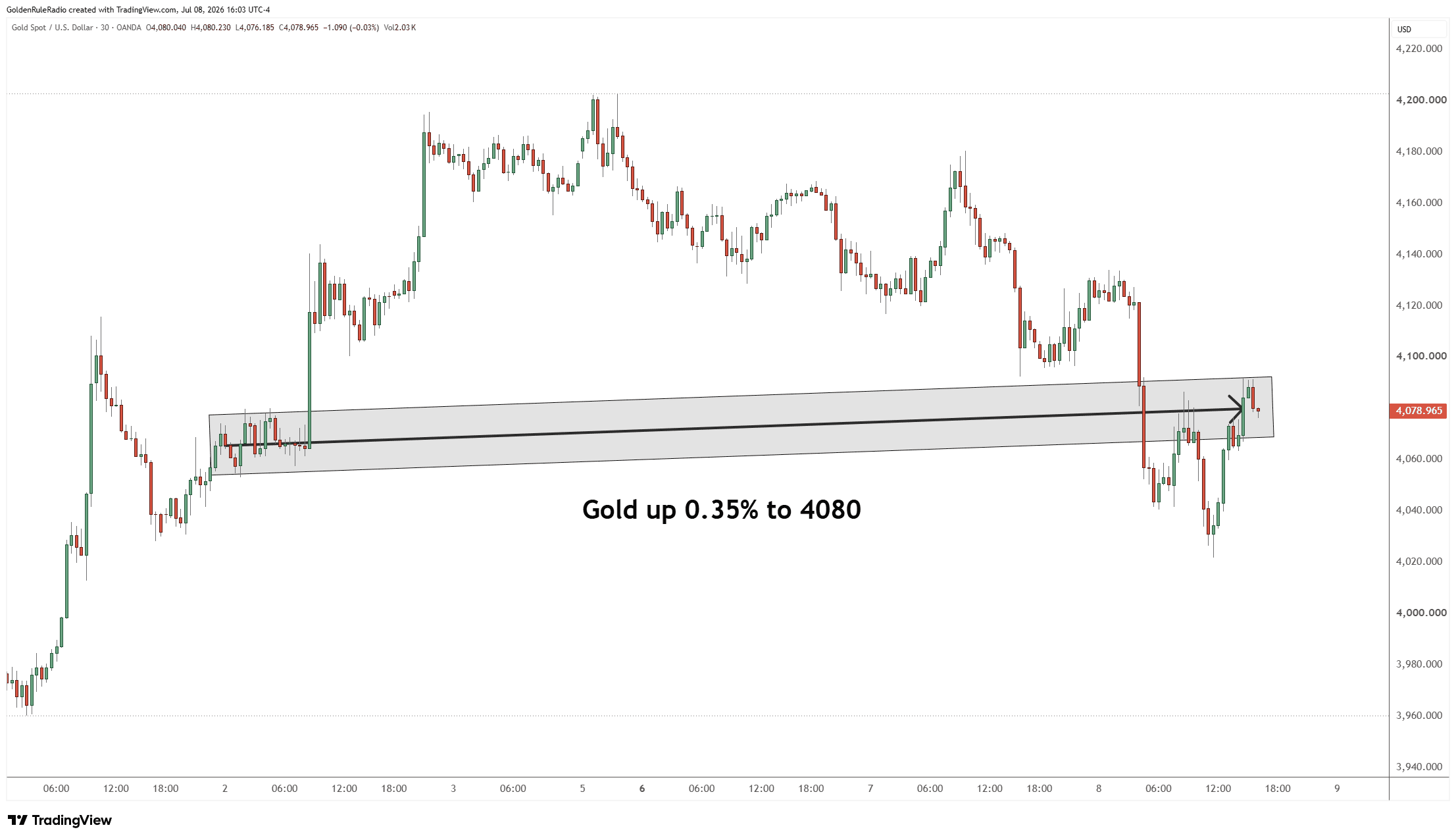
The price of gold is up about 0.3%, sitting at $4,080. It pushed back above $4,000, tagged $4,100 intraweek, and is holding just below that level.
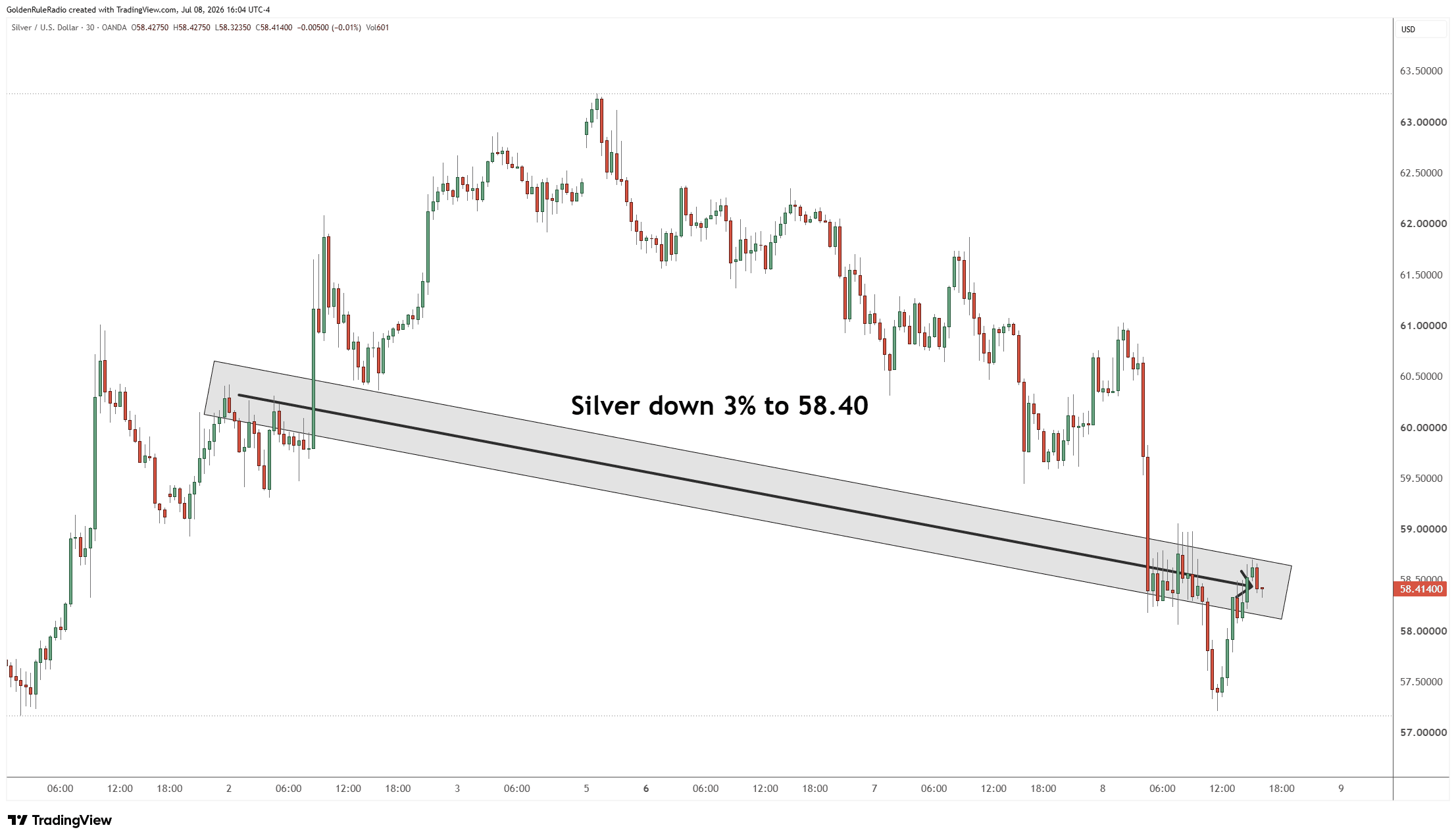
The price of silver is down 3%, currently at $58.40 — the biggest mover on the board this week, and not in the direction silver bulls wanted.
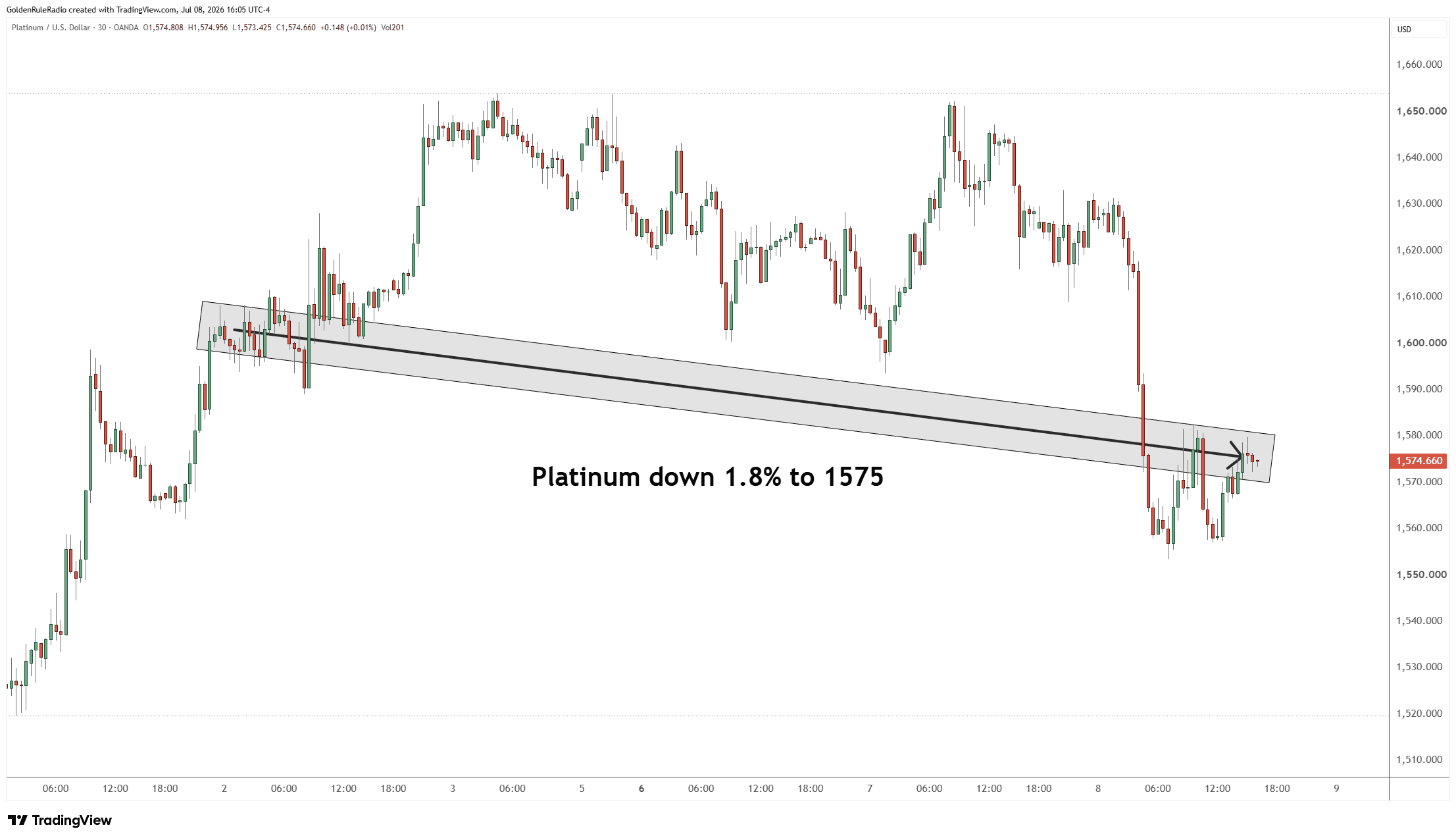
Platinum is down 1.8% at $1,575, still holding under the $1,600 mark.
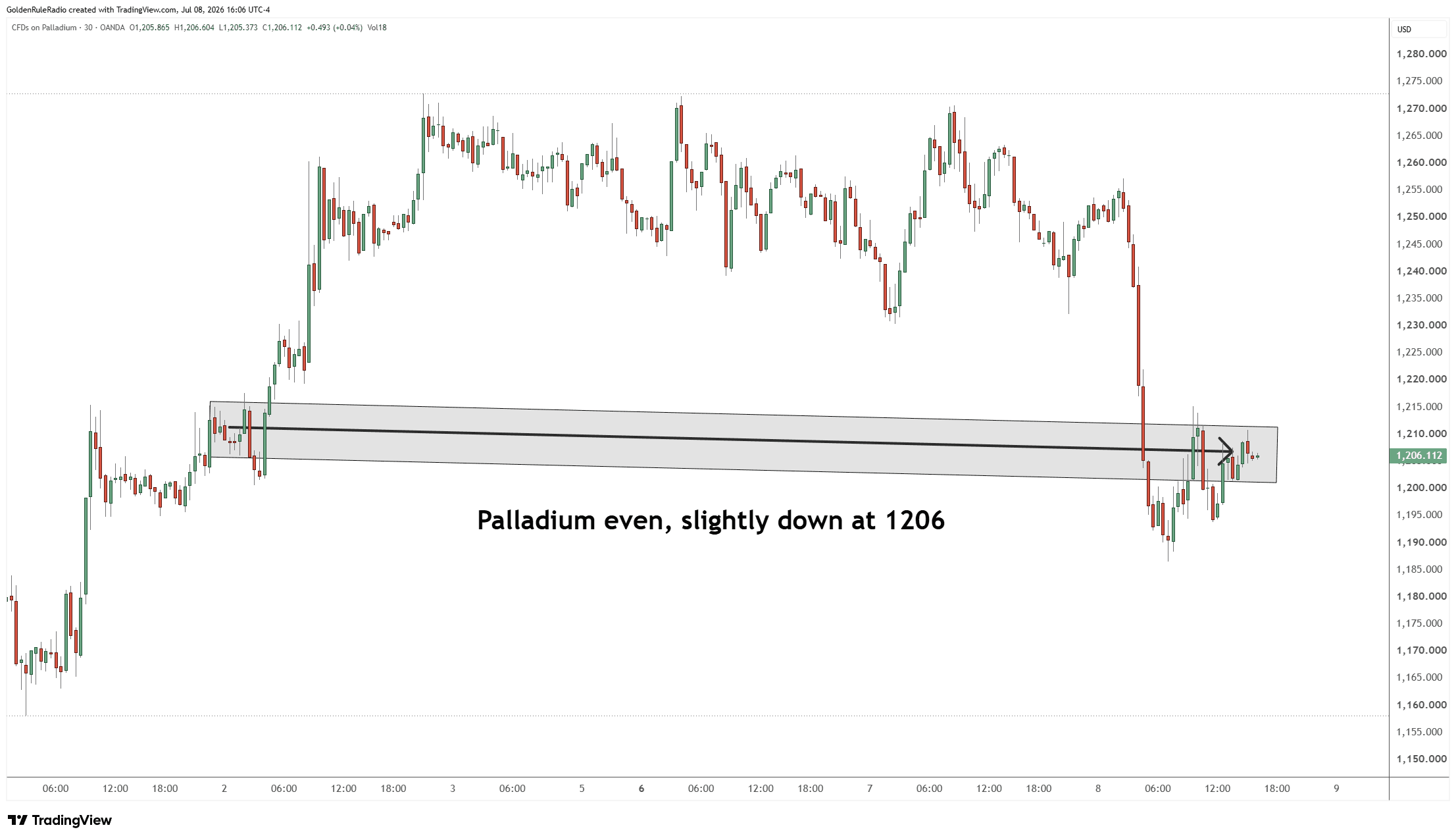
Palladium is essentially flat, down a couple of dollars to $1,206.
Looking over at the paper markets…
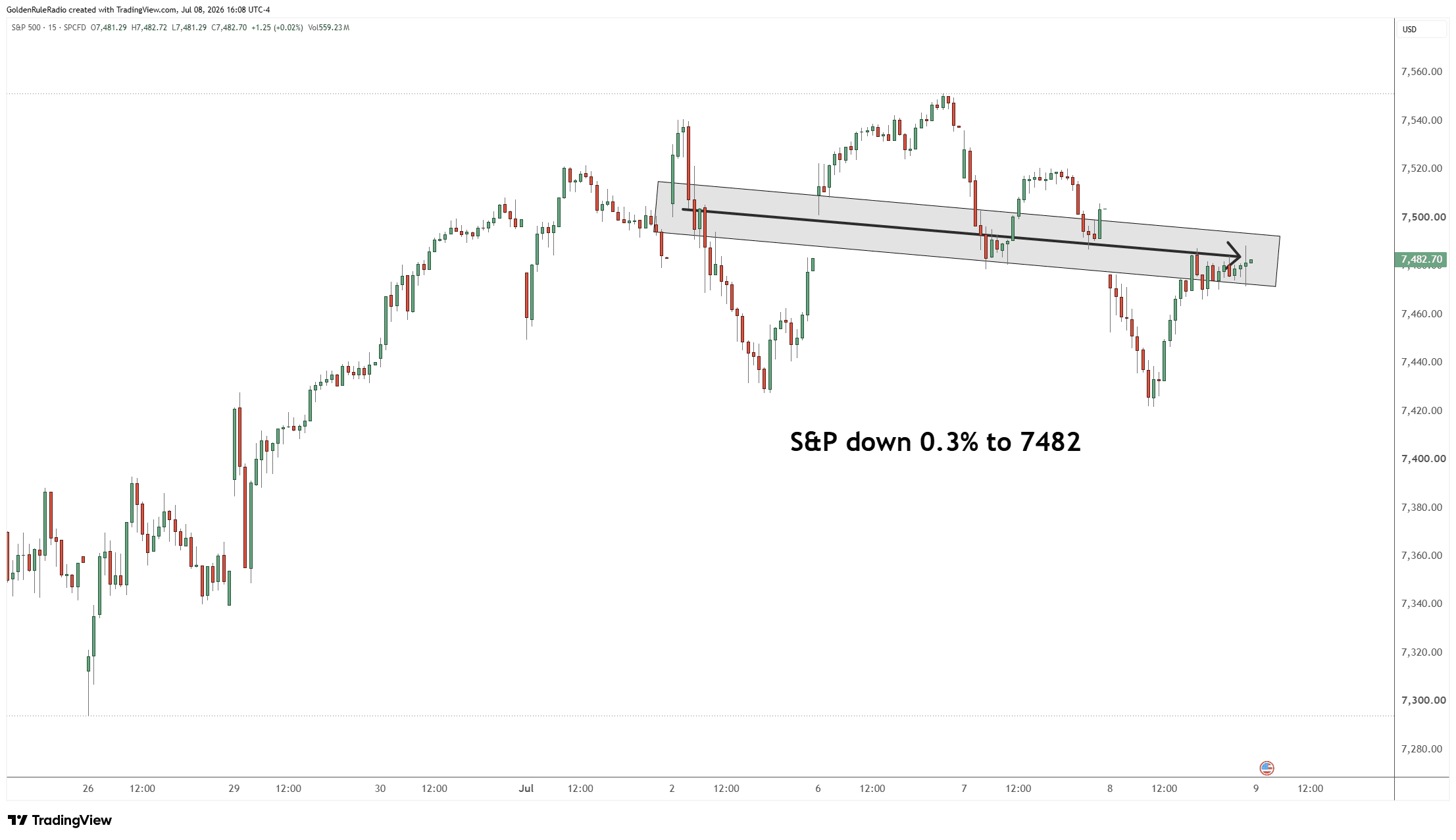
The S&P 500 is down about 0.33% to 7,482.
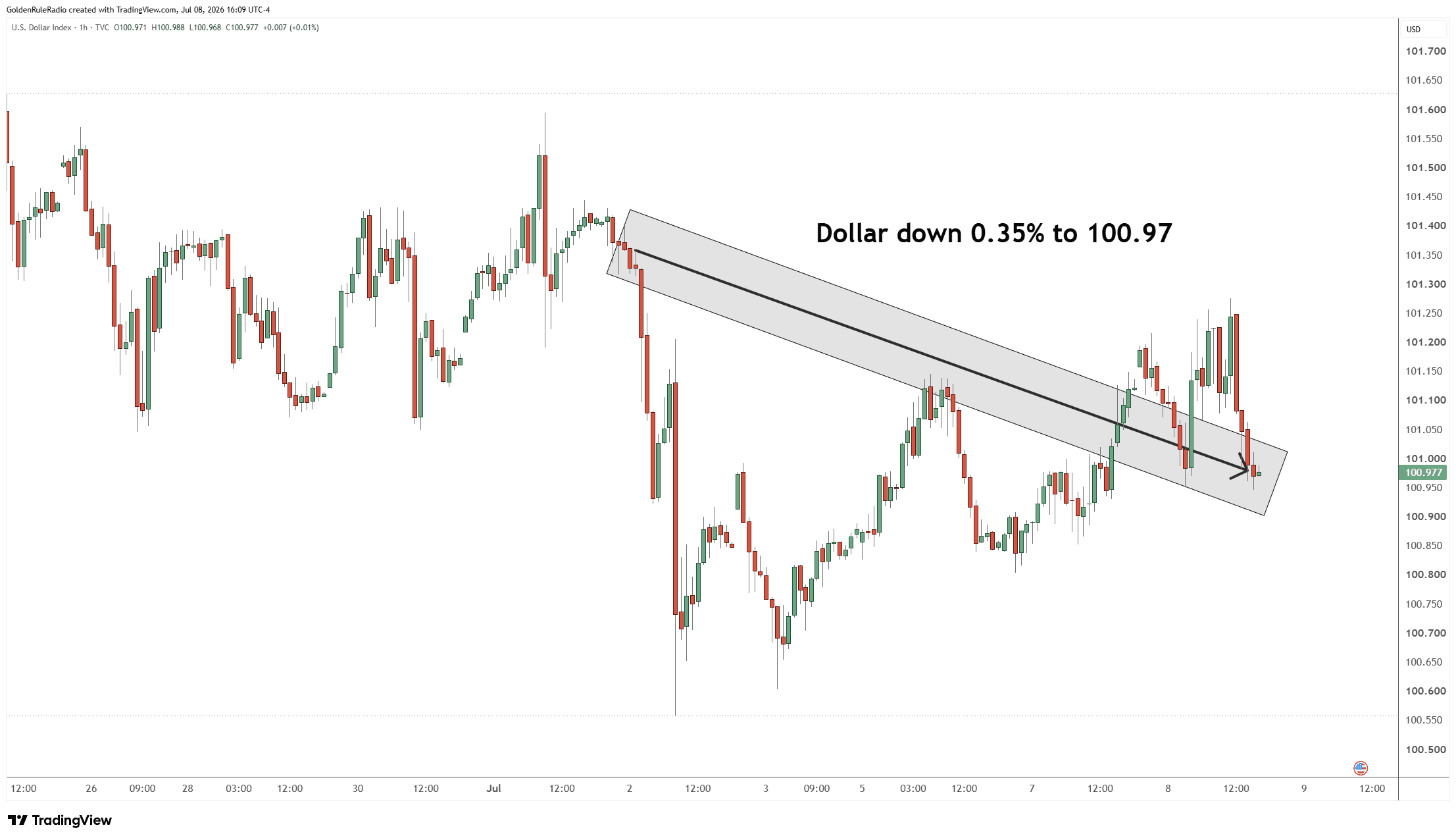
And the US Dollar Index is down 0.35%, sitting right around 101 — though it has been climbing over the last several hours.
Gold is Ignoring Its Own Headwinds
Last week we made the technical case for a bounce off support, and we got one. Gold rallied roughly $200 off the prior week’s low. Then the rally stalled, short-circuited by the Iran situation. Six of the last seven days were positive; the seventh gave much of it back.
But look closely at how it gave it back. Gold traded down to around $4,025–$4,030 as tensions escalated, then climbed back to $4,080 while the news was still getting worse. Rising bond yields, a firmer dollar, spiking oil — historically that combination tanks gold in the short run. This week it didn’t.
That is a meaningful change in character. When an asset stops responding to its traditional headwinds, it usually means a different buyer has taken over the marginal bid. In gold’s case, we know who that buyer is.
China Demand Puts a Floor Under Gold
For the twentieth straight month, China posted net gold imports and added to reserves. That is not a headline; it is a floor. The East has been the persistent, price-insensitive buyer of physical metal, and the West has largely been the seller — or at best, the permission slip that lets the metal move.
This is the paradigm shift we keep coming back to. Central bank accumulation is not a trade that gets stopped out on a bad week. It is a multi-year reallocation away from counterparty risk and toward an asset no government can print or freeze. Which brings us to the news item that should have every foreign reserve manager’s attention: after Iran fired on neighboring countries, the U.S. Treasury moved to freeze Iranian regime bank accounts. Every sovereign holding dollar reserves just watched that happen.
Gold-Silver Ratio Has Reversed
The gold–silver ratio is back at 70:1, knocking on the door of the 71–72 reversal high from early February. It has spent the last several months well below its ten-year average of 81. From where we sit, the ratio looks like it has bottomed and turned.
Here is the pattern we have watched for two decades: people buy silver when gold gets too expensive. Silver gets exciting at the end of a major push, when the crowd arrives and the gold bandwagon has priced them out. In slow, methodical grinding markets — the kind we appear to be entering now — gold beats silver, and the ratio climbs.
Silver’s ideal environment is a raging GDP, disinflation, and heavy industrial offtake. None of those are on the horizon this quarter. Solar, defense, EV batteries, AI data centers — those are all real fundamentals for silver. They are just a question of when, not if, these fundamentals will increase demand for silver.
We could stair-step back into the 75–95 band the ratio occupied for four years post-COVID. We could also chop between roughly 55 and 75 for a while. Either way, if you swapped gold into silver at 100:1 or 90:1 during 2025, this is the zone where you should be asking your advisor whether it is time to harvest those ounces back into gold — not waiting for a 30:1 print that history says you may not see.
The Stock Market’s Floor Is a Warning
The most common question we field right now is some version of: why isn’t the stock market crashing?
Part of the answer is structural. Roughly 48% of private investment money sits in equity index funds and ETFs. Every pension, 401(k), and IRA contribution is new payroll money buying one of everything, every month, on autopilot. That is a perpetual bid — a floor built out of set-it-and-forget-it flows, with a 1% advisory fee attached for the privilege.
The other part of the answer may be coming. Bill King made the point this week that there is a strong chance the Fed steps in to buy equity ETFs during the next major downturn, and that it becomes standard practice — because China and Japan are already doing exactly that. A Bloomberg commentator followed with the observation that the U.S. stock market has effectively become too big to fail. It is the nation’s retirement plan. The Fed as buyer of last resort in equities is no different in principle from the Fed as buyer of last resort in Treasurys.
For gold owners, that is not a bearish signal. It is confirmation of the thesis. A market held up by balance-sheet expansion is a market that requires currency dilution to stay up. Gold is the direct beneficiary.
What We’re Watching
Gold dipped below its 65-week moving average earlier this week and has already reclaimed it. Anything above roughly $3,960–$4,000 keeps the uptrend intact. We still see a path back to $4,200 and a retest of $4,400 — after which gold can decide what it wants to do next. Seasonality helps here: June is historically gold’s weakest month, and we are out of it.
The main risk to that view is a serious equity selloff. If a genuine bear market kicks in, metals typically get sold in the first wave alongside everything else, because gold, silver, and dollars are what liquidate cleanly when margin clerks call. That would blow up the near-term charts and reset support levels lower. It would also be a gift.
Our recommendations:
Add on the 65-week. When gold pulls back to that long-term moving average, that has consistently been a safe place to add ounces. It is not a trade; it is a savings deposit.
Revisit the ratio. At 70:1 and rising, the arithmetic of a silver-to-gold swap is getting more attractive, especially inside an IRA where the gain is not taxed on the way through. If you loaded up on silver at extreme ratios, you have already captured most of the available move.
Do not wait for the crisis. What you do before a shock matters vastly more than what you do in the middle of one. Gold is not reacting to bad news right now the way it used to. That tells you the repricing is already underway.
Make Your Move
Wondering whether it’s time for a ratio trade — or simply your next acquisition? The team at McAlvany Precious Metals has a collective 75 years of experience investing in the precious metals market. We are happy to speak with you about your goals on a no-obligation, complimentary consultation. Reach out to us at 800-525-9556.